Every so often double 1s become a topic of conversation and people get quite excitable. In fairness I have been known to get quite excitable about double 1s in a number of my games, as have many of my opponents. In fact, I would wager a small chocolate bar that no one who has ever played Kings of War has not got excitable about double 1s at some point. Double 1s have undoubtedly given me some interesting moments, so here are some choice four letter words (and slightly longer words) I associate with them:
Hope
I think it’s a flaw of human nature that we tend to remember the bad rather than the good. A bad gaming experience seems, so often, to accompany polite suggestions that double 1s is a silly rule and should be cancelled. However, the chances are that as often as the icy claw of double 1s have stolen victory from the dice bags of the righteous, so the hot flush of hope has been felt as an opponent double 1s and the gargoyles (insert unit name of your experience) survive to hold up not one, but two regiments of Soul Reaver cavalry (insert nasty, vicious enemy unit of your choice here) for another turn.
For some reason people are programmed to remember the bad stuff (I’m assuming some sort of primitive survival instinct). It’s also why just about every customer service course I’ve ever attended goes to great pains to point out customers are 10 times more likely to complain than give a compliment.
Perspective is a frustratingly relative thing, but the truth is that this rule is as beneficial as it is detrimental to all players (in the grand scheme of things).
The joy of Scud surviving as a result of a double one, wiping out a nasty big thing and then turning to threaten stuff, not bad.
Golf
Bear with me because this maybe a bit of conceptual reach. I’ve noticed this with friends I play regularly that double 1s can be considered a bit of a golf handicap style barometer (I did say a reach) of how much extra I need to do to start getting the odd draw or even win. When I’m playing someone better than me and double ones come up in my favour I like to keep a mental note. In particular, how many of them contribute towards a not quite so bad loss, an unusual draw and an inexplicable win. This might be one of those things that really is “just me”, but double 1s always stand out to me and I tend to have a view at the time on just how influential they’ve been.
That being said, I think it’s important to stress that I don’t think winning a game because of double 1s doesn’t count. I also don’t think it in anyway invalidates the achievement, as I’ll explain below.
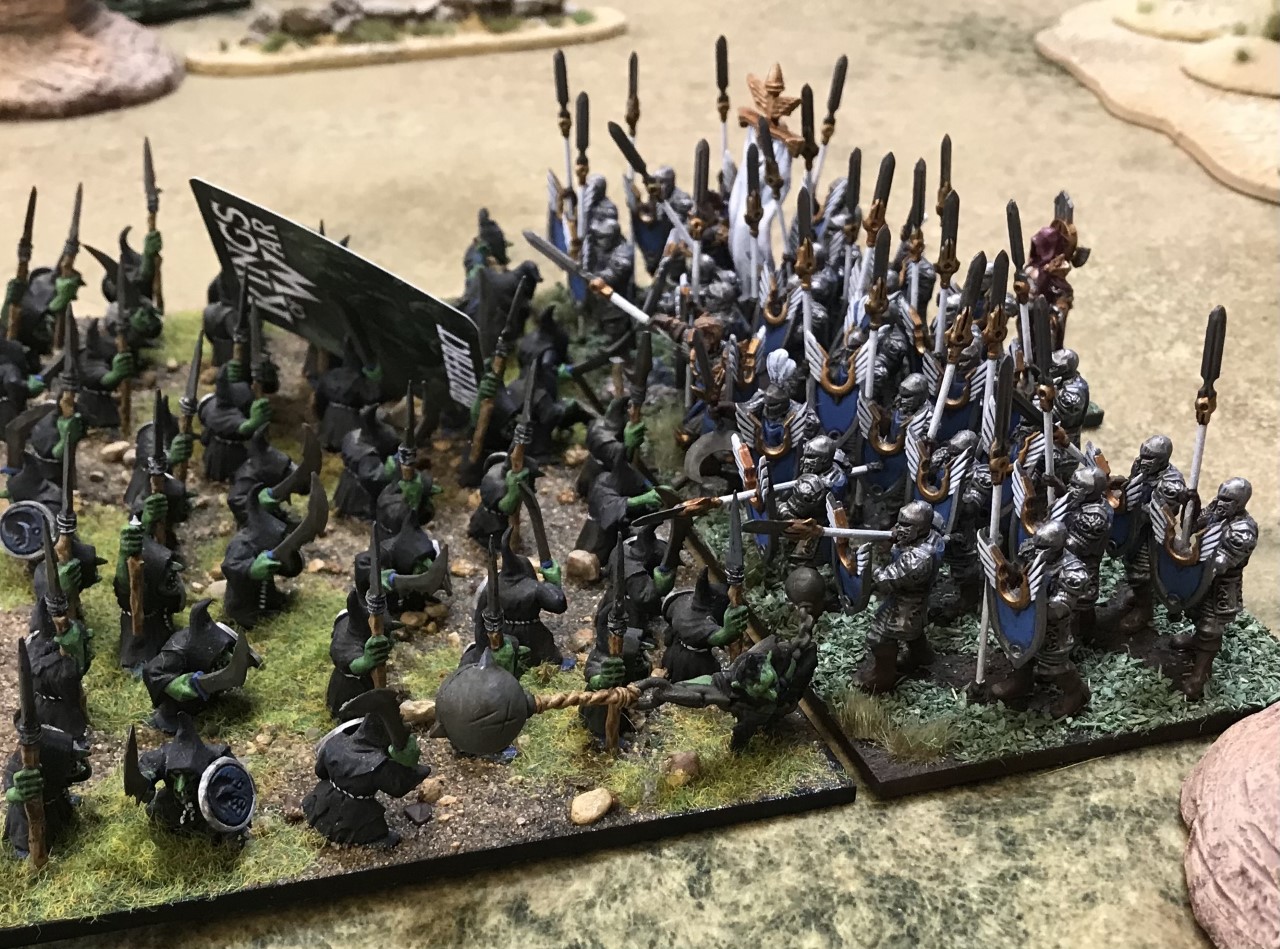
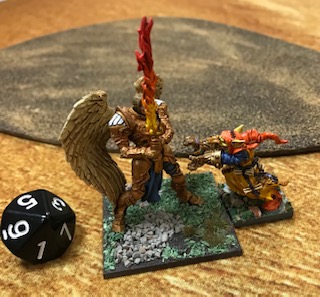
A bad gaming experience seems, so often, to accompany polite suggestions that double 1s is a silly rule and should be cancelled – the alternative thumbnail for this article.
Self-Improvement
Double 1s often lead to a lot of deep breathing and deep breathing is great for mindfulness (apparently) and mindfulness is great for self-improvement (also apparently). No?
Also, Kings of War is a game of probability. What I mean by this is: if you are better than your opponent at list building, managing scenarios, movement, etc. you will probably win (there’s probably some official maths statisticky thing way of putting this, but that’s not my area of expertise). Yes, it’s a dice game, but its not a game of chance. Yes, you can have a bad dice day, but that won’t be everyday (although it’s possible your bad dice days could just happen to align with the days you play Kings of War). In addition to this the double 1 rule is something that’s printed in the rule book, and we know about it. That means, just as with any other rule, we can learn to minimise its impact by taking account of it in the decisions we make on the table-top.
Are we even sure they really make that much of a difference to the outcome?
One of the interesting things I’ve noticed writing battle reports is that even though double 1s, at the time, might seem pivotal in a game very often when you consider the game as a whole they are not. Interestingly many of the games I lost that involved “pivotal” double 1s were games, if I’m honest, I probably would have lost anyway. In the same vain, games I won (particularly where the double 1 was not in my favour), I may have had to work hard to pull back, but I actually had the tools and the ability to get the win.
The point here is meant to be a positive one – my experience makes me believe that double 1s are very rarely pivotal in deciding the ultimate outcome of a game, but you might have to think a little harder to get there.
Narrative loveliness
Kings of War doesn’t have separate health and morale stats. They are brought together in the nerve test mechanic. This means that the nerve stat and tests are not analogous with how many survivors there are in a unit following an attack. A great thing that comes out of this of course is multi-basing (intended or not), which is something that seems to be a real stand out when it comes to Kings of War as a hobby, rather than just a game.
What this rules mechanic acknowledges is that a unit’s decision to stay in the fight will be based on a number of things, such as casualties and bravery, consequently failing a nerve test does not mean the unit has been slaughtered. Therefore, it opens up narrative options to explain the decision to stay, or go.
And this, dear reader, brings me to what I believe to be the fundamental reason why double 1s should be in Kings of War. Whilst this is not intended to be a historically accurate representation of how goblins operate in theatres of war against sexy demons (Yeap, talking about you Scud, definitely not Succubi) it is still a representation of sentient beings hitting each other and so needs some reference in reality. So, just as most will make the sensible decision in the face of overwhelming odds, some won’t – and that’s what double 1’s represent: heroic last stands, evil generals so fearsome their soldiers would rather die than run or just plain bewilderment about all the spiky things being pointed in their general direction.
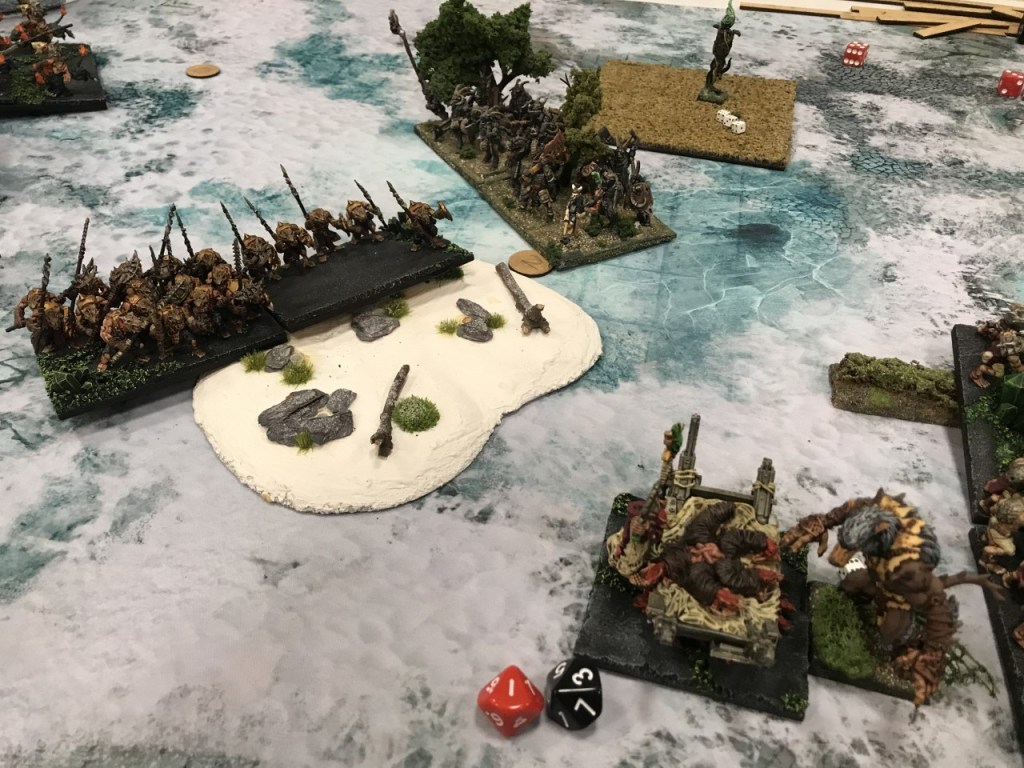
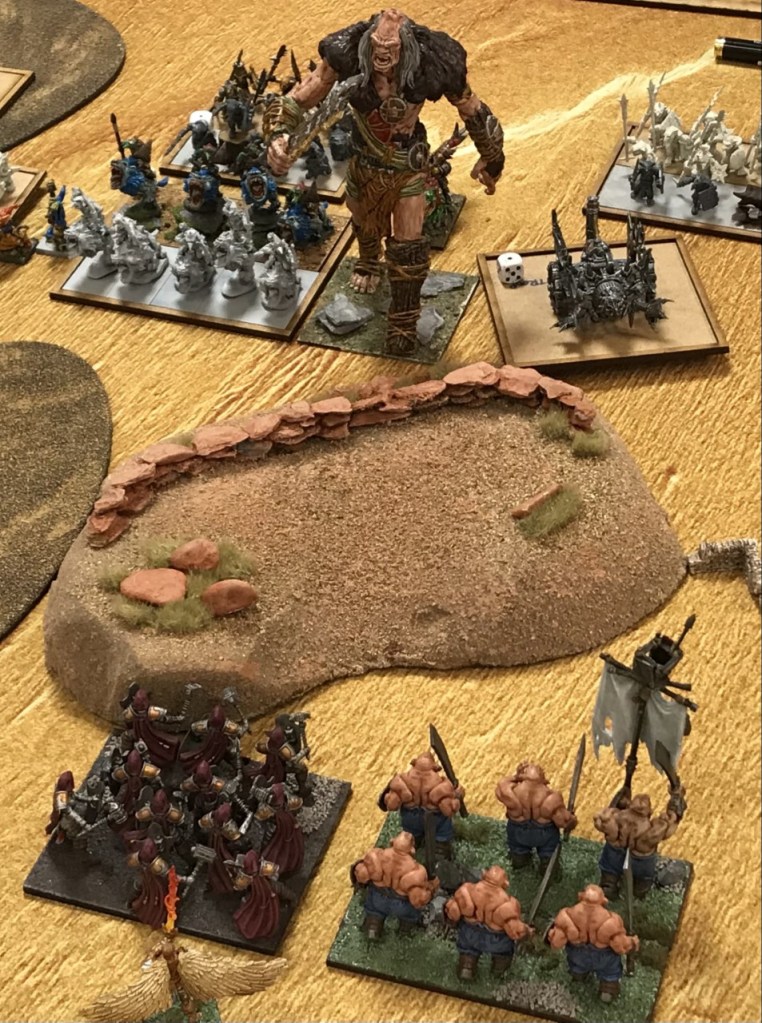
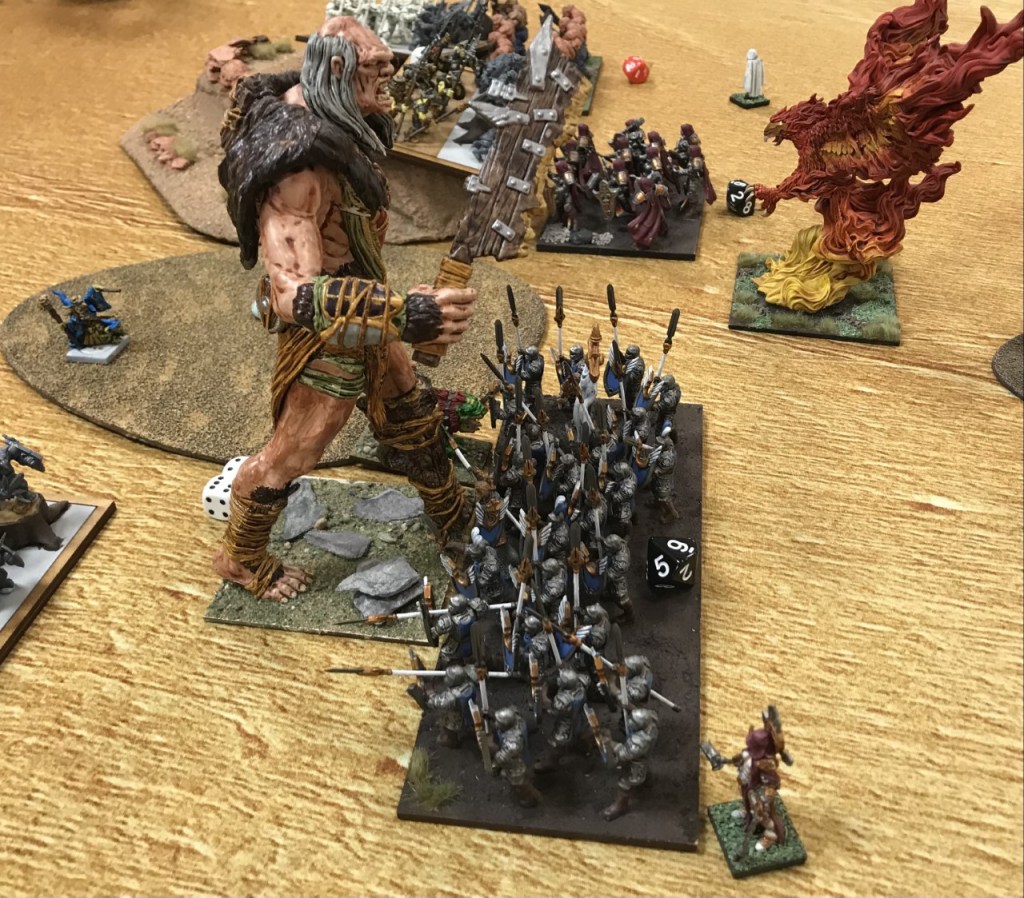
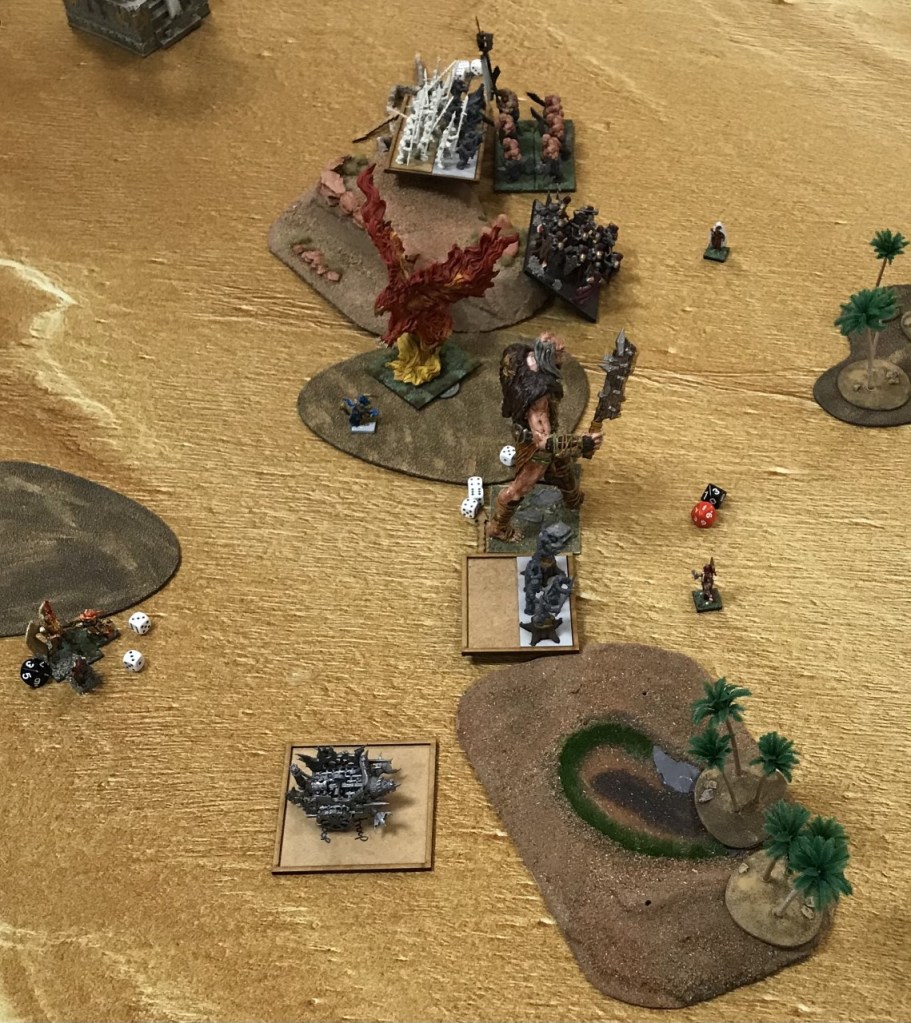
Clearly this giant is not about to die, but having secured some lunch may decide snacks are better than fighting – for now.
And so, to the challenge…
I’m going to close with a bit of a challenge, especially if you’ve stuck with this and still believe double 1s are the work of the devil. Why not, the next time you play, give you and you’re opponent the chance to throw in a guaranteed double 1 once during the game.
Yes, it might make the game an unmitigated disaster, but it might also help keep the rule more front of mind in your game play (because the reality is it is possible it could happen in every game) to help improve how your army responds.
It might also change the way you think about key combats, because for every ruck involving several hordes and regiments in the middle of the table there is a chaff unit that wins an objective or rear charges a titan that can change the course of the game. Having the option to throw in a double 1 means you can use it tactically against your opponent, so you have to think carefully about where it could have the biggest impact and that in itself might produce some interesting insights.
Christina Henry, a horror writer with an increasing back catalogue of great reads including the fantastically gruesome Alice and the terrifically twisted Lost Boy.
What’s it about?
Smith’s Hollow is charming little town. The sort of place you would go for a quiet life. A great place to raise kids, but it has a secret. Unknown to them, Lauren and her little brother David are at the centre of a bloody mystery which will make Lauren see the Ghost Tree, her favourite childhood hang out very differently.
Is it any good?
Of course. Christina Henry’s work goes from strength to strength. Blood, gore and spine-tingling suspense. In short everything you could ever want from a horror book.
I tend to write narrative battle reports. Partly because I enjoy writing stories, and partly because I’m not one of the best players in the world. I’ve found over the past year, or so, that writing battle reports has improved my game. Even writing a narrative report I refight the battle through the pictures, and find myself fairly regularly asking myself why I did something, or why I didn’t do something else.
Last night’s game was great fun, and very close. Looking through the pictures over a coffee this morning a few things occurred to me. So, I thought rather than put them to one side I’d do a bit more of a traditional battle report, focussing on the game rather than the narrative.
Scenario: Salt the Earth
Since the return of gaming in the UK I’ll admit to have been taking things easy with lots of games using scenarios like Dominate or Invade. Salt the Earth is one of those scenarios I think you need a game plan for, and I just didn’t have one. Fortunately, neither did my opponent. When it came to objective placement my opponent went random, whilst I tried to cobble together some form of strategy. Because the Herd are so obscenely fast I expected the majority of the fighting to end up in my half. I definitely didn’t see me making it all the way to the enemy deployment zone. So I kept my scoring tokens as close to the centre as possible. My one tactical placement was a 1 point token behind the house in the Herd’s deployment zone in the hope he would send a unit over to baby sit it, taking the unit out of the game, giving me less to deal with in the centre, where I expected at least another 1 point token to be.
Points: 2,300 (yes, Clash is very much in my thoughts)
Army lists
I’ll let you judge the lists yourself. The one thing I would say is that as a Ratkin player with lots of defence 4 Herd makes me very nervous. With most of their units having melee 3, high attacks, some sort of strength enhancement, pathfinder and lots of speed getting charged by hordes tends to be a terminal experience. It’s also worth noting that all this nastiness is largely neither cavalry or flyer based, making Phalanx pretty irrelevant. It’s built into my list because it’s an all comers list rather than a specific anti-Herd affair.
Ratkin
1 – Master Scurrier with Boots of Levitation
2 – Warlock with Boomstick
3 – Mutant Rat Fiend
4 – Tangle
5 – Weapon Teams
6 – Night Terror with Talisman of Inspiring
7 – Scud
8 – Hackpaw regiments (one has Mace of Crushing and one has Blade of Slashing)
9 – Tunnel Runners regiment with Caterpillar Potion
10 – Shock Troop horde with Plague Pots, Phalanx and Brew of Sharpness
11 – Warrior horde with Plague Pots
Herd
1 – Spirit Walkers hordes
2 – Beast of Nature with wings and extra attacks
3 – Moonfang
4 – Minotaur Chariot horde with Brew of Haste
5 – Centaur Bray Strider regiment
6 – Guardian Brute horde with Brew of Sharpness
7 – Lycan horde
8 – Harpies
9 – Druid with Bane Chant
Turn 1
I won the roll for this and opted to go first. The Master Scurrier had already scouted forward, hence why he’s not in line with the rest of my deployment.
This turn was pretty uneventful. I moved the left flank forward in such a way that the beast of nature would not be able to sneak past me without getting charged by something.
Scud lightening bolted the harpies behind the centaurs, taking them out of the game.
The centre and the right flank crept forward as I didn’t want to give the Herd any charge opportunities just yet. I was also hoping I would be able to shoot off one of the hordes in the centre before combat started, because each of them could reasonably be expected to one shot anything I had in my centre, and could win the charge. I decided to go for the Guardian Brutes because with crushing strength 2 they represented the greatest threat. The Warlock shot at the Brutes, wounding them, but not killing them.
The Herd’s response was fairly conservative on the left and in the centre, moving to be outside the charge ranges of my fastest movers. On the right, things were a little different, and the entire flank surged forward. This would leave me with loads of charge options for the next turn, none of which would be that appealing.
End of Turn 1
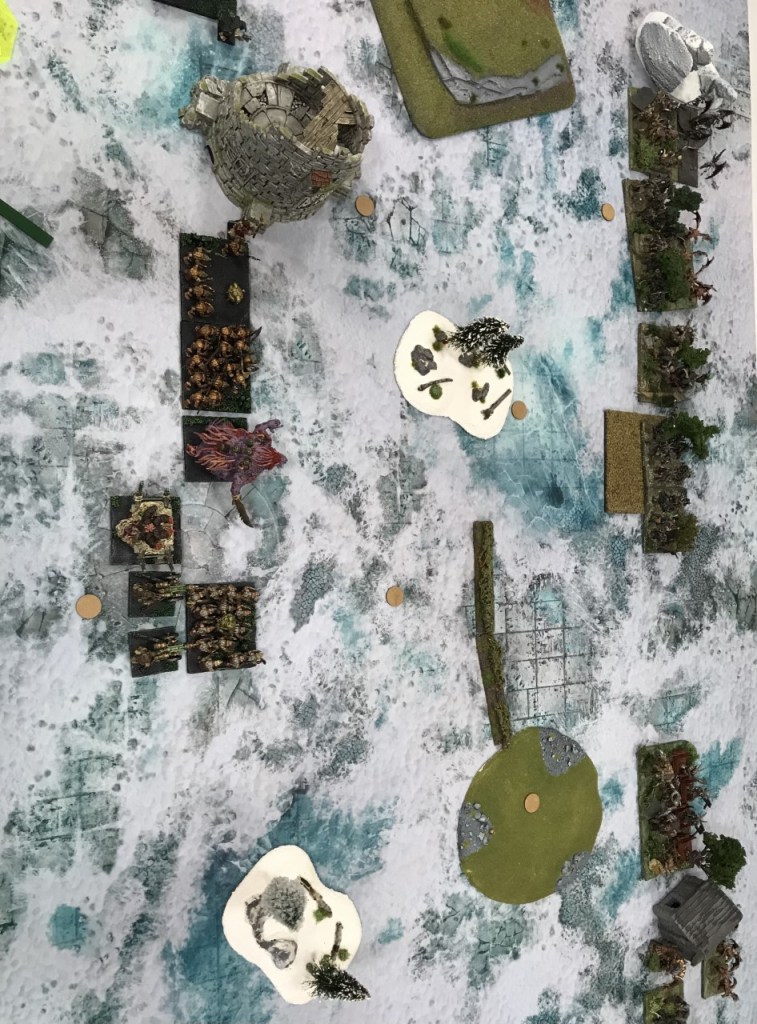
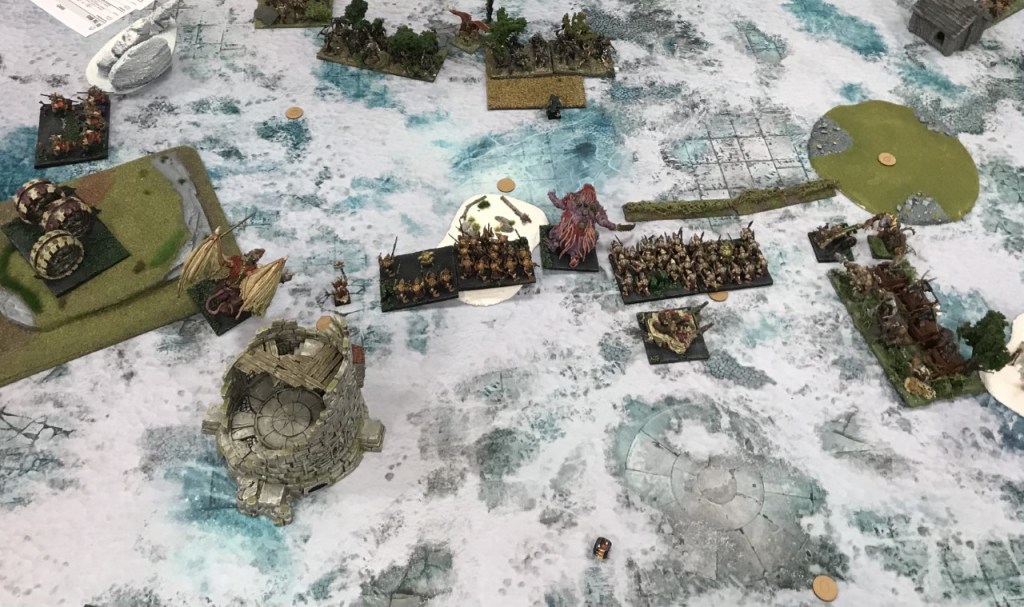
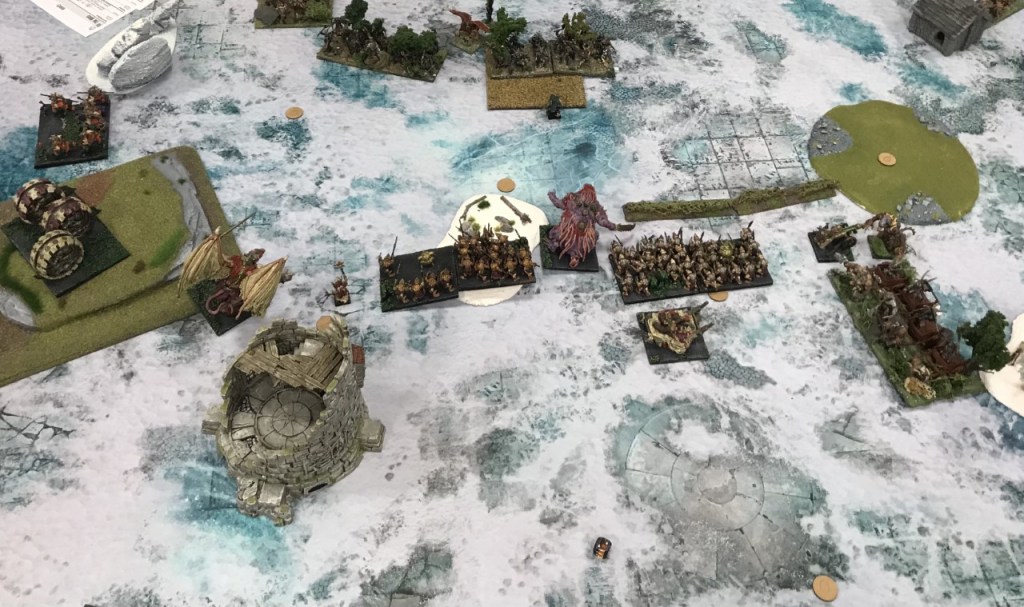
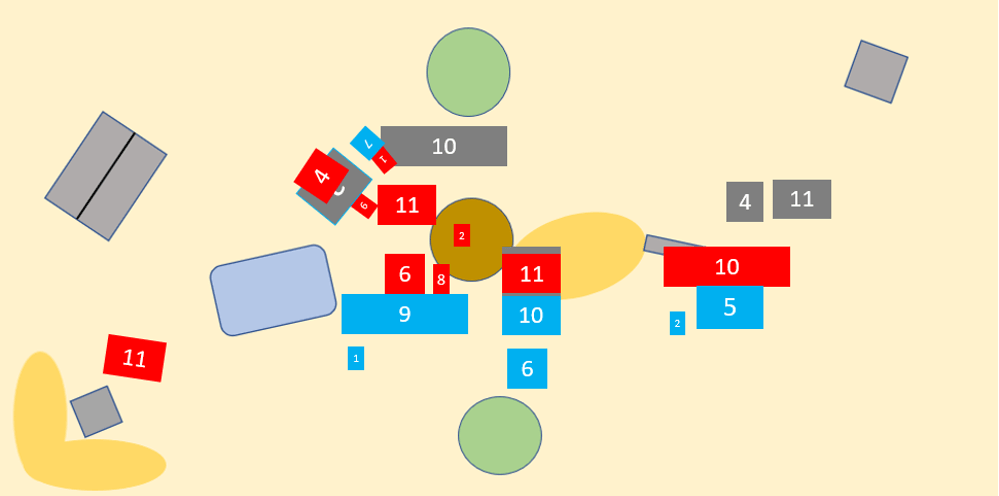
Set up, end of turn 1 and 2.
Turn 2
This turn was all about sacrifices and shooting. On the right I felt the best option was to try and hold things up for as long as possible. Whilst neither the Night Terror or Hackpaws are that terrifying at front charges, they can be a pain if they find their way around flanks or rears so I knew my opponent would want rid of them. The Hackpaws went into the harpies as these troops are ideal for grabbing late stage objectives so I figured if I could get rid of them now it would be one less thing to worry about, and the Night Terror went into the Werewolves on the basis it had the potential to do the most damage, but in reality it had no real chance against anything.
The rest of my movement was really about positioning shooters and ensuring the Beast of Nature couldn’t get behind me. Scud, the Warlock and the Master Scurrier were positioned to shoot at the Brutes, successfully taking them off the table.
The Master Scurrier was positioned so that it was more than 6 inches from any of my units. Whilst I was happy for something to charge him I didn’t want any follow up moves bringing the Herd into my centre.
Finally, the weapon teams fired at the chariot horde in the hope of chipping some damage off.
The Herd went all out to wipe out the Hackpaws, putting Moonfang and Minotaur Chariots into them – it worked, no surprise. Happily, the Night Terror survived (albeit waivered), which meant the Lycans would have to wait until the next turn to to catch up with their buddies.
In the centre the Herd started a mini reform with the beast of nature moving out of the left hand corner and the remaining harpies heading off to claim the 1 point objective that had been revealed on the right.
End of turn 2
Turn 3
This turn saw my attempts at cunning movement start to come together. The Master Scurrier charged into the Spirit Walkers on the right. Although he isn’t mighty 4 attacks at 3s to hit, 2s to wound and vicious was going to get him there and block up Spirit Walkers so I could start to get my infantry and the fiend within charge range. The attacks hit, but not surprisingly weren’t enough to do anything of any note.
The left flank positioned itself to get as many charges into Herd units as possible the next turn, and lightening bolts hazed the Spirit Walkers on the left, not doing much, but every little would help next turn.
On the right the weapon teams had another turn of shooting at the minotaur chariots, before one got charged and completely wiped out.
The Lycans removed the Night Terror and tried to catch up with their comrades, and Moonfang moved as close as he could to the remaining weapon team, unable to charge him because the minotaurs had been blocking his line of sight.
The only other significant action of the turn was the horde of Spirit Walkers backing away from the Master Scurrier to stay out of charge range of anything more substantial. This would reduce my options for next turn.
End of turn 3
Turn 4
Turn 4 finally saw the Ratkin join battle on their terms. The Herd had carefully manoeuvred to offer one meaningful target and so I charged it with everything that could reach. Spirit Walkers are very dangerous, but with defence 3 they are real glass cannons, I had to take the unit off the table in one go or there was a high likelihood I would lose a unit. Unfortunately, the Shock Troops were out of reach so the honours fell to the unholy coalition of the fiend, Scud and a regiment of Hackpaws. A few dice rolls later the walkers were gone and I was a little bit more relaxed.
The combination of the multi charge, the presence of the beast of nature and the centaurs meant I wasn’t going to have this all my own way and consequently the only real option in terms of reforming was to back off.
The Master Scurrier went into the other walkers again, this time hindered, but still managing to hold them up.
With so much combat going on the Warlock was deprived of worthwhile targets, and so headed over to the centre to provide some support to the weapon team targeting the Minotaur. Fortunately the shooting attacks came off and the chariots disappeared.
The last weapon team breathed a sigh of relief as Moonfang found an opportunity for maximum shenanigans. Using a combination of height and nimble he was able to get a flank on the Tangle that had been facing the walkers and the Master Scurrier. Despite his best efforts the Tangle remained in tact. Finally, the Lycan horde charged the weapon team and crushed it underfoot.
End of turn 4
End of turns 3 and 4, one walker horde down.
Turn 5
By the end of turn 4 I was feeling pretty confident, and I had made a pretty important decision. I decided not to use my Shock Troops to attack the remaining walker horde. That decision was based on us deciding to limit the game to 6 turns due to time restraints and, mainly, because I was worried that if I took the Shock Troops out of the centre they wouldn’t make it back in time to secure the objectives.
With the beast of nature clearly on its way to secure the 2 point token I therefore needed 4 points to win and this is probably where I stopped thinking quite as clearly. I had, to be honest, largely forgotten about the beast so my reaction was a little less thought through than it should have been.
I decided that I would try and lightning bolt the beast, whilst using the fiend to tie up the walkers. At this point I seriously underestimated just how good they are. In order to hit the beast I needed to turn Scud (and the Warlock) to face it. Not surprisingly the shooting was not enough, the beast would make it to the objective and the centaurs were perfectly placed to tie up my Tunnel Runners and Hackpaws.
I had hoped that by getting the charge off with the fiend the walkers would be stripped of their thunderous charge, and so wounding on 4s would give him a chance of survival, but the Druid’s Bane chant went off, and wounding was back to 3s. The walkers managed about 14 wounds and even with Scud’s rallying and inspiring the fiend went down.
Things were starting to look pretty good for the Herd, so naturally we got the first meaningful double 1 of the game, followed in short order by the first double 6 of the game.
Moonfang had done about 12 damage to the Tangle and was ready to move on with the aim of reaching the centre to add his unit strength to that of the walkers. Double 1 meant the Tangle stayed in the fight. In what could be politely be described as an unfortunate sequence of events, the Lycans rolled a double 6 to waiver the warrior horde. The warrior horde was of course affected by the aura of fury from the (you guessed it) Tangle, keeping them in the fight as well (although this fight was not as critical).
Its fair to say I ended the turn on something of a reflective note!!
End of turn 5
Turn 6
After a bit of mulling stuff over I decided the best/only course of action was to see if I could shoot the walker horde off the table. It had already sustained some damage from the Master Scuttler, although it was still a reach. The first nerve test went my way, but the second one didn’t – and that’s the one that counts.
Fortunately, I had positioned Scud so the walkers couldn’t charge my Shock Troops. That meant they could sit tight and hold the 2 and 1 objectives to either side of them. After the Tunnel Runners and Hackpaws had finished off the centaurs the Tunnel Runners managed to reform sideways and claim the 1 point objective on the hill on the left.
Of course, I was far from out of the woods. Moonfang was within easy lopping of the centre and the failure to stop the walkers with shooting now meant Scud was literally the only thing standing between the walkers and the central 2 point objective. If they killed Scud and followed up they would equal the unit strength of the Shock Troops rendering the objective void. If they killed Scud and Moonfang turned up Herd would win the objective, and the game.
There was of course the small matter of the Tangle vs. Moonfang to be resolved. Tangle struck, and miraculously wavered Moonfang taking him out of the equation. So the deciding combat got underway.
At first I felt reasonably confident Scud could survive as he has a higher defence than the fiends, however the shooting meant the horde still had its thunderous charge benefit, and a successful Bane chant sealed the deal.
I think it was Einstein who said the definition of madness is to do the same thing and expect different results, he just might have a point! So the walkers moved up to share the 2 point objective with the Shock Troops, the beast held the other 2 point objective, the harpies held the 1 point by the house whilst the tunnel runners and shock troops managed to hold their respective 1 pointers leaving the game in the hands of the Herd, 3 points to 2.
End of turn 6
The unholy collaboration, end of turn 5, a smug beast of nature.
Final thoughts
Stick to the plan – this might sound a bit weird, but I was really going for a draw on this as I’d only planned to hold 4 points of objectives. My plan had been to fight in the centre knowing I had place 3 points of objectives there, and expecting at least one more to appear, which it dully did. I think seeing the 2 point objective turn up on my door step and getting to turn 4 without being wiped off the face of the earth might have got me a bit excitable. Had I ignored the 2 point objective the beast claimed and turned Scud to face the walkers instead quite a few options would have presented themselves – for one thing a double charge with Scud and the fiend. This would have delivered more wounds in the first round of combat, removed the thunderous charge and given the Herd player a difficult choice (even with Bane chant) as to who they went for when/if there had been a second round of combat.
Another option would have been for Scud to shoot at the Druid in turn 5, potentially removing inspiring and Bane chant which again would have changed the dynamics of both turns regardless of whether he chose to shoot or fight.
Remember your heights – height is probably one of my favourite dynamics in the game, and whilst it can be quite an easy thing to remember early on in the game it can be quite a different matter as time grinds on. Height played quite a big role in what was happening on the right flank especially the charge on the Tangle which could have really gone either way, and genuinely surprised the hell out of me. Being honest I think I forgot about heights when it came to assessing the walker situation. I don’t think I had fully realised that the Druid was a viable target in turn 5 due to Scud being considerably taller than the walkers.
All in all it was a great game and a great way to get back into rats having spent a few weeks playing Basileans and Abyssal Dwarfs, and I’m definitely looking forward to a few more rat based games in the coming weeks.
Centaurs clash with Tunnel Runners, end of turn 6, the Tangle survives.
I started playing fantasy wargames over twenty years ago. Back then there was only really one readily available and easily accessible game. In a time before the internet Games Workshop’s Warhammer Fantasy Battle (WHFB) ticked all the boxes in terms providing a solid ruleset, some great fluff and a wide range of beautiful looking toys. Equally important was that they were easy to get hold of through dedicated shops in most UK cities.
But times, and more pertinently, technology change. Whilst GW is still the big fish in our relatively small hobby pond it is certainly not the only one. The number of companies offering rules and miniatures seems to have expanded so rapidly, I would certainly take time out to provide a small round of applause to anyone who can name them all. It is, in some ways, something of a golden age for fantasy wargamers as we must surely have the widest choice of rules, and the greatest choice of toys to play them with. But will this golden age go the way of all others?
Paladins by Northumbrian Tin Soldier
How we got here
To my mind there are two main reasons we are where we are. The first, weirdly maybe but hear me out, was the End Times. This was the event that ended GW’s Old World, taking with it WHFB. Although WHFB was waning in popularity I believe the decision to pull the game in one fell swoop, and replace it with a very different system (and I want to be clear here – different is not code for any negativity to Age Of Sigmar I genuinely like the game), resulted in a lot of people taking the decision to try something new at the same time. I suspect for many of those people it would have been an inevitable decision, accelerated by the End Times, had GW let WHFB continue on its trajectory. However, because there were suddenly a lot of people all looking for new games to play the market responded, and new games were forthcoming (albeit some were not new, just not that well known).
The second reason for us being where we are is technology. Social media and content producers have undoubtedly played a massive role in allowing small companies to show off their products (in addition to the more traditional channels such as shows). In addition, 3D printing is providing a whole new avenue to explore in terms of miniature design, distribution and fulfilment. The distance we have travelled, from those heady days of having to go to a shop in the hope they have what you want, to being able to print an entire army in your spare bedroom is just breath taking.
But are we in danger of doing an Icarus? And what would that even look like?
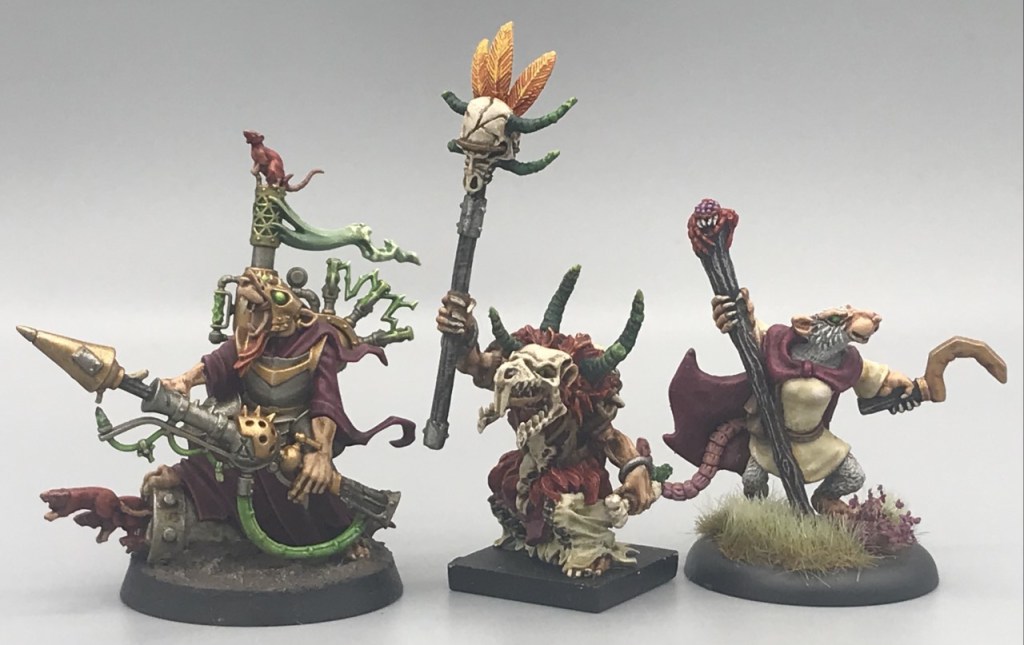
Rat wizards by Games Workshop, Mantic and Oathsworn
What actually are the down sides?
Maybe I’m just being a bit negative. There’s nothing like a global pandemic to remind you that you don’t get everything your own way all the time.
Sure, from a customer point of view the current picture is pretty rosy, but, what about the companies that serve up these glorious steaming platefuls of hobby goodness? I guess the danger to my mind is we reach a point where, as customers, we are spread too thin. It becomes impossible for us to support so many different ventures, regardless of how much cool stuff they create, and companies just can’t make a decent turnover (and I mean this in a purely relative way – the sort of relative that allows everyone involved to earn a decent living without giving that a pounds and pence figure). Consequently, a major challenge companies have is how to make sure we buy their stuff.
The key, ultimately, is like any business, to understand their customer base, understand what they want, and enjoy, and keep serving it up.
Spellcasters by Bad Squiddo, Male Wizard from somewhere on the web.
Intellectual property plays a really important part in this. One of the reasons many people are attracted to fantasy wargaming is because of the weird and wonderful creatures and creations the genre enables, both from a modelling and gaming point of view.
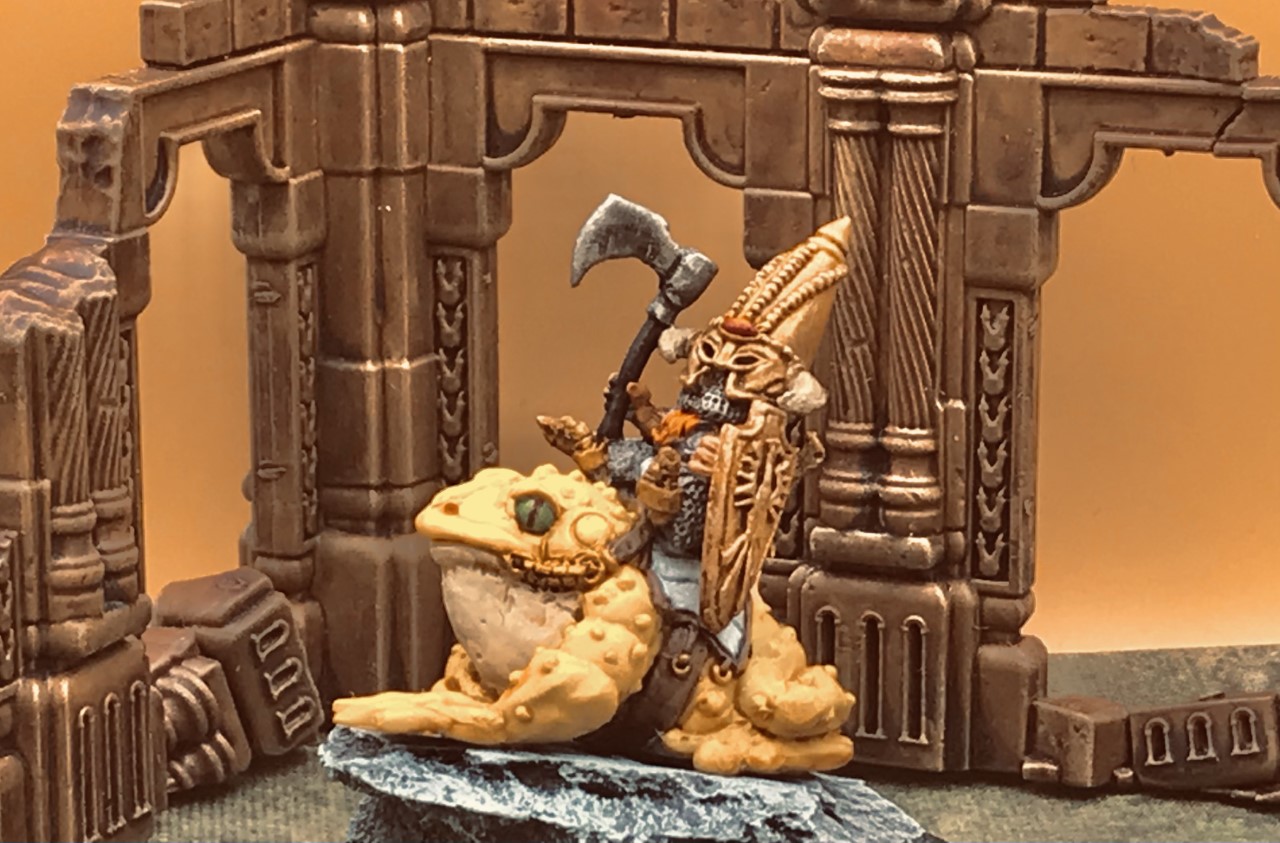
What is interesting to see is that as more and more model options come to market from model companies (I absolutely include companies that create 3D printing files in this), those companies that produce both miniatures and rules are starting to break away from the old tropes that have, for so long, been the mainstay of fantasy wargaming. No longer is fantasy trapped, thematically, in the dark ages with subtle elf mages, dower Dwarfs who keep their feet firmly in the ground and those merry, shoeless, but ultimately largely pointless on the battlefield Halflings. In some worlds Elves now wield hammers and fight alongside cow mountains, Dwarfs cruise the skies and Halflings… they wear shoes (as well as riding trolls into battle).
These evolutions of our favourite factions have undoubtedly raised a few eyebrows, but to date don’t seem to have led to any rage burning of toys episodes (unlike End Times), which I can’t help but consider a success. These changes benefit the companies that make them by allowing them to be first to market with models that reflect these new units and creating differentiation in their ranges. It also addresses a fundamental element of the hobby which has always seemed somewhat paradoxical in nature. Fantasy settings give the opportunity to create literally anything, and yet it seems to have taken quite few years for Halflings to try on shoes, amongst other things (feel free to insert you’re own pet concern here).
Assassins by Northumbrian Tin Soldier and Mantic
So, when doesit all come crashing down exactly?
I think this really depends on how you hobby. For those people who happily flit between different games and different model producers I think the world is unlikely to change, although companies will come and go. However, for gamers who favour a particular system or company there is always the chance that it could all come crashing down around your ears. The biggest piece of advice I can give, outside of supporting the companies you like, is whatever you do don’t toast your army, my WHFB Skaven army went on to become my first Kings of War Ratkin army, and I’m certainly not alone.
In reality the future of the hobby will mostly be influenced by the companies that enable it, both current and future. They will play by far and away the biggest part, for many people, in deciding how models are made and how we play with them. I fully expect to see more eyebrows raised as fan favourites continue to evolve and new ones are created, and I’m excited to see how rules writers will breathe life into these creations: and maybe, just maybe, Halflings will finally get to experience the flip flop.
In the UK we’ve slowly been creeping back into the comfort of artificial light, enclosed spaces and real models. It started in back gardens, then gaming clubs and now tournaments. Of course, this has all been under the auspices of the “not quite sure what’s going on” normal. In sunny Bristol (this is not irony we’ve been bathed in the damn stuff for weeks) clubs have been back for a while, but tournaments had yet to reappear.
A few have been taking place in the UK and I’d been considering packing up my toys and venturing abroad in the hope of getting some practice in ahead of Clash of Kings. Chief amongst my many weaknesses and shortcomings are clocks, so I really wanted to get in at least one timed event before October. Fortunately, local tournament supremo Matt James (also of rules committee fame) decided to organise a 750 point a side session the Sunday before last.
It was an unusual sized event, but Matt had put some thought into it, and in addition to the points limit there were a number of additional restrictions on army selection, such as only one flyer and a further points limit on units.
Initially, I was excited about the event because it was a chance to get a day of gaming in, and to remind myself of the joys of clocks. However, as the day approached it started to dawn on me just how much of an interesting challenge it was going to be because deciding on an army list was damn near impossible.
Army selection
My immediate reaction was to go for my tournament faithful – the Ratkin. However, after a lot of thought I couldn’t really get my head around what an army I’d be comfortable playing would look like. I love my synergies, but with a low point count and the other restrictions in place it became difficult to see how these could be maximised. There was an additional impediment due to me and my rats not being on good painting terms. This further limited my options in terms of what I would have ready, and what I would be prepared to rebase.
The other thought that took roost in my mind was what other peoples’ armies might look like. I had a hypothesis that most people would go for a list that favoured winning the charge. I was expecting to see knights and flying characters. I didn’t fancy facing off against those sorts of lists with an army primarily composed of defence 4 and a reduced nerve due to a lack of rally.
So no longer convinced the rats could handle it I reached for the Basileans and went in completely the opposite direction to what I assumed the rest of the field would bring. A Spear horde to provide a big slug of unit strength and discourage cavalry and fliers, supported by foot Paladins with shields to provide another slug of nerve, unit strength and a predictable (if not wildly exciting) damage output.
The army would be led, and healed, by a Priest with the Shroud of the Saint – I figured having heal 6 would wash away most chip damage from shooting as well as keeping the infantry in the fight. A regiment of Elohi would provide a seriously irritating roadblock to stop faster armies having an easy time choosing their charges. They would also have a chance at knocking off thunderous charge, which I expected in abundance. The final choice was quite difficult because, to cut to the chase, I wanted an Ur-Elohi but points and restrictions wouldn’t allow it – the answer came in the form of an Ogre Palace Guard Captain. Not a go to for many but as a scoring unit, that self inspires, has brutal, crush 2 and is pretty much all round rufty tufty, it struck that in a pinch this was the budget angel I was looking for.
The List
Priest with Shroud of the Saint
Ogre Palace Guard Captain
Elohi regiment with Pipes of Terror
Knight Paladin regiment on foot with an Aegis Fragment
Spear horde
The Games
Six games were played in all and so many things prevent a blow by blow account (such as your sanity), so here’s a brief overview.
Game 1 – Goblins, Control – win
This game came down to a grind off in the centre of the table between the Spear horde and a Rabble legion, and a charge on the Paladins by a mincer mob troop. The Paladins withstood the charge, and with the help of the Elohi destroyed the Mincer. The Spears, supported by the Priest stayed in the fight with the legion, the grind continuing to the end of the game.
Game 2 – Kingdoms of Men, Pillage – draw
The choice of a Spear horde really came into its own. A regiment of Knights and General on flying beast stripped out all my other units, but the horde was able to hold two objectives whilst presenting a really unattractive target for the mounted warriors who backed off to claim two other unguarded tokens.
Game 3 – Northern Alliance, Invade – win
This was my first-time facing Ice Elementals, and they are a pain. Fortunately, they spent most of the game chasing my Elohi, who with a little help from the Priest, managed to stay alive and keep them occupied. This game was really close, as a ruck in the centre of the table involving almost all my troops and a horde of snow trolls prevented all but one of my units from crossing the line, but fortunately that was enough.
Game 4 – Basileans, Dominate – win
My opponent had gone for the alpha strike version of the Basileans. Mounted Paladins, Ur Elohi and Gur Panthers. It was a close game that came down to foot Paladins slugging it out with each other. I had one of those moments around turn 3 where I accidentally moved the Priest out of inspiring range of my foot Paladins, fortunately they survived their combat, and having realised this mistake I promptly, but also accidentally, moved the Priest out of inspiring range of my Spear horde who were not so lucky!
Game 5 – Forces of the Abyss, Loot – loss
The Forces of the Abyss carried the day going completely unbeaten and tabling everyone! Brave Basilea was the exception. The Priest survived! The rest of the army was completely shredded in short order. This army was one of the few that didn’t depend on cavalry for its punch, instead relying on a Chroneas and Abyssal Fiend (wingless) that chewed their way through everything on the table without having to worry about phalanx.
Game 6 – Kingdoms of Men, Kill – draw
This became a bit of an infantry off in the centre of the table, as both armies consisted mainly of human infantry. For me it all fell apart because I failed to take into account what I would do if a regiment of Shieldwall I flank charged with the Spear horde and Paladin regiment double 1’ed. Of course, they double 1’ed.
With the benefit of hindsight there was so much more I could have done differently, but it had been a long day. Overall, I think this game could have ended up being very different, but I think both I and my opponent were a bit tired by the end of the day. In another stunning example of “oh yeah, should have thought about that” his Foot Guard scrapped with my Paladins whilst our respective sources of inspiring duked it out. He opted to resolve the infantry combat before the commanders. The inevitable happened – my Paladins survived on the second role of the nerve dice before his Warlord slaughtered my Priest. Let’s quickly move on.
Takeaways from the day:
Clocks are still my weakness – there never seems to be enough time! I timed out on two occasions although, fortunately neither affected a final result. Timed games are still something I’m relatively new to, having played just 4 tournaments previously. I don’t have an issue with timers, it’s just something I need to work a bit more on and it was good to get this event in before Clash to remind myself to get a damn move on.
Ogre Palace Guard Captain – whilst this guy doesn’t get seen that often in larger lists he made a great addition to this force. He was intended to play a similar role to an Ur Elohi, and for the most part it worked (although speed was somewhat lower). It’s certainly given me an insight into how he could fit into a larger force. Also, it gave me the excuse I needed to paint up Mantic’s awesome Paymaster (all that remains now is to find an excuse to paint up the Matriarch, Brave Bully and Goblin Slasher, surely there must be some kind of army that would allow me to field them all together).
Getting to know a different army much better – although I’ve had my Basileans for a little while they’re an army I’m only just starting to warm too. Probably one of the most challenging things about this kind of event is not just the restrictions on the lists, but the further restrictions that are self-imposed. In my case this meant units I had available for use and how far I was willing to go in terms of building new stuff and rebasing existing elements. Consequently, my choice of army was driven more by necessity than anything else, but I was really impressed by their performance and my interest in the army has been rekindled. In addition, the experience will definitely have an impact on my army build in the short term.
Exhaustion – It’s been a long time since my first, or even last event, and I genuinely forgot just how tiring it can be on the old brain.
Areally fun day out – played competitively Kings of War can be quite unforgiving and the smaller the army size the less opportunity you have to fix mistakes or oversights. These games certainly required a fair bit of thought and I definitely felt the presence of the clocks. But just as in pre-covid times a good event is always more than the sum of its parts. Between the overall organisation, some friendly opponents and some games that got the old brain in gear it was a good day out and I’m feeling excited about Clash.
It’s been a while since I last wrote one of these, but now I’ve finally got around to playing my first Halpi’s Rift game it seemed the right time, what with the Mantic back to gaming month and all, to get creative.
It was a relatively straight forward decision on which plane to play on – the first one. I decided to go with my Basileans for this game because it felt a good fit narratively. The army was built through a slow grow campaign that took place on an undiscovered island. The army’s leader, a self appointed Priest named Sha’leis, is a charismatic preacher who walks the fine line between righteous devotee and heresy. In Basilea she would undoubtedly attract the attention of the authorities, but she is largely unheard of in the hegemony because she, and her followers, spend all their time spreading the word of the Shining Ones outside Basilea’s borders. Consequently, the idea of taking a trip to an alternative plane of existence, or several, would undoubtedly be her kind of thing.
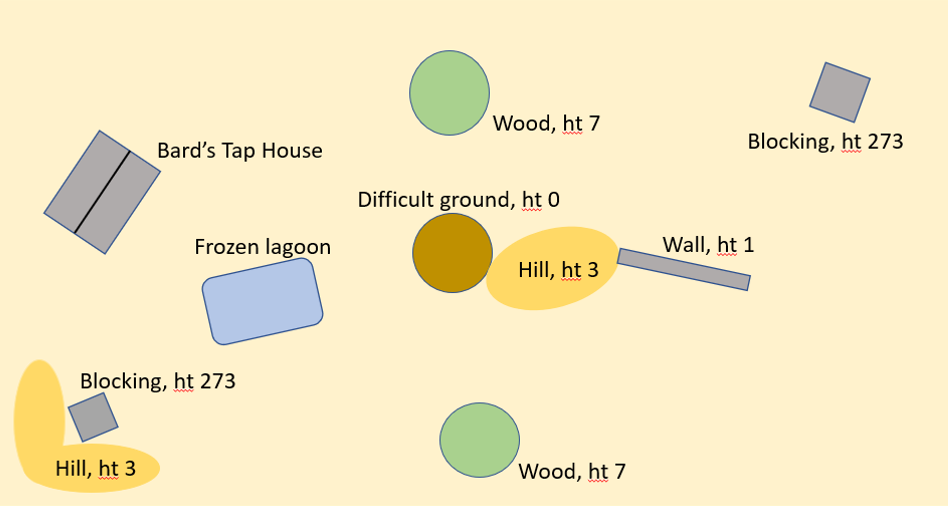
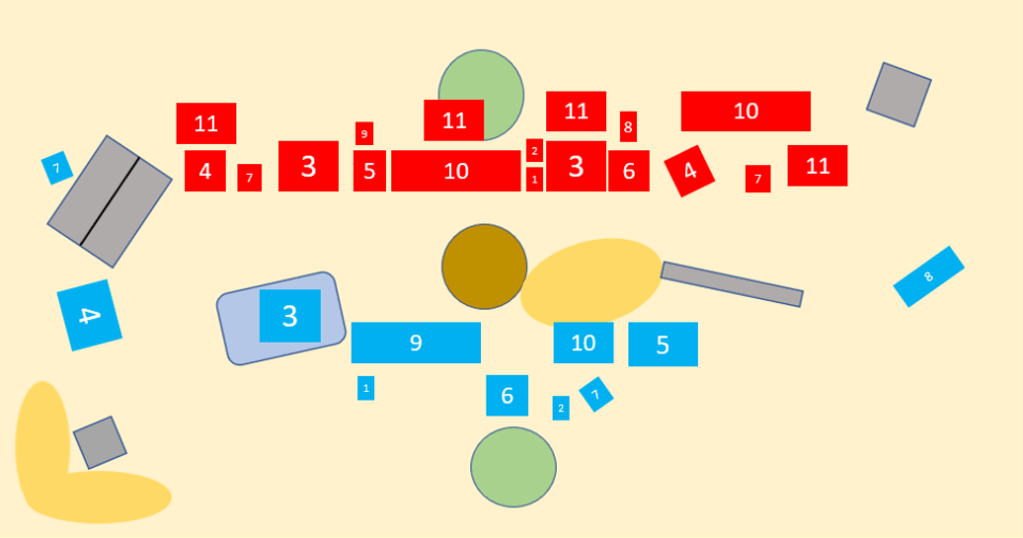
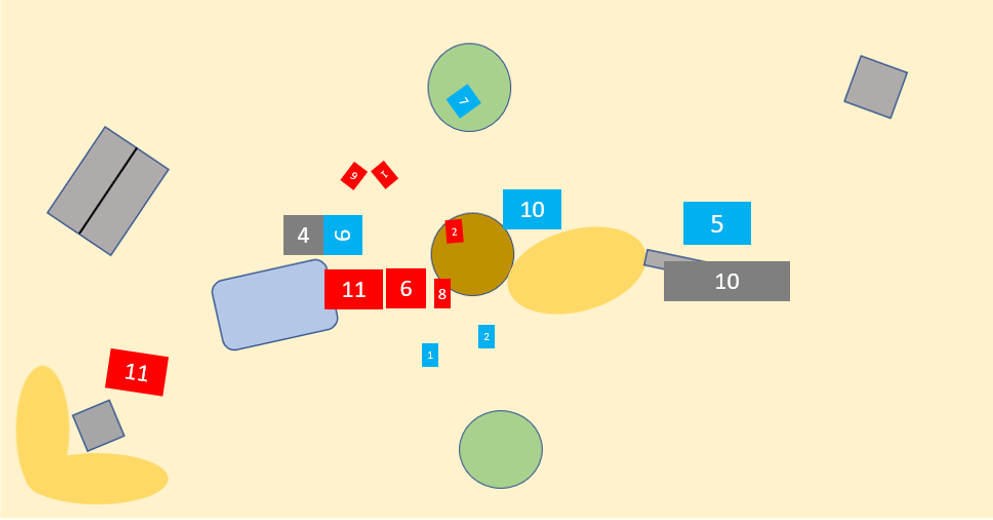
I’m trying out a new format to show what’s going on turn by turn. The pictorial representations of the battlefield aren’t precise, but hopefully it will make things a bit clearer than dodgily angled photos – there are also a decent number of pictures as well.
Points: 2,000
Scenario: Invade
Plane: Material
The armies
Basilea
1 – Sha’leis – Priest with Shroud of the Saint
2 – Anyta – War Wizard swapping Fireball for Lightening Bolt, Alchemist’s Curse, Pointy Wizard’s Hat
3 – Mounted Paladin Knights with Aegis Fragment and Caterpillar Potion
4 – Gur Panther regiment
5 – Ogre Palace Guard horde with Brew of Sharpness
6 – Phoenix
7 – Ja’y’ll – Ur Elohi
7 – Sa’y’ll – Ur Elohi
8 – Elohi regiment
9 – Spearman horde
10 – Foot Paladins with the Defender upgrade and Aegis Fragment
Goblins
1 – Grupp Longnail
2 – Wiz
3 – Fleabag rider sniffs regiment
4 – Mincer Mob troop
5 – Goblin Blaster
6 – Giant
7 – War Trombone
8 – Goblin King mounted on Fleabag
9 – King with Jareth’s Pendent
10 – Rabble horde
11 – Rabble regiment with Mawpup
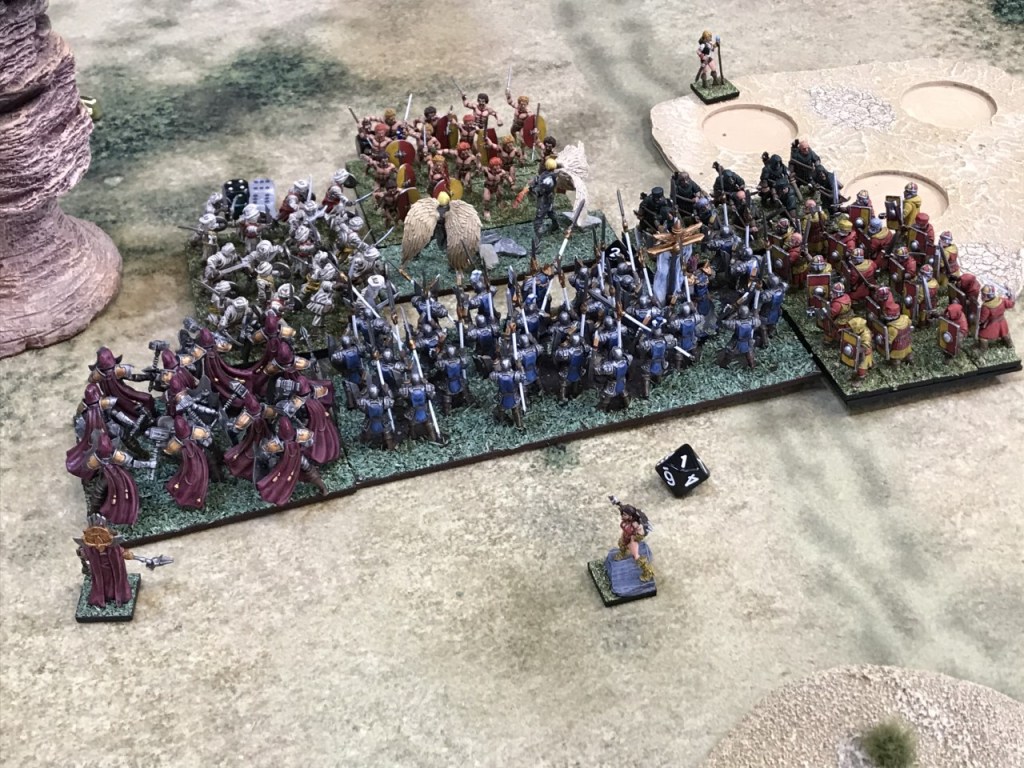
The field of battle.
The army marched as armies are want to do: with purpose. Anyta wandered if the rank and file, or for that matter the sergeants-at-arms and officers who marshalled the neat ranks and columns into place, had even noticed the change as they had crossed from the physical world of Panithor to here. A moment’s reflection led her to conclude there was something decidedly reassuring about the army’s apparent indifference to their new location – after all they were here to fight, not see the sights.
Anyta had been uncertain when she was approached about joining Sha’leis’ expedition to the outer planes of existence. The scarred Priest’s enthusiasm seemed dangerously close to naivety, but the Ur Elohi who attended her, one at each shoulder, indicated her vision and motivation was rooted in something deeper. Besides she thought, how many other mortals would get to see the Material plane?
The landscape was a strangely familiar place. Rooted in the world of mortals, but somehow more. A frozen lake lay to Anyta’s left, with a tap house beyond it, yet this was not a cold place. Far from it, the ground was arid, baked brown by a sun that did not seem to show its face. She wondered briefly about the tap house which looked so out of place in such a lonely landscape.
Anyta’s meditations were interrupted by the flurry of wings. Elohi landed close by. She turned to look at the new arrivals glowing and resplendent in their highly polished armour, flaming blades dancing in their still hands. The Ur Elohi Sa’y’ll approached her, silently extending his arm towards her.
“Take it.” The angel said.
She took the object the angel offered her and inspected it thoroughly. It looked like a battered wizard hat from the stories her gran had told her when she was barely able to walk.
“Put it on.”
As much as she wanted to do as the angel said she could not help but raise an eyebrow, “Surely this is not the time for childish dress ups?”
“Surely you of all people understand that all stories, no matter how childish, are an embellishment of a truth. True, not all wizards wear pointy hats, but one did, and it was that wizard’s wish that I should pass it on to you when you arrived here.” The angel replied.
Anyta stood in shocked silence doing her best to process the implications of the angel’s words. She had known no other wizards. Her magic had not been learnt in a university or college. Her magic had arrived with the wind that had destroyed her village and left her homeless. Was this some pittiful attempt at humour, angels were not known for their wit, or had Sa’y’ll simply made a mistake, something he was also not known to do either.
“I would suggest you put the hat on and focus on the present. Now is not the time to worry about sartorial stereotyping and I can guarantee it’s the last thing on their tiny minds.” said the angel nodding towards the goblin ranks that seemed to have appeared from nowhere on the other side of the plane, “Focus on the present now, and there will be time for the past later.”
Turn 1
Almost as soon as the angel had stopped talking the horns sounded the advance. Anyta was hardly surprised Sha’leis had taken the initiative. She’leis was not one to hold back, and the superior training of the Basileans meant they were prepared far quicker than the goblins, who even as the armoured warriors moved forward, seemed to still be milling around deciding what would go where. The confusion was most evidence around the giant’s feet where a mount king pointed frantically, yet never in the same direction twice, which resulted in the giant either hitting or standing on each of the units around him. Only the King managed to escape, instinctively wheeling his mawbeast away from the flailing giant.
As the drama around the giant died down, the goblin army suddenly seemed to realise the humans had started their advance. They responded slowly, moving forward, firing off a flew poorly aimed arrows that for the most part either fell against the rocks in the ground or thudded into shields.
End of turn 1
Turn 2
The mounted paladins and panthers on the left flank had ranged forward of the infantry and found themselves facing a bewildering array of war machines. Thinking better of going head to head with the mincers the panthers charged the war trombone sending the crew fleeing from the field. The paladins charged the blaster in the entirely accurate belief that anything with that amount of gun powder in it and a goblin in charge should be the first on the kill list.
Sa’y’ll watched the cavalry strike, breaking their targets. Concerned that the paladins had left their flank exposed to the rabble horde the Ur Elohi charged into their front flaming sword slashing left and right, holding the goblins at bay.
Inspired by Sa’y’ll the Elohi regiment on the far right charged a regiment of rabble cutting a handful down, but failing to route them.
The goblin attack was now gaining momentum. The giant let out a savage battle cry as it smashed into the spearmen. Despite the initial impact the soldier’s training and experience kicked in allowing them to quickly reform and prepare to fight back. To their right the foot paladins received a charge from the fleabag sniffs, raising their shields to fend off the slavering beasts.
The mincers started their blades spinning and began their relentless march forward. The mob on the right piled into the flank of the Elohi, shredding the angels leaving broken wings and golden blood on golden armour. The mob on the left charged into the front of the panthers scattering the creatures and sending them running from the field. Spurred on by the success of the mincers the sniffs and their king charged the mounted paladins, but failed to make the same mark on the armoured warriors.
End of turn 2
Armies advance.
Turn 3
Ja’y’ll felt a surge of energy rush through him (+5 attacks in melee as a result of the channelling table). Raising his sword above his head he flew into the flank of the central rabble horde. Despite being caught between the two angels the goblins managed to stand their ground and muster the courage to fight back against Sa’y’ll, knocking him to the ground.
Concerned by the menacing mincer to their left the mounted paladins counter charged the sniffs, routing them before wheeling out of their field of view. Seeing the mincer was now unable to charge the knights in a rare moment of leadership and heroism the goblin king on foot charged into the front of the paladins, holding them up while the mincers positioned themselves for the next charge.
With Sha’leis and the Pheonix casting heal to keep her loyal soldiers fighting, and the spearmen and foot paladins locked in their respective combats Anyta watched the goblin forces on the right flank advance. Only the ogre horde stood ready to stop their advance, and whilst these brutal warriors would fight to the last and take many of the creatures down with them she knew they would eventually be overrun. She set out towards them preparing to cast a lightening bolt, but as she uttered the words of the spell she felt a far greater power stir within her. An energy rushed through her, setting her spine ablaze, but despite the raw power there was something comforting and familiar. The warmth of a bed time story blanketed her mind and she heard her gran’s voice speaking unfamiliar words. Without thinking she repeated each word and the fire in her spine spread to her chest, then to her arms, exiting her body through her hands. Whatever this was it was no lightening bolt. a swirling vortex of orange and white energy flew from her hands and smashed into the war trombone. As the smoke from the explosion cleared Anyta was shocked to see the crew and weapon remained but no longer moved, their flesh stripped away and recast in bronze.
End of turn 3
Turn 4
Anyta took a sharp breathe as she surveyed the goblin statue. The removal of the war engine combined with a surge of magical energy (+5 attacks in melee from the channelling table) gave the ogres the opening they had been waiting for. They rushed forward hitting the mincer head on. Blows rained down on the goblin machine, and despite it’s heavily armoured front it eventually gave way and collapsed. Despite the ogre’s victory they were now surrounded by goblins. Anyta reached out and let her gran’s words guide her, seconds later the rabble regiment on the ogre’s flank would stand ready to charge for eternity.
Following their victory the ogres had drawn back behind the wall, which meant when the rabble horde charged them they were force to fight around the obstacle, breaking the little coherency they had making no impact on the ogres.
In the centre the impasse continued. The giant had been joined by the mounted goblin King, but the reinvigorating powers of Sha’leis’ words and the Pheonix kept the spearmen in the fight. The foot paladins shared the relentless battering of the men-at-arms, finally routing the sniffs, only to take a charge from another rabble regiment.
Grupp had been spent much of the battle skulking besides the central rabble horde. As they finally broke, enthusiasm and bodies burnt by Ja’y’ll’s blade Grupp charged the angel punching indiscriminately with her armoured gloves. The angel was unable to block every blow and those that landed sent electric waves surging through his body, tangling with the sounds of breaking men and horses as the mincer ploughed into the rear of the mounted paladins, shaking him to his core.
End of turn 4
The grind continues and Grupp charges Ja’y’ll.
Turn 5
As the goblins flooded across the plane Sha’leis felt defeat reach out to her. She bowed her head and prayed that her soldiers would be protected whatever fate had in store for her. As she spoke the Pheonix flared and flew towards the centre of the plane. The creature had felt the energy of the ancients and sent its healing energies towards Ja’y’ll (the spell reached it’s target due to an additional 6 inch range provided by the channelling table). Refreshed, Ja’y’ll struck back at Grupp, but with his mind still affected by the shock from the gloves he failed to do any meaningful damage. Seeing the wiz in trouble the goblin King, buoyed by what would soon be the legend of how he defeated a regiment of mounted paladins single handedly, went to her aid, but even with the combined efforts of the goblin leaders the angel endured.
Things took a desperate turn in the centre as a regiment of rabble joined the melee against the spearmen. The sheer weight of opponents finally proved too much for the men at arms and the spear block crumbled. On the right the ogres remained bogged down as the horde of rabble refused run despite the terrible damage inflicted upon them, but hope only requires the smallest of cracks to allow her shoots to grow. And so it was, that the foot paladins put the last of the rabble in front of them to the sword and surged forward in triumph bidding their bothers in arms to follow them.
End of turn 5
Turn 6
The Pheonix burned brighter than ever Sha’leis had seen it. Somehow the bird had made a connection with the plane and once again its energy course through its molten veins (+5 attacks in melee from the channelling table). The bird shrieked before soaring towards the last mincer, grabbing it in it talons, soaring into the sky and dropping it. The machine broke apart as it hit the ground showering the immediate area with chunks of metal, splintered wood and any number of screws and nails.
On the right the ogres finally broke the rabble horde, running forward to ensure every last one of the escaping goblins were cut down.
Seeing the tide turning Ja’y’ll broke from his combat and ran for the shelter of the woods in case the goblin leaders tried to take their frustration out on him.
End of turn 6
Anyta supports the ogres as they hold the right flank whilst the Phoenix takes the Mincer for a flight.
Final thoughts
That was one hell of a close game and despite Basilea winning 8:5 it really was on a knife’s edge because the sheer number of goblins meant they were able to keep the Basileans in their own half for most of the game. In fact, because this was a 6 turn game the orges had to remove the goblins from the table and roll a 4+ on the follow up move to secure the win (thanks to Sha’lei’s prayer they managed to roll a 6!).
Overall the setting was massively fun to play. It’s a really nice alternative to the standard game and I’ll definitely be taking the Basileans onto another plane. What I found interesting about this game was army choices. My opponent choose a pretty regular force without any of the goodies from the campaign magic items section, or the plane specific spell and magic item lists. I, on the other hand, decided to lean pretty heavily into the setting. For the first time not only did I take a war wizard, but also tooled her up with the pointy hat to give her an extra magic level and the Alchemist Curse spell on its highest setting, dropping a second ogre horde to accommodate the change.
It’s arguable that the magic gave my force the edge. I had more channeling dice and a spell capable of doing up to 12, piercing 4 hits a turn. Certainly I felt on three occasions the channeling dice could not have landed more perfectly: the additional range to the healing spell that kept Ja’y’ll in the game and the extra attacks for the orges and the Pheonix that allowed them to one shot the mincers. That being said, if my opponent had spent more points on items and spells this would have been at the expense of boots on the ground, so… I think we all know this is the not even a scratch on the surface of post game analysis that could occupy months and provide no meaningful outcome. So I’m going to stop right there. So whilst this is a wholly insignificant sample size of one my first impression of Halpi’s Rift is massively positive, as for me it delivers on flavour, whilst maintaining some wholesome balance.
I’ve now played my first couple of games using the lovely new Witch Hunter models from the most recent kick starter, and the rules in the second and third Oathsworn Journals, so I thought I’d share my first impressions.
I think Witch Hunters in fantasy settings are a really interesting faction. Historically speaking, witch hunts were simply murders of innocent and vulnerable people who either wouldn’t or couldn’t conform to society’s norms (I mean I tend to start from the position that most victims were probably not having it away with the Devil disguised as a gate post/cat/oddly shaped rock or carrot).
Of course, in the realms of fantasy magic is real – and that changes everything. Our real-world fantasists and psychopaths have a reason to exist. The enemy is real, no longer imagined. These shady operatives provide useful services, waging a secretive war against the occult and the obscured, the threat from beyond the veil. They have a story to be told that could, on occasion, see them considered heroic; dare I say even… noble?
So now my band of shady, paranoid and totally untrustworthy slayers of weird stuff have started their tabletop adventures I thought I’d share my first impressions.
Building the band
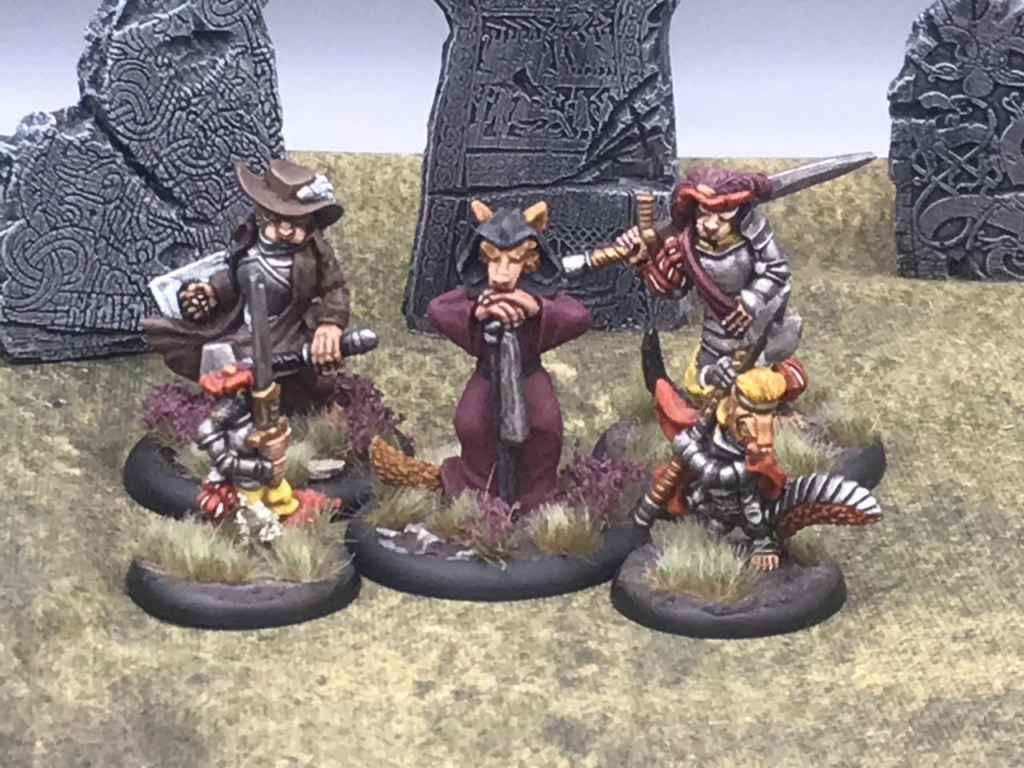
Warband wise I think the models are fantastic. They provide a great starting point of instantly recognisable beasts, guaranteed to make even the loyalist Royalist a little nervous that their name might be on the top of a suspect list.
The wider range provides some great options to build out some characterful warbands, whether it’s adding a local scout to show them the location of their current most wanted, town watch to provide a bit of extra muscle, or a baying mob of locals keen to burn something down. There are loads of great options to create warbands with a strong narrative feel.
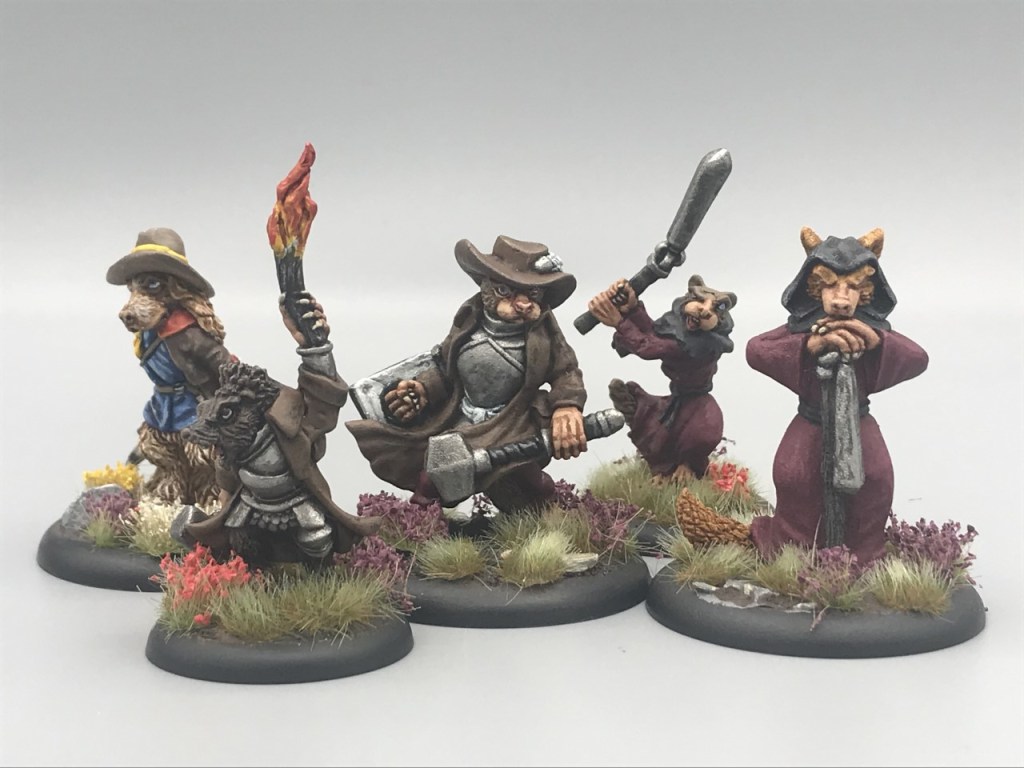
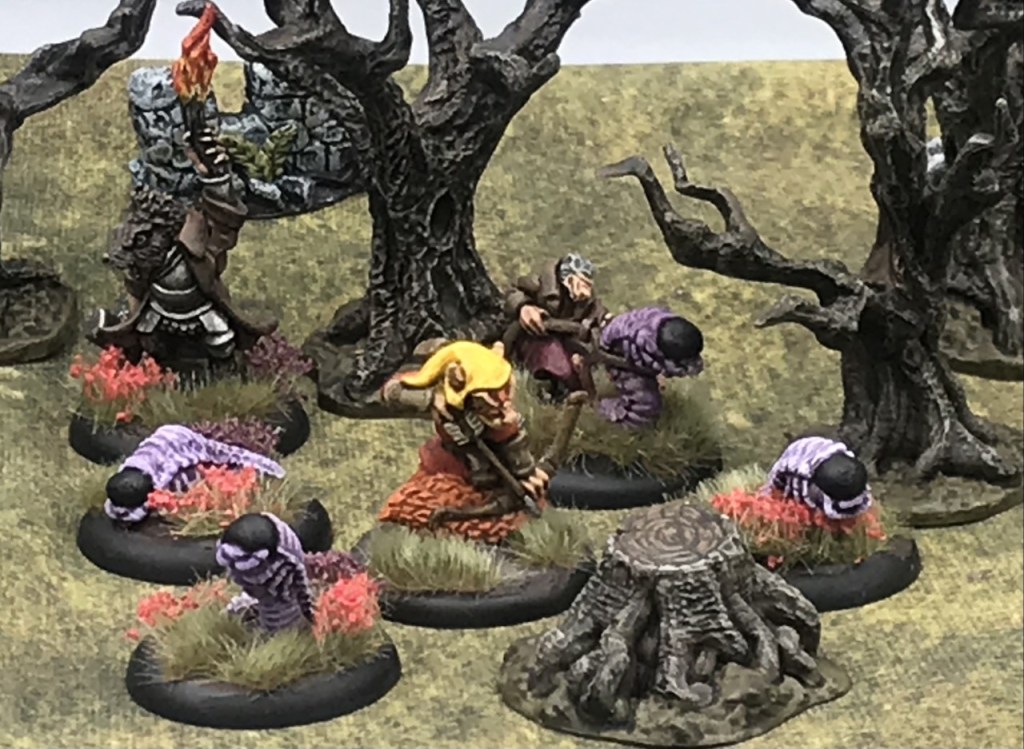
From left to right… Something’s up at Mrs. Miggins place, local watch show visiting dignitaries sights of interest, release the grubs.
Faction rules
Rules wise this faction is quite different from the initial four. There is a free characteristic upgrade for Fortitude for up to three characters. Whilst this isn’t the stat that probably jumps to mind as the most useful, it does provide some characterful support against some magic spells and gives a bit more staying power when the route roll offs come around (I always see witch hunters as being very determined and dogmatic, so a little extra stoicism is always welcome). The Fortitude increase also helps activate the ‘definitely not magic’ Divine Might powers which, as previously stated, are definitely not magic. A bit more on those later.
The additional core faction rules are optional paid for upgrades. The first of these is the Malleus Maleficiarum (The Hammer of the Witches), originally a book published in 1486, which takes on a much more literal interpretation in Northymbria. It’s a weapon upgrade for the warband leader which increases the damage of a normal weapon when hitting undead and magic users. It’s a nice touch thematically and the damage increase against magic users gives the boss a buff against living warbands as well (albeit the magic users amongst them).
The warband also has the option to give two of its members Critter Boss, a new skill that allows the warband to recruit Stag Beetle grubs (a Northymbrian stand in for hounds). There are three different types of grubs that bring different skills to the warband. It’s a great differentiator and allows warband access to some relatively cheap beasts (made cheaper by not needing equipment) with useful skills. There is the added benefit that if the character with the Critter Boss skill dies the grubs become berserkers, which not surprisingly drops the priority of the character with that skill on the enemies’ ‘To Kill List’ pretty rapidly.
Finally, there is Divine Might, righteous powers that augment these warriors of god (gods?) in a mystical, but totally unmagical way. These function in a similar way to magic and target rolls use Fortitude, but there is a key difference – there is no weak or delicate offset (although armour still restricts use). Understandably this makes these powers a little more expensive than spells, but it opens up a number of different ways to build and use the faction’s ‘not spell casters’ which I’m having fun exploring. These powers are a mixture of roll off buffs and anti undead/magic user options so its worth giving a thought to what you’re likely to be facing out there, because if you’re not facing necromancers once the two spell mouse magician is dead you could have quite a few redundant tools rusting in the box.
The verdict
It’s early days, but I’m really enjoying the faction and I can see loads of potential for different types of builds. I was initially worried that the warband rules might overly focus on smashing the undead, leaving the warband with a bit less in the tank when fighting mortal beasts, particularly those warbands who don’t have the courteously to include a magic user. But I don’t think that’s the case.
Whilst its fair to say there are some Divine Might powers and the Malleus Maleficiarum that will pack more punch against certain foes than others there is plenty to explore and the fact that most (pretty sure all) anti undead magic also affects magic users means there will generally be targets for them amongst the original four warbands.
The most interesting thing for me has been considering what skills I pick for my leader and second, and who gets Divine Might and the Critter Boss options. It’s worth remembering that additional skills cost valuable pennies, so you can find characters quickly building in cost.
I’ve decided to have a go at picking skills that give me a better chance of picking my fights. Fighting the undead currently is all about taking out any character with the Invocation spell – the extra bodies it allows the necromantic faction to bring to the table is seriously disruptive so stopping these creatures early is important. To that end I’ve chosen Burst of Speed for my leader to give him loads of reach.
My second has Slippery. Not only does this allow him to move from fight to fight at will, but as I have given him some Divine Might it means he can also exit a combat and cast if this looks like the better option. In both cases these characters are tooled up to allow them to pick, or support the right fight. That being said I’m taking a bit of time working out what the ‘right’ fight is!
I’m also having a go with a mouse critter boss, and three grubs, who also has some Divine Might – the theory is that because people are less inclined to target him whilst the grubs are still on the table he is free to buff characters in a ‘not magical way’ and so far this is working.
Moving forward I see lots of scope to try out skills that I wouldn’t have previously considered, like Paladin and Critter Master. So far, I’ve only scratched the surface of these reasonably maligned critters, and I’m really looking forward to seeing what else they have to offer.
Work, rest and play.
How is my warband shaping up?
Being honest, two games into the current campaign, and its not looking good! Their first game was against the first iteration of the undead list (very scary) which saw all but the leader and a grub go out of action. One grub died, my mouse picked up a niggling injury and the weasel had to miss the next game. Fortunately, I made enough pennies to replace the dead grub.
In the second game I faced off against a Wild Beast band with no magic users (no benefits from the Malleus Maleficiarum) and was one beast down! Not surprisingly that didn’t go well. Fortunately, the permanent injury table was ‘kind’. The Fox is now Fearsome, but there wasn’t enough food to feed everyone one, so I’m going into the next game on the back foot, and that’s if the mouse manages to make it! On the plus side though, if I lose the next game at least there is the promise of a sympathetic Freelance to look forward too. What can go wrong?
Its finally happening… the UK is slowly being released. Actual physical gaming is once again on the table, as it were. After so many months locked away from the Covid it is great to be meeting with friends and getting the dice rolling once again.
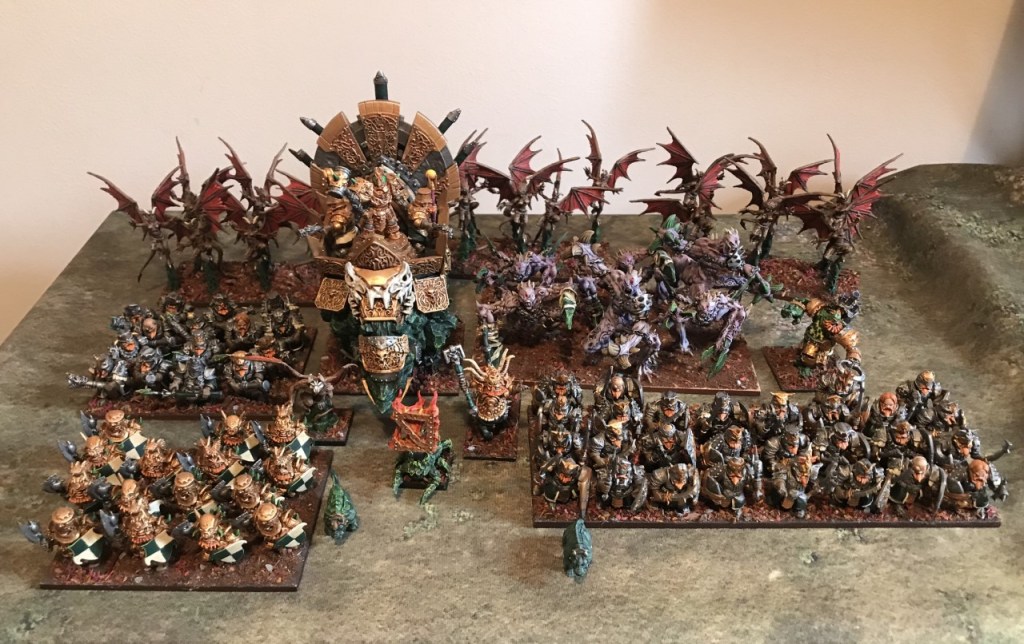
With my local club opening its doors last Sunday I’ve already managed to get a game in, and it couldn’t have come soon enough as my enthusiasm for painting rats has been on the wane. Hence, it’s been a while since my last update on how the Manticisation of my rat hordes is going. I had hoped to combine the next update (this one) with a bit of a battle report, but aside from some of the lovely big resins and characters I haven’t been keeping up with the rank and file which means unlocking units are a bit thin on the ground.
On the plus side I have now completed all the new individuals, and what a lovely bunch they are. Mantic have done a great job with these and I’m keeping my fingers crossed that there may be some mounted characters in the pipeline. Not only are they useful on the table, but I also have a bit of Goblin envy, which is not a good look.
Mantic have created a great selection of individuals.
The call of the dice
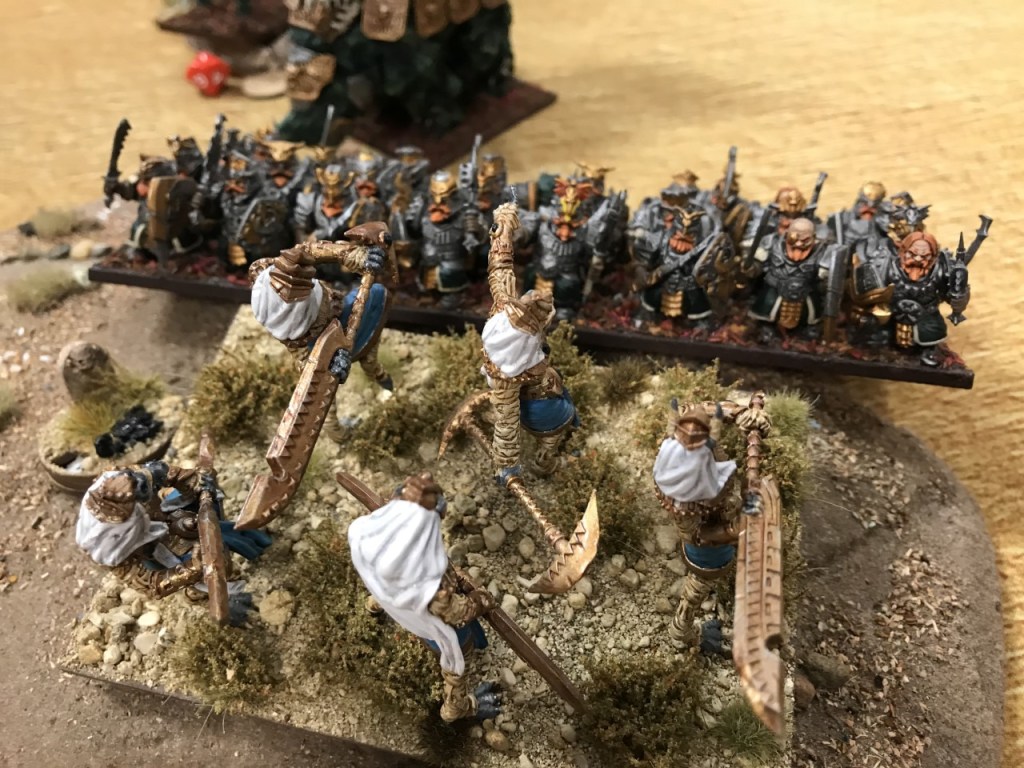
My lack progress on unlocking units for my rats was good news for my first lockdown project, my Abyssal Dwarfs, giving them a chance at an outing. It was great to get them on the table against the Lazy Pirate, Steve Evans, and his fantastic Empire of Dust force. As a first game it was hugely enjoyable. My fluffy Abyssal Dwarf army (no Golems, no mortars), combined with Aura of New Army (all units receive -1 to hit, -1 to wound, defence 2 and nerve 3/5), against a nice crunchy solid grind list featuring the Idol of Shobik and the Soul Snare ended in a largely expected loss (admittedly far greater than expected).
Win or lose, its great to be back on the table.
And what a loss it was, not only was I tabled without Steve losing a single unit. But thanks to the Soul Snare I believe the undead were pretty much back to full health by the time my final figure (the Hexcaster) left the table. Of course, a bit of post-game reflection highlighted just how many fundamental mistakes its possible to make in a single game. The highlights (lowlights?) include: forgetting Shobik is shambling, forgetting that units that kill an individual can over run into units behind them, putting the Helfane in the wrong place, sending Ba’su’su off without any real purpose, bringing 305 points less than my opponent to the table… yes dear reader 305 (so glad army lists get checked before tournaments). But none of these things are to be dwelt on, because for the first time in many months a game was actually played and, most importantly, I have my mojo back.
The first 2K
Getting back to gaming has got my enthusiasm for rats back, and in the last few days there has been serious progress. In order, to get some unlocks I’ve focused on finishing a second warrior regiment and rebasing some Tunnel Runners. Whilst its not exactly what I want to take to Clash of Kings it means I now have 2,000 points available to start getting some games in, and my focus is back. Happy days.
If you’ve made it this far why not give the post a like, or follow the blog.
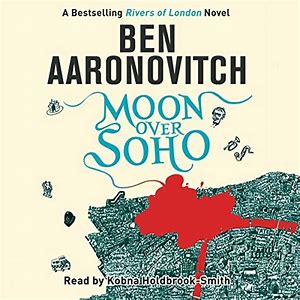
The follow up to Rivers of London, a murder mystery set within the mythic and modern city of London.
Who’s the writer?
Ben Aaronovitch is a London author whose early career in screen writing saw him write for Doctor Who and Casualty.
What’s it about?
PC Peter Grant is now a year into his wizard training. Whilst London seems to have put the explosive climax of Rivers of London behind it, the scars remain very real for Peter and his closest colleagues, but there is no letting up.
A number of seemingly natural deaths amongst jazz musicians kicks off an investigation that brings Peter’s personal and professional lives awkwardly close.
Is it any good?
Loved it.
This is a great second instalment that moves the story on beautifully. Aaronovitch delivers yet more fantasy, thrills and humour with a side serving of jazz and careful observation. London continues to be a powerful influence on the story, and as you might expect the majority of the action takes place in Soho.
The relationship between Grant and his Master, and commanding officer, also moves forward. This is an interesting dynamic that allows Aarnovitch to explore a number of important themes such as race and policing, important to both the main characters and the city of London. All in all this is a great second instalment.
I now have a bit of quandary – book number three or try something different?
It’s slightly unnerving that even without the joy of regular gaming the first few months of 2021 have already disappeared. However, the upside to this, certainly for those in the UK, is that there is the scent of gaming in the air as we move towards a bit of a relaxation of lockdown (first game organised, list chosen and army painted).
Despite the scarcity of games the mini producers, games designers and content creators have delivered some fantastic stuff for our continued delight. So I thought I would pull together a few of those things that have brought a smile to my face over the last couple of months, or will keep me smiling in the coming months.
Halflings have arrived in Oathmark – March saw the release of the unofficial army list written by Joseph McCullough. It’s limited by the standards of what’s available to other races so no linebreakers or cavalry, but they have their own characters and spell list. There are also a range of metal miniatures that have been added to the Oathmark section of the Northstar website to support it.
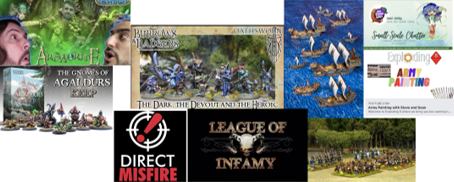
Burrows and Badgers Kickstarter – After, it’s fair to say, quite a bit of teasing The Dark, The Devout and The Heroic has landed. This is BnB’s latest Kickstarter which brings with it, not only another influx of anthropomorphic awesomeness, but also two new factions with the undead pawing their way out of the ground and the Witch Hunters intent on crushing their bones. Although it’s now closed, it’s scheduled to land in June so it shouldn’t be long before the these awesome models reach the Oathsworn webstore and the table. New rules are also on their way to support the factions, so I’m sure I’ll be having a look at these a bit more in due course.
Northumbrian Tin Soldier Kickstarter due in – The Gnomes are growing, in presence rather than size, with The Gnomes of Agaldur’s Keep. This typically fun faction went up on Kickstarter at the end of last year. I’m looking forward to it arriving in April as I’m have a number of the models earmarked for my Saga: Age of Magic force.
The League has finally arrived – Back in 2019 Mantic’s dungeon crawler with a twist went up on Kickstarter. Unfortunately, there was a bit of a delay in the delivery of this one due to Covid, so a little over schedule it has now arrived. Hats off to Mantic for the way they managed this one. I can imagine there were more than a few premature grey hairs grown in Mantic Towers, but they did a great job of keeping in contact and explaining what was going on. Well managed guys. And by the way, if you aren’t aware of this game, the twist is that the playable characters in the game are all villains. So whilst this is a co-op, messing with you’re fellow adventurers is not just encouraged, its written into the rules. I’ve managed a couple of games so far and am really enjoying it.
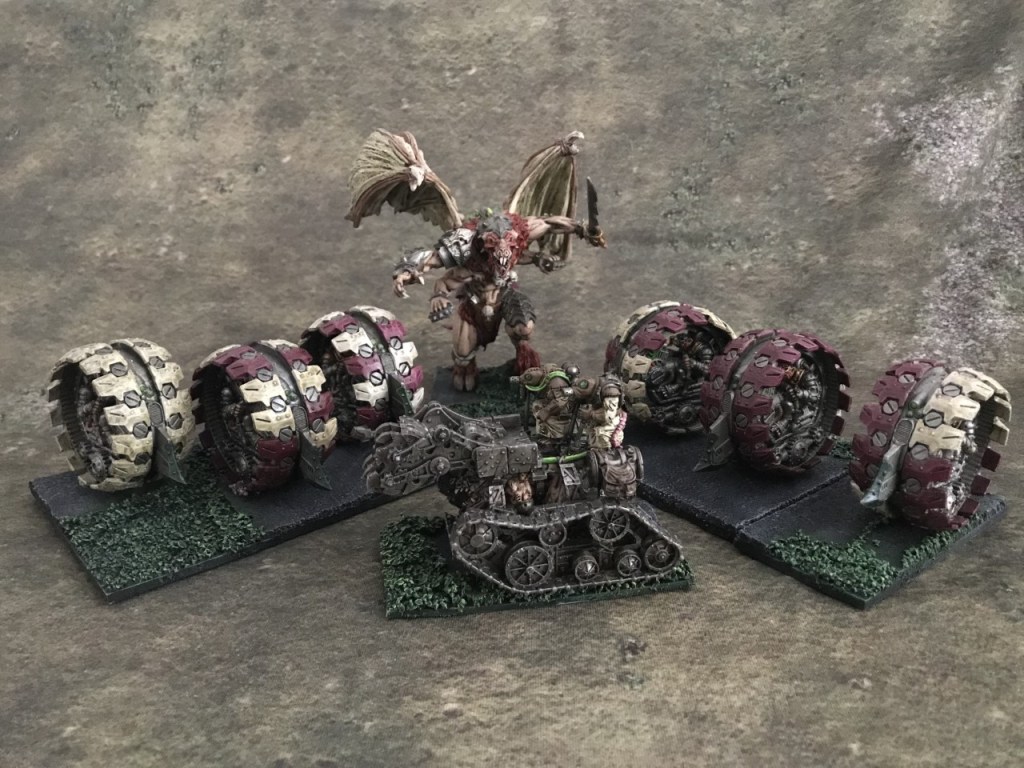
Mantic rats and tiny undead ships – If you’ve looked at this blog over the past three months you’ll be aware Mantic are now doing their own Ratkin range for Vanguard and Kings of War. Mantic have worked up a pretty solid formula for army releases with a plastic set to cover off the core troops and resin sculpts to cover off the special units and characters. I loved their Abyssal Dwarf range that was released last year, and the rats build comfortably on that success with some beautiful resin miniatures. The first wave is now out, with a second wave out towards the end of April. Mantic have mentioned in podcasts that everything in the army lists will be represented, and it almost is. I’m hoping there will be a final wave after the next to cover off the handful of mounted characters not yet supported, especially given how great the mounted Goblin characters are (surely it’s not right to be envious of a Goblin?).
In addition, the Empire of Dust has taken to the water with their very own range of ships for Armada. Whilst I’m not a big fan of ship games Armada has been really well received, and visually this is my favourite faction so far.
Something to listen to
I’ve been flitting between various podcasts and Youtube channels (as you do) and thought I would share some of my highlights:
The Andy and Rem Show – Traditionally an Age of Sigmar show, the boys have been exploring other fantasy games and inviting some interesting guests on. Recently they had the founder of Warploque miniatures on to talk about his journey in the industry and show case some of his fab Arcworlde minis.
Exploding 8’s Steve and Sean – In their most recent episode the guys have been talking about painting armies. As someone who loves rank and flank games, but is not a fan of the painting required to get these armies on the table, this is a great overview of some ideas and approaches to getting large to-paint-piles battle ready. Both are seasoned gamers and painters, Steve has around 17 completed Kings of War armies (I say around because the number just keeps going up), so bring some valuable insights to the topic.
Small Scale Chatter – A new podcast on the scene with Anjuli Smith, aka GeekGirlBookWorm off of Twitter, talking to various guests from within the miniatures community. The first episode kicked off with Annie from Bad Squiddo in the hot seat talking about her community miniature development project which I found fascinating. Great energy and I look forward to more.
Direct Misfire – After a bit of a hiatus the guys are back with some general Kings of War hobby chat, a review of an event in Australia (yes they are still allowed them over there) and their awesome theme tune to warm up your ears.
So that’s a brief round up of what’s been keeping me sane. If you’ve got this far why not follow the blog, click the like button thing, or you can follow me on Twitter Eddie Bar@EddieBe77 for the same sort of stuff, just much smaller and bit more regular.
































 The Wizard's Bookshelf