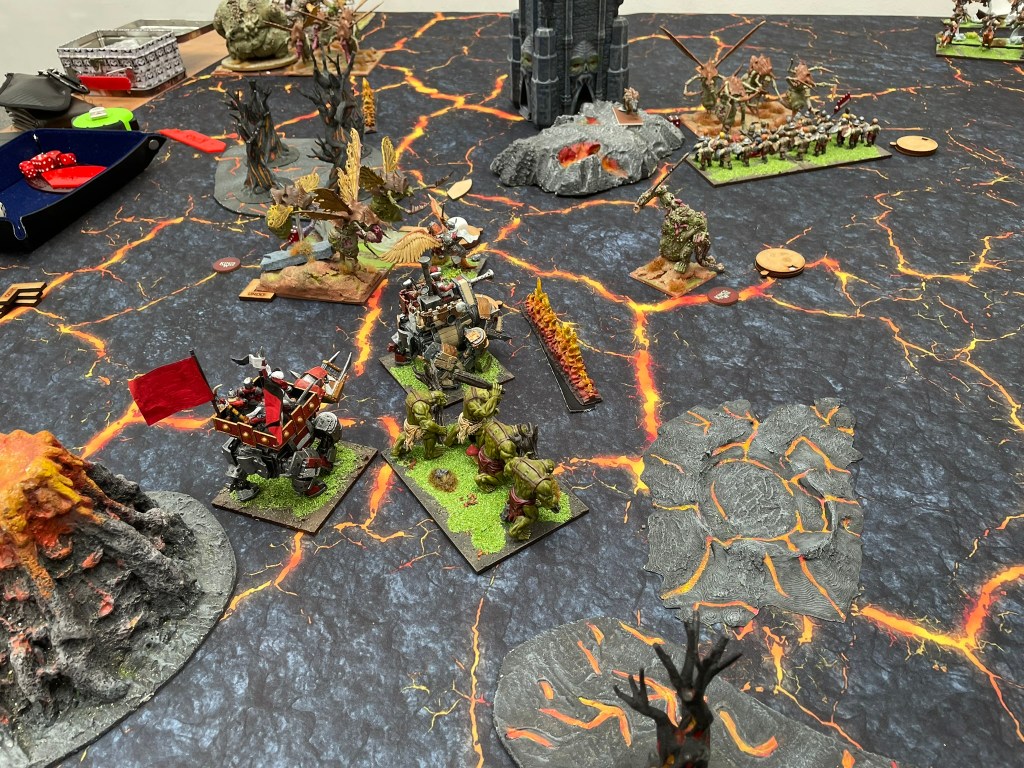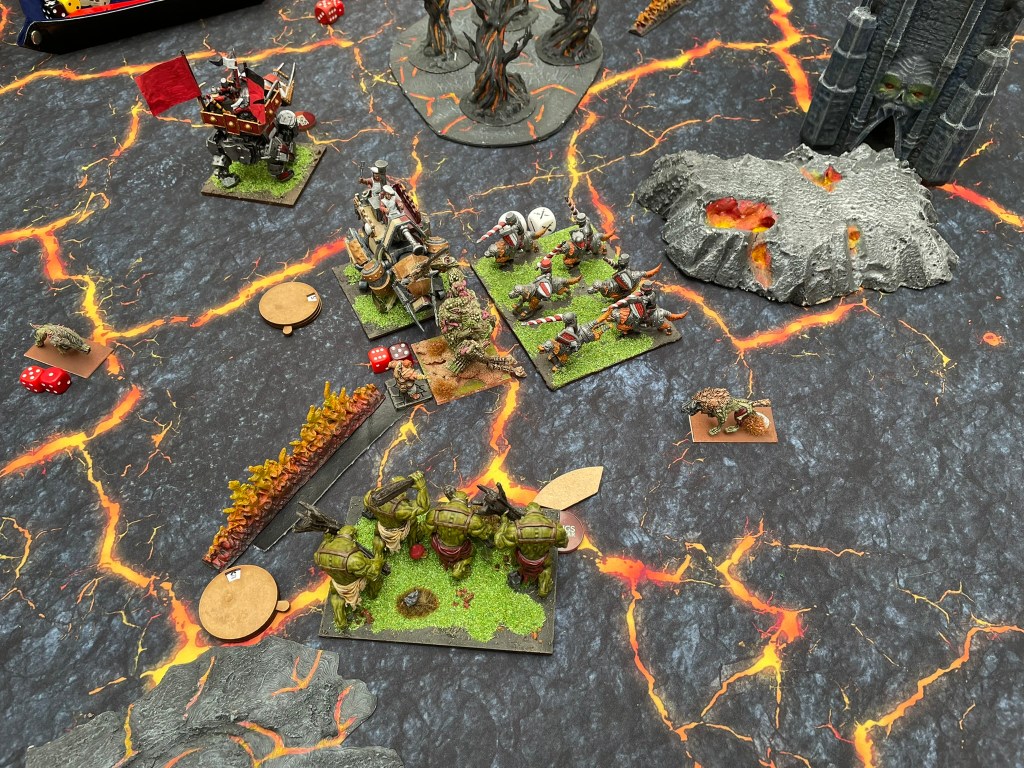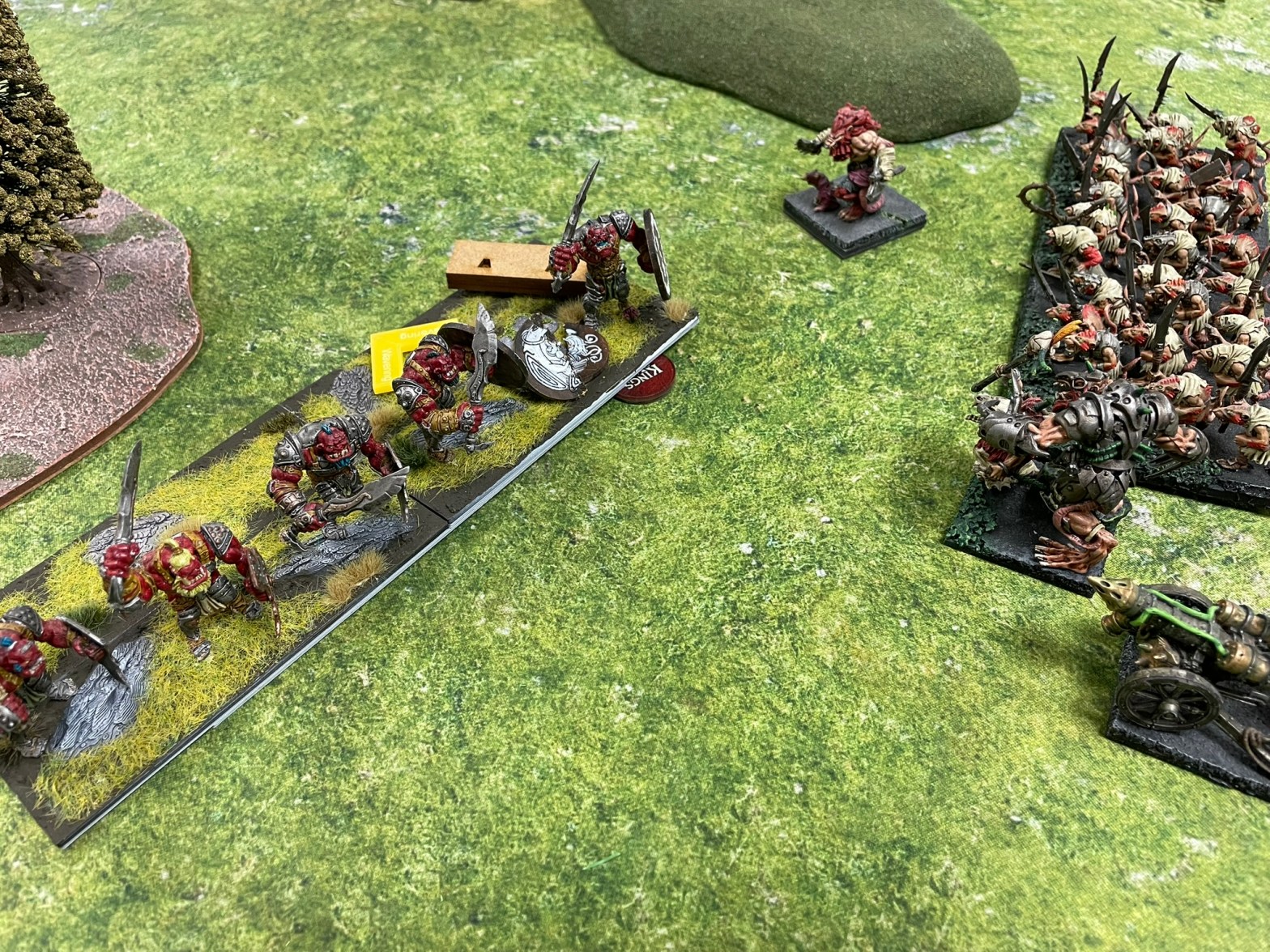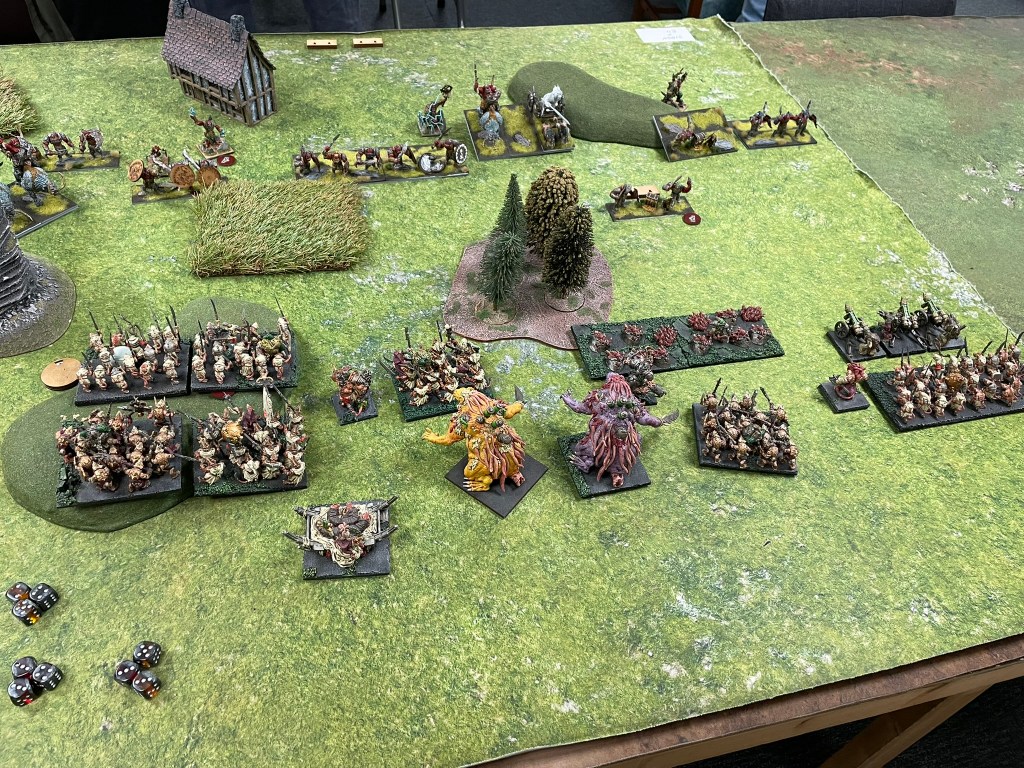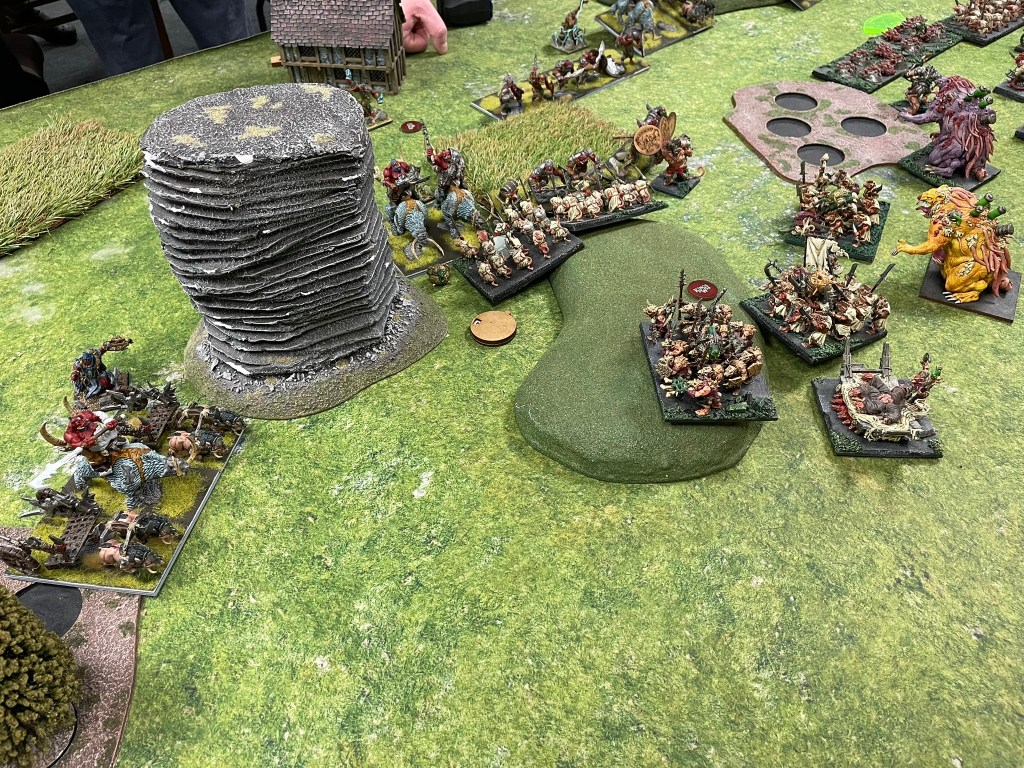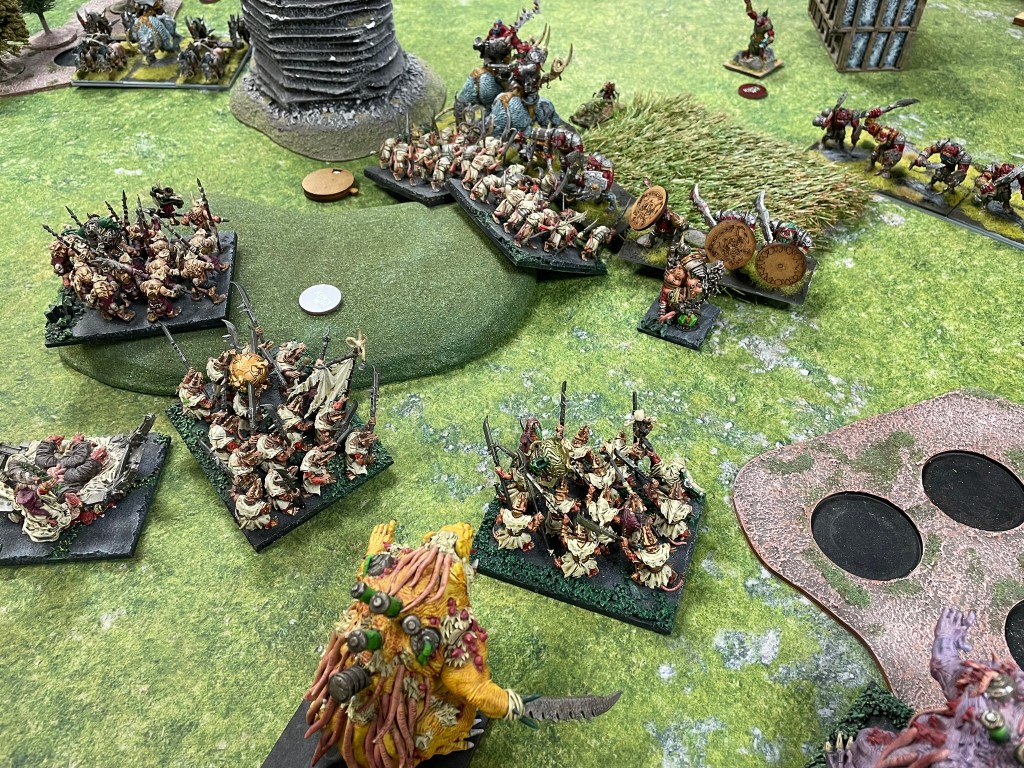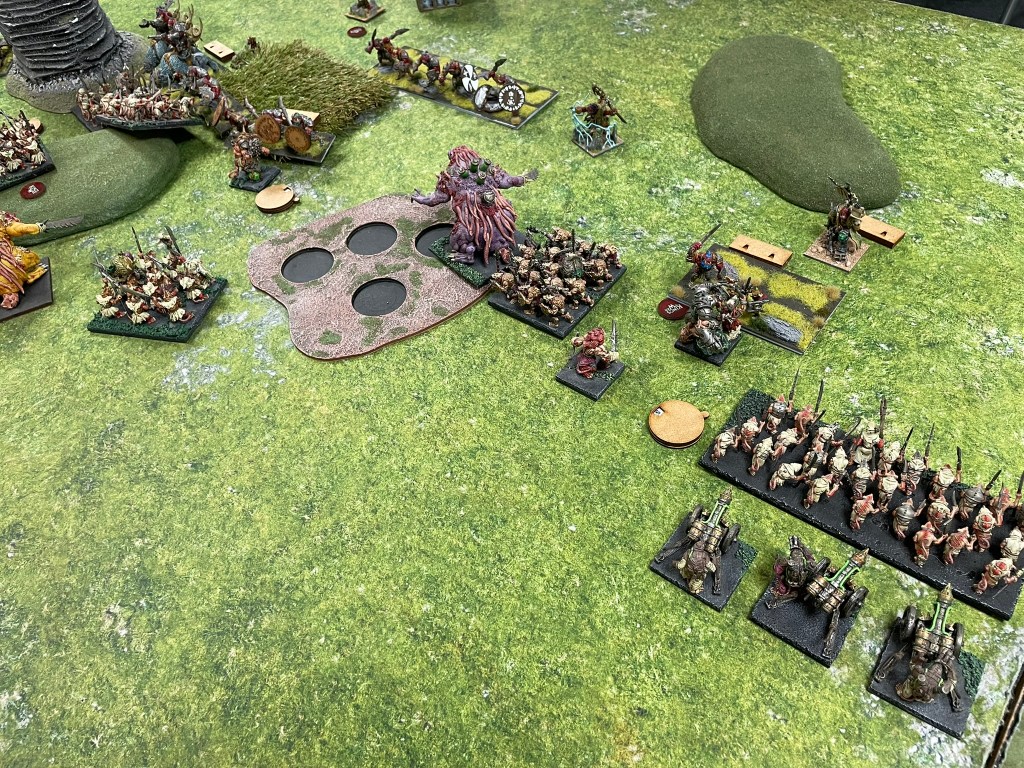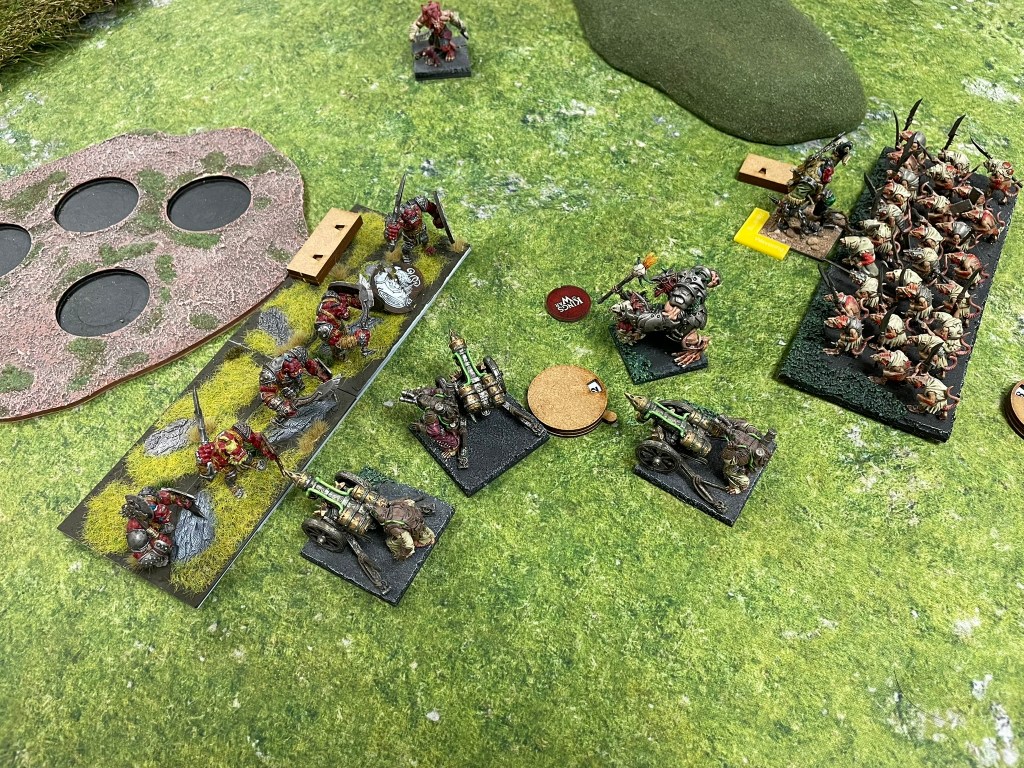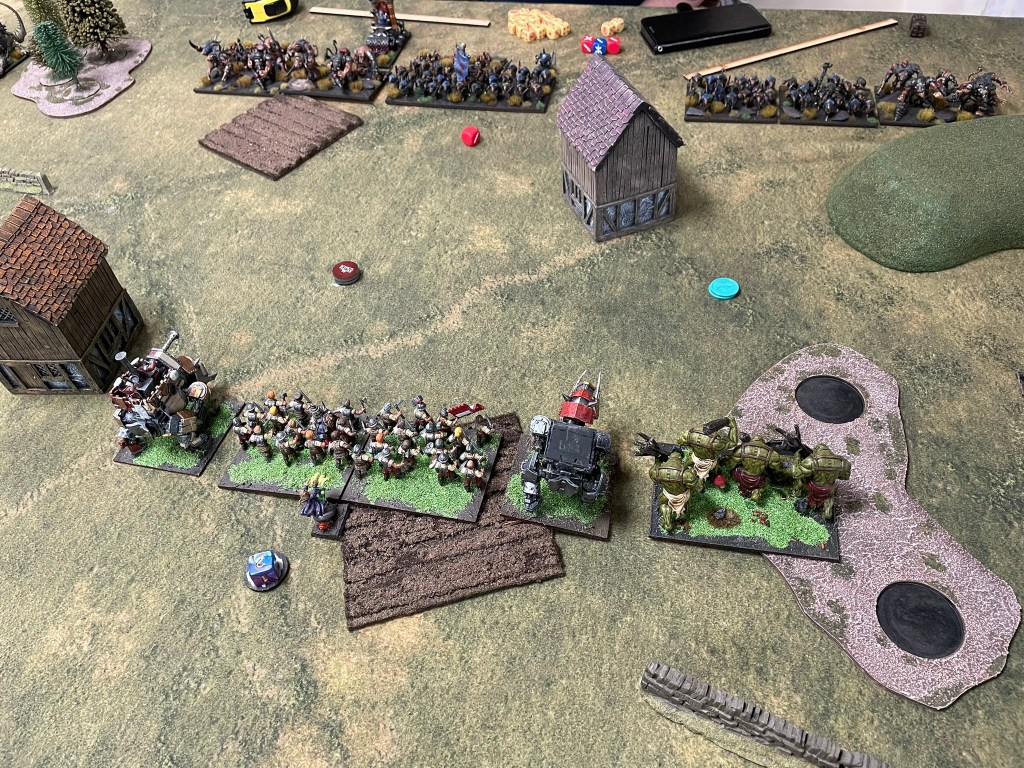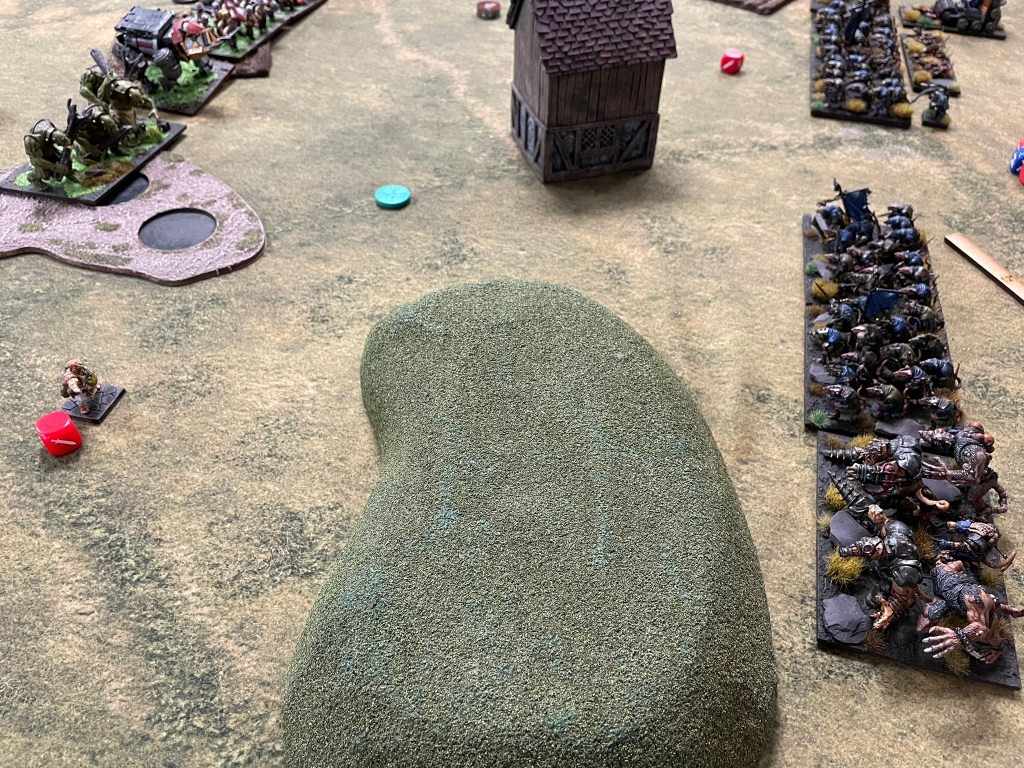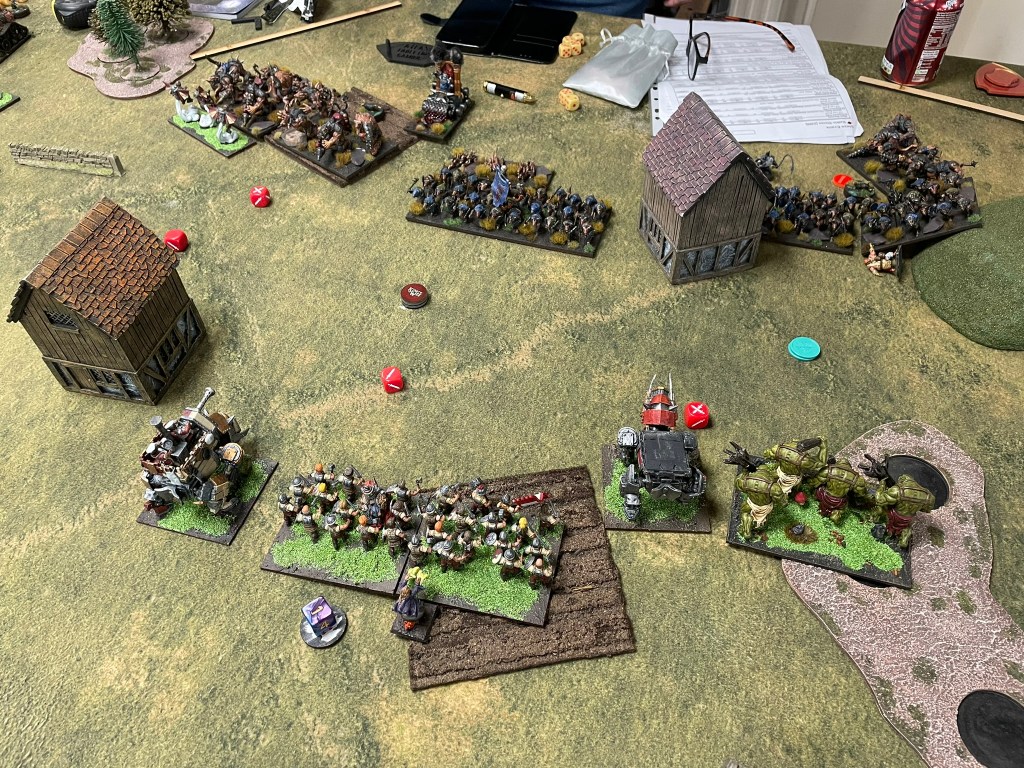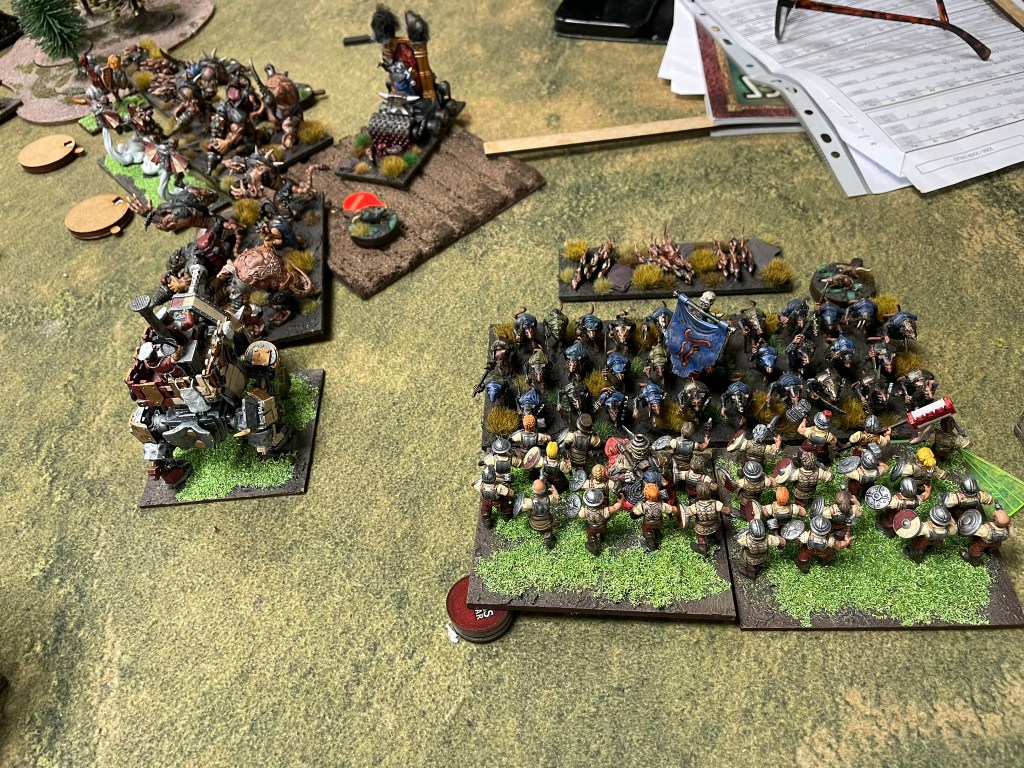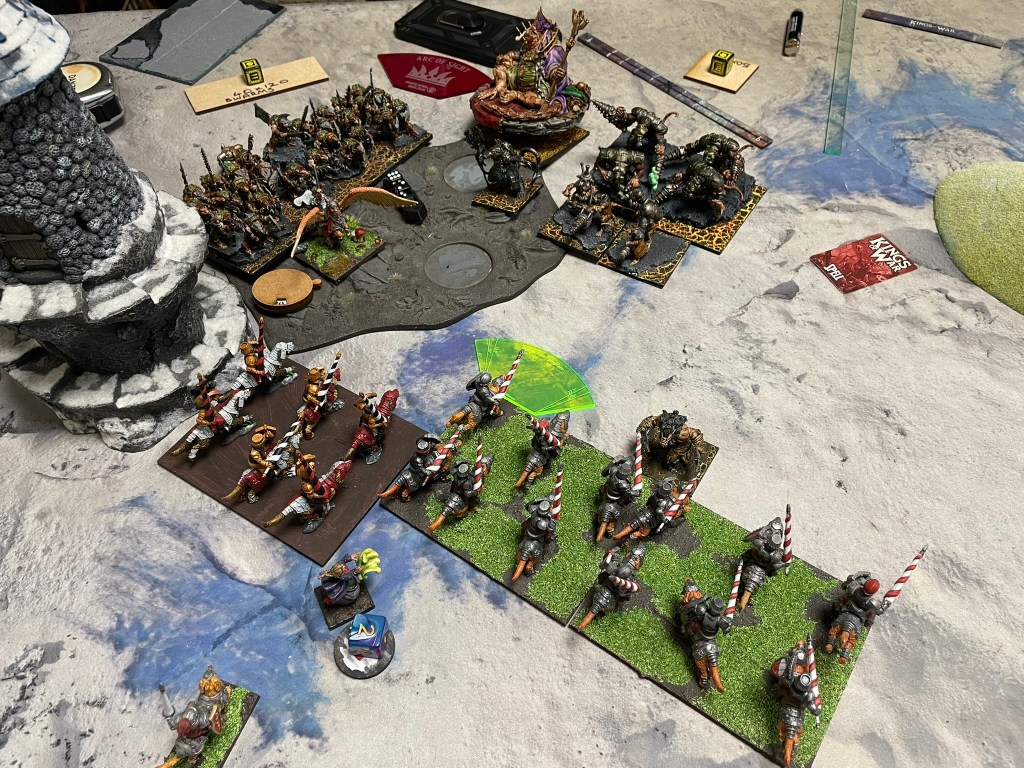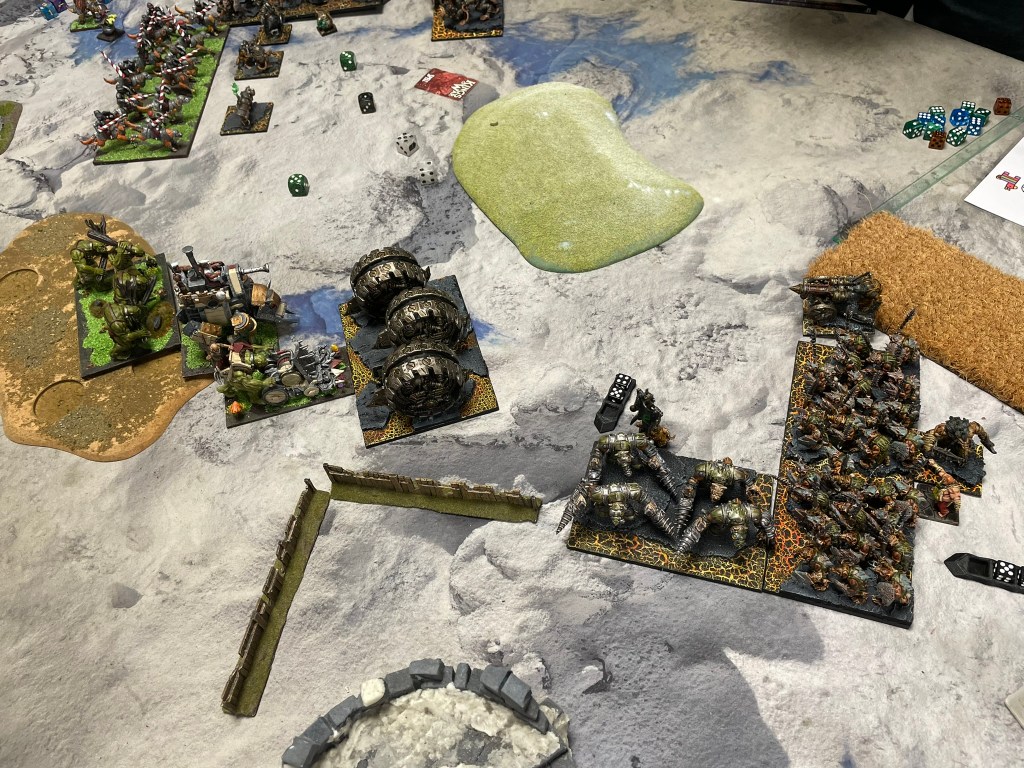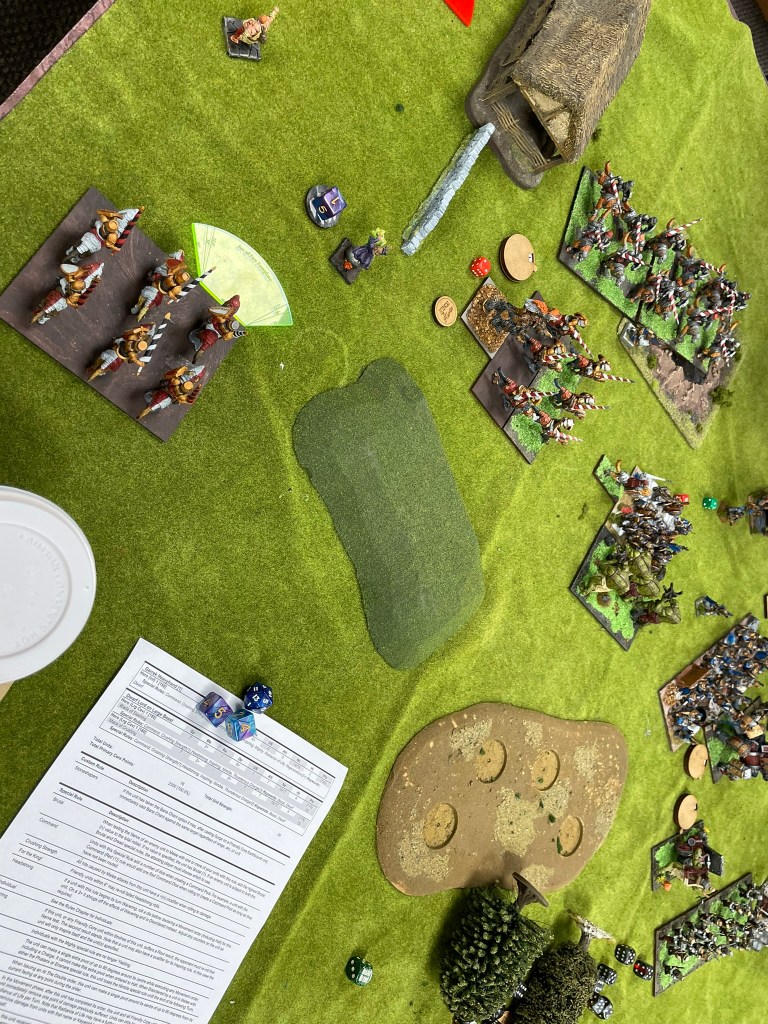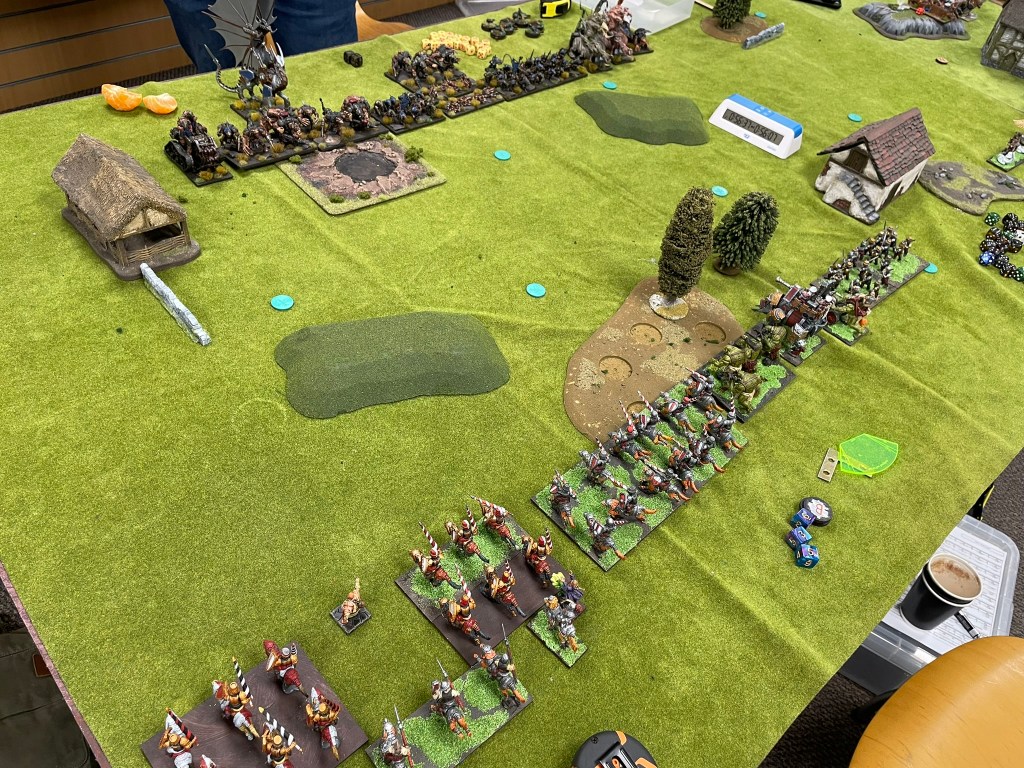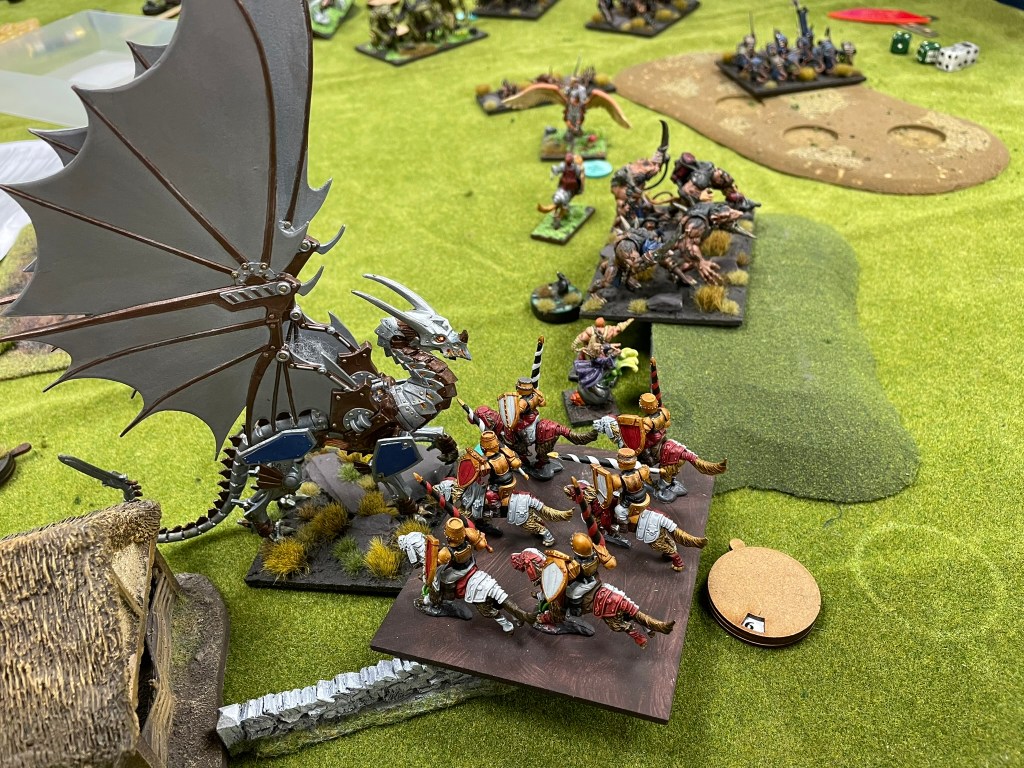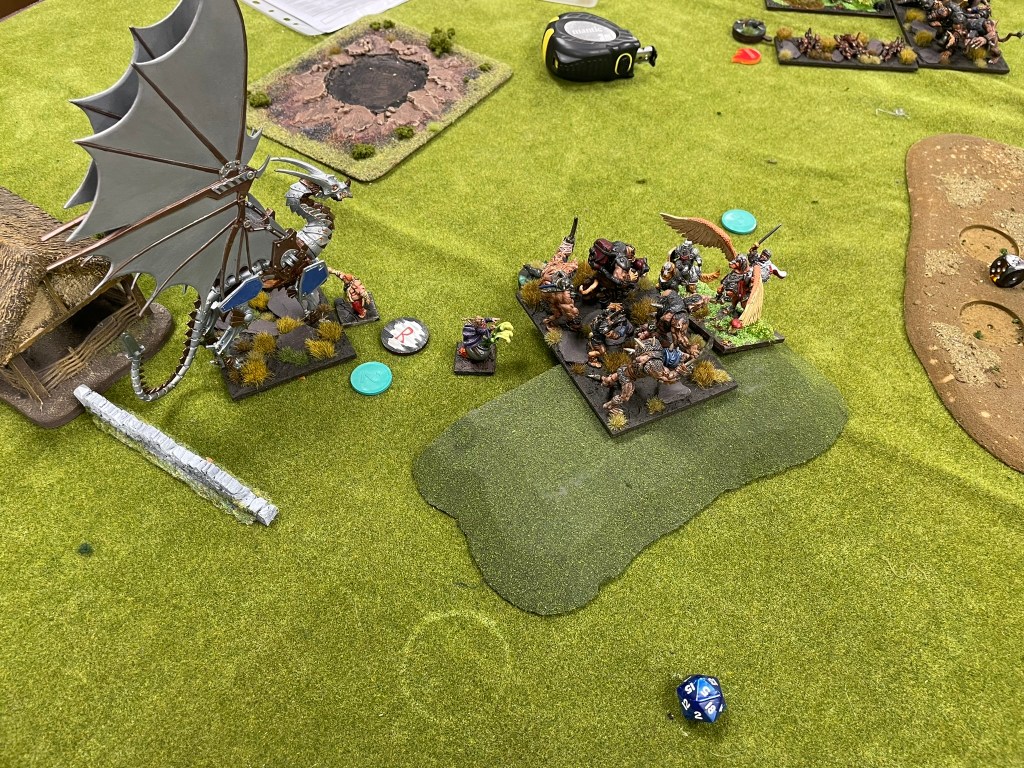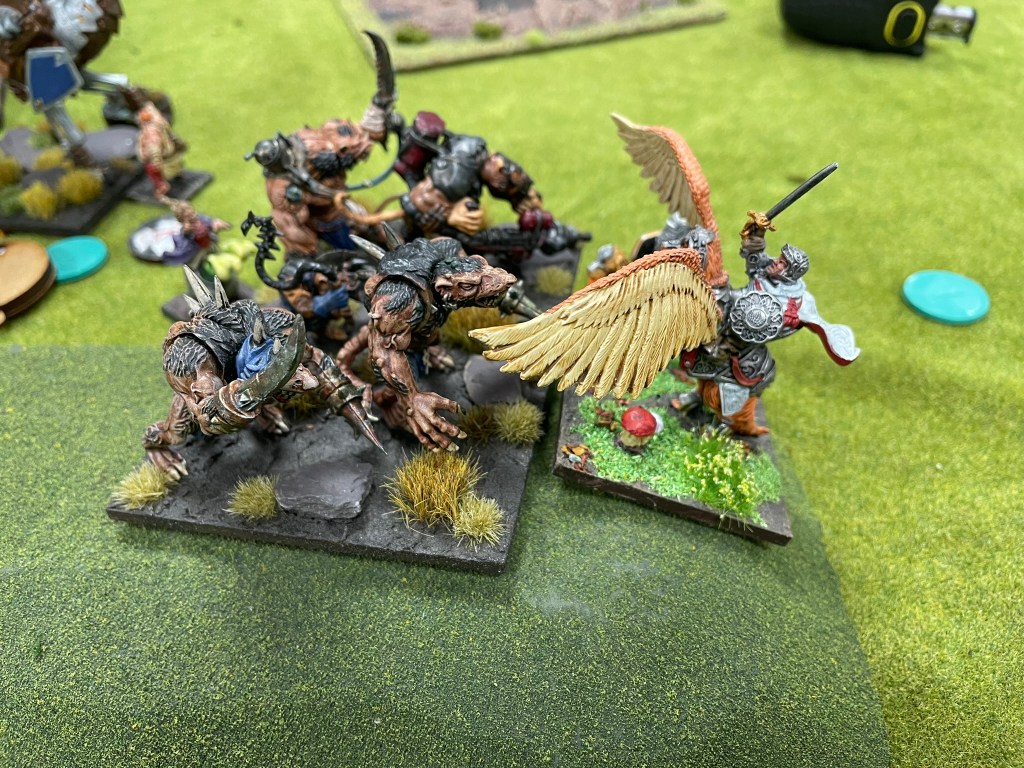
The New Moon was a few weeks ago and that means I’ve had time to reflect on any changes I want to make. A couple of things have happened since that event. I’ve had a bit of time to think about how much my final position was the fault of my army selection over my use of it. I’ve played another couple of games and halflings won the UK Masters (not mine for avoidance of doubt).
Whilst I don’t have any particular aspirations to make it to the Masters, I do like to see what better placing players do with the armies I play to see if there any lessons to be learnt. For what it’s worth I really liked Radek’s list. It’s one of those lists that just doesn’t look particularly tough and pulls together some of my favourite units, such as Wild Lancers, multiple Iron Beasts and Greedyguts. It’s the sort of list I’d love to be able to play well but know I wouldn’t!
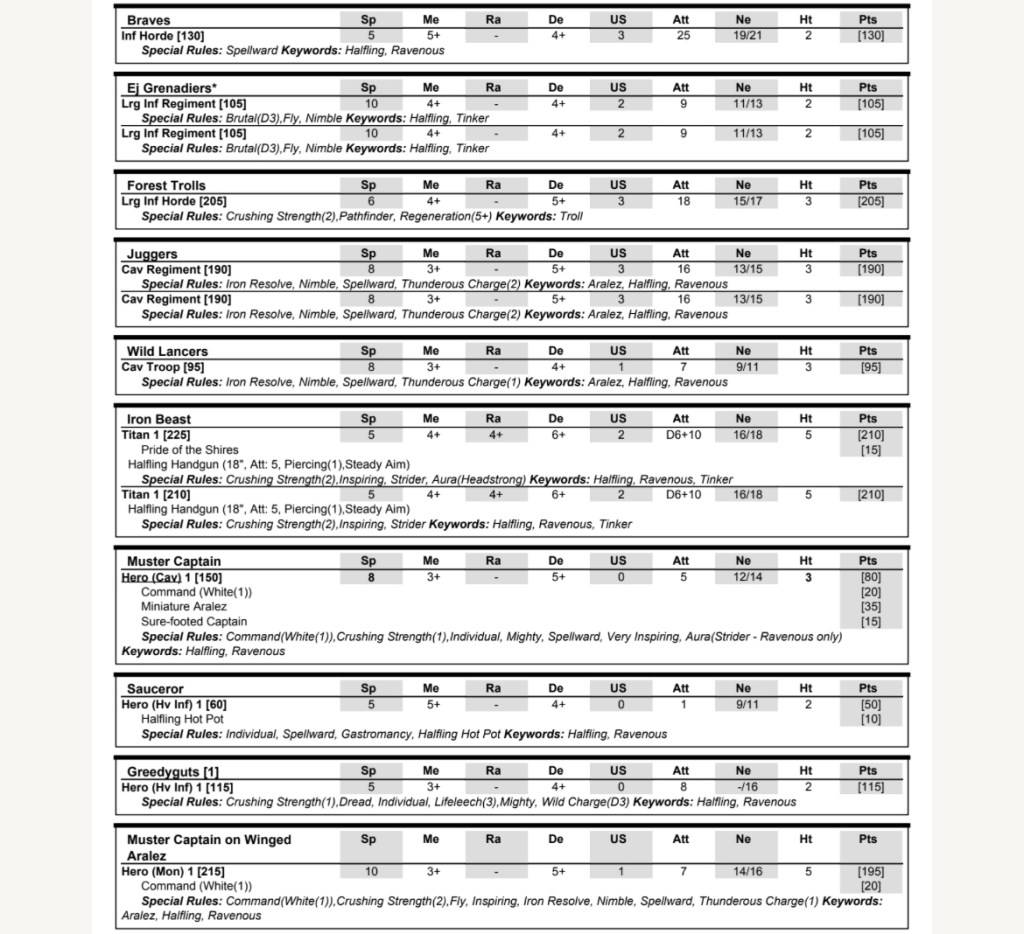
What was of particular interest to me was the inclusion of one sauceror with a hot pot and Greedyguts. Since I first started playing halflings I’ve always used Gastromancy and always brought two saucerors to the table. By its very nature Gastromancy is fickle. I’ve heard it described as a trap (i.e. not worth the points), but I’ve never signed up to that particular view, but I have increasingly questioned just what the right number of saucerors should be.
I tend to get seduced by Gastromancy in its more aggressive forms, brutal and wild charge, but throughout the New Moon there were too many times when the better choice for a number of turns would have been lifeleech or rally. My rationale for this is that halflings aren’t super killy, so my experience has been that even when brutal 3 is in play it often gets wasted as the fighters just can’t deliver. On that basis you might as well just throw some rally up and wait for the counterpunch. I further frustrate my forces by putting one of my saucerors on an aralez, and I’ve slowly come around to realising that much mobility isn’t necessarily needed. So, taking Radek Bry’s example I’ve played a couple of games with just one unmounted sauceror with a hotpot. It definitely felt more proportionate. The hotpot has been great at levelling out the uncertainty of Gastromancy, and whilst I have had to put a bit more thought into where I place the sauceror and how they move it definitely seems the resource spent on Gastromancy is now more appropriate.
That means I have some extra points to spend. Happily, I’ve made two further changes which have shaved a few more points from the list. Whilst I think the Heroes of Hoedenberg is a great update I just didn’t find it was really used in my games. I’m not expecting my Stalwarts to kill things, they are a roadblock, so elite isn’t adding much, and the Iron Beast is generally quite close to them, so the inspiring isn’t needed either. Finally, the shooty trolls just haven’t really used their guns, so they’ve been changed to regular forest trolls (which we all know are the best types of trolls). All in all, these savings add up to about 115 points, which is the exact cost of a Greedyguts.
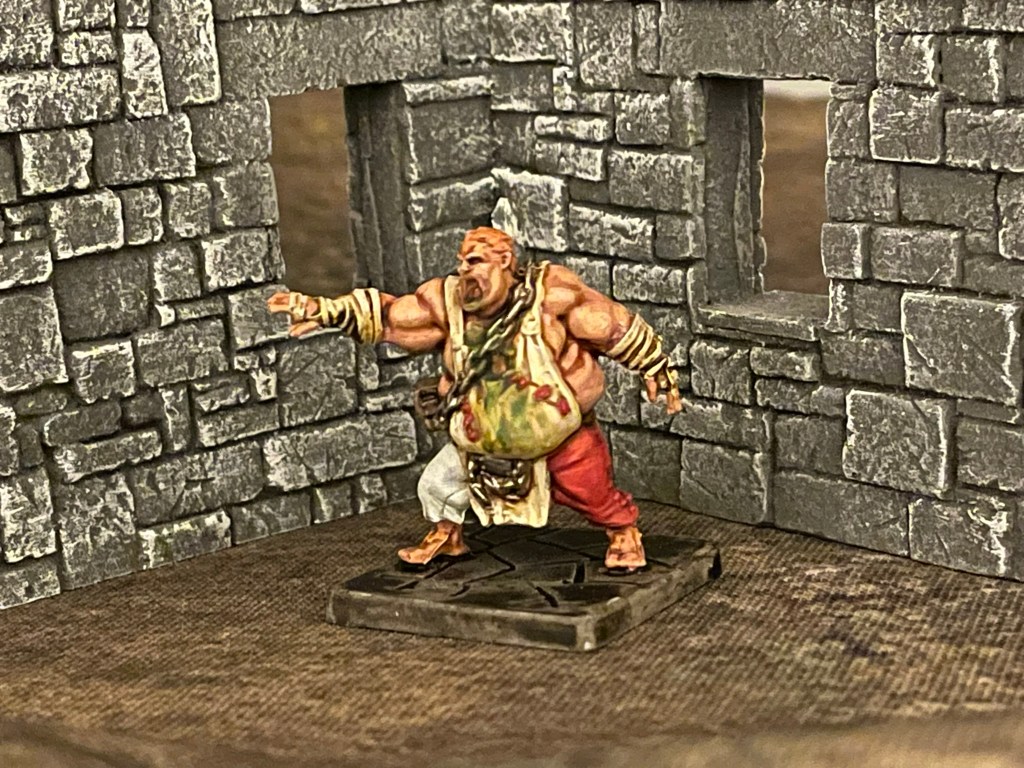
I’ve always loved his rules, but the defence 4 made me nervous. I think this is more because I thought his stats were not dissimilar to a Mutant Rat Fiend, and that little beastie has a habit of disappearing from the table very quickly if you aren’t careful. Having played against Big G though and seeing him in Radek’s list definitely made me want to give him a try. Fortunately, the model is a delight to paint up, which is always nice.
So far, I’ve run him out twice and he’s done brilliantly. I still have my reservations but there is nothing more satisfying than watching him munch his way through one thing after another. Clearly, whilst there are some similarities between the Fiend and Big G more fundamental differences around movement and points cost make Big G a very different prospect. I’m really looking forward to seeing just what he can do once I’ve got a bit more practice in with him.
Aswell as messing around with the list I’ve also ordered a few extra basing bits. The army is a work in progress in a number of ways and I wouldn’t call any of its units completed at the moment, but I’m hoping to share some complete units soon.
Have a great week peeps, and if you don’t want to miss out on any future posts pop your email address below.
I hope this letter finds you well. It’s been a bit of a trek getting here, and I’m not entirely sure it’s quite all Grandgnome Grabdistuff said it would be. I’m wondering if we took a wrong turn somewhere and he doesn’t want to admit it, you know how he can be. It’s a lot colder than I was expecting, you were right I should have packed the jerkin with the furry lining.
It’s also a bit weirder than I was expecting. I mean we’ve all heard stories of Grabdistuff’s journeys before, and I know everyone in the village says he wears his pointy hat the wrong way up, so to speak, but I’m starting to wonder if there’s a bit more substance to them than a pint of mushroom cider and that funny smelling tobacco. I mean, it turns out that he is best friends with a talking squirrel and does literally ride around on a talking toadstool…
…and then there’s the bears. Up here the bears are a bit different. Last Thursday Grabdistuff introduced me to Theodore Phuqspin, the newest addition to our party. Apparently, he’s a very experienced treasure hunter. You wouldn’t think it to look at him though as he looks suspiciously like a teddy bear, although he says things sometimes that you would hope no teddy bear would actually say, especially if there are children around… the big bears up here also have their own way of doing things. Not only do they do the thing Papi says they do in the woods everywhere but the woods, but they also carry massive swords and axes, and if there is something I am now more certain of than anything else in my life, it is that an angry bear should not have access to an axe…
Write soon
Brergle, the enchanter’s apprentice (now starting to believe Grabdistuff is actually an enchanter)
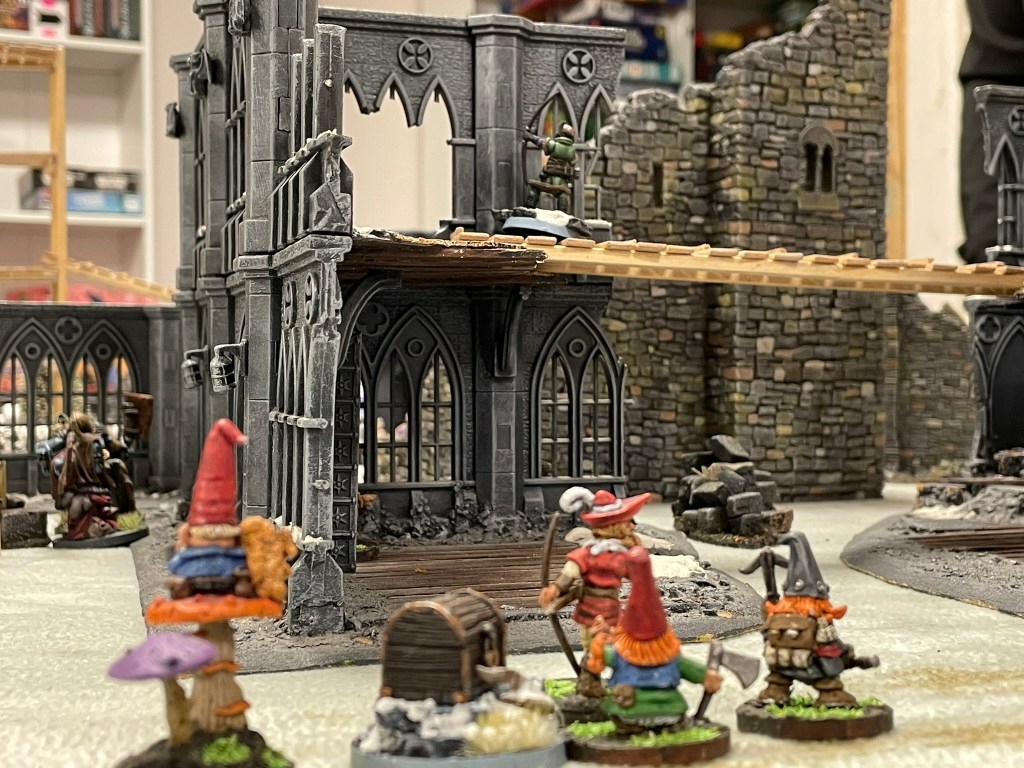
I really enjoy a game of Frostgrave, but haven’t had time to play it regularly over the past year. When I do, I invariably lose my warband roster after a couple of games and so I never seem to see my warbands grow. I’m hoping this year will be different.
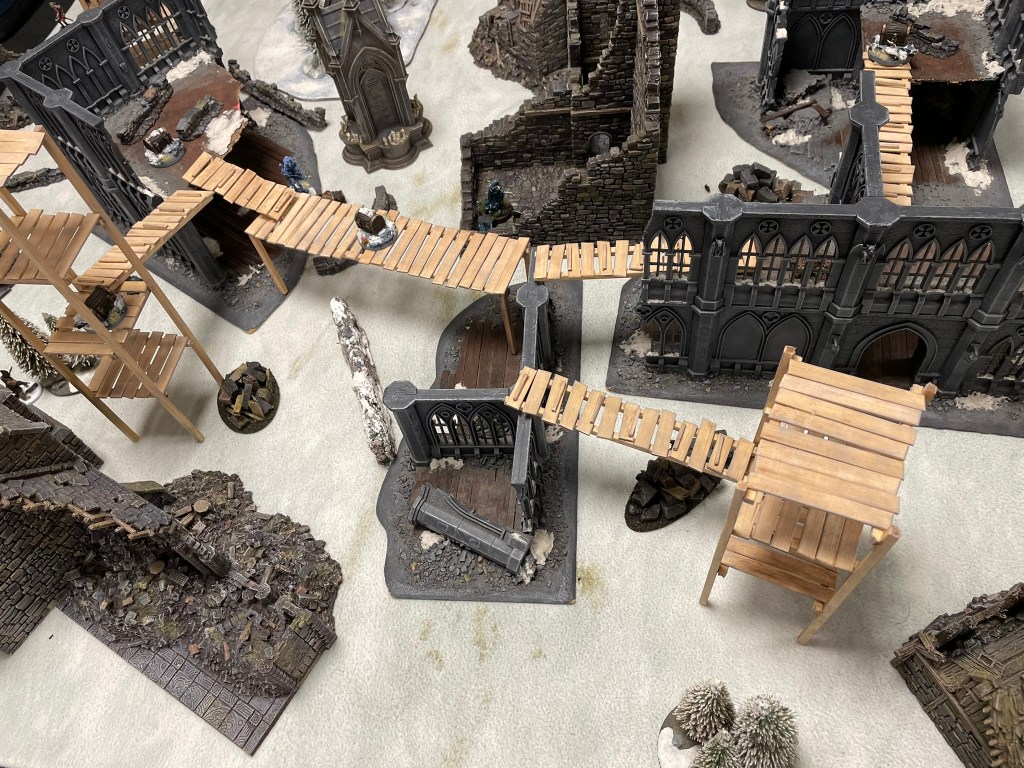
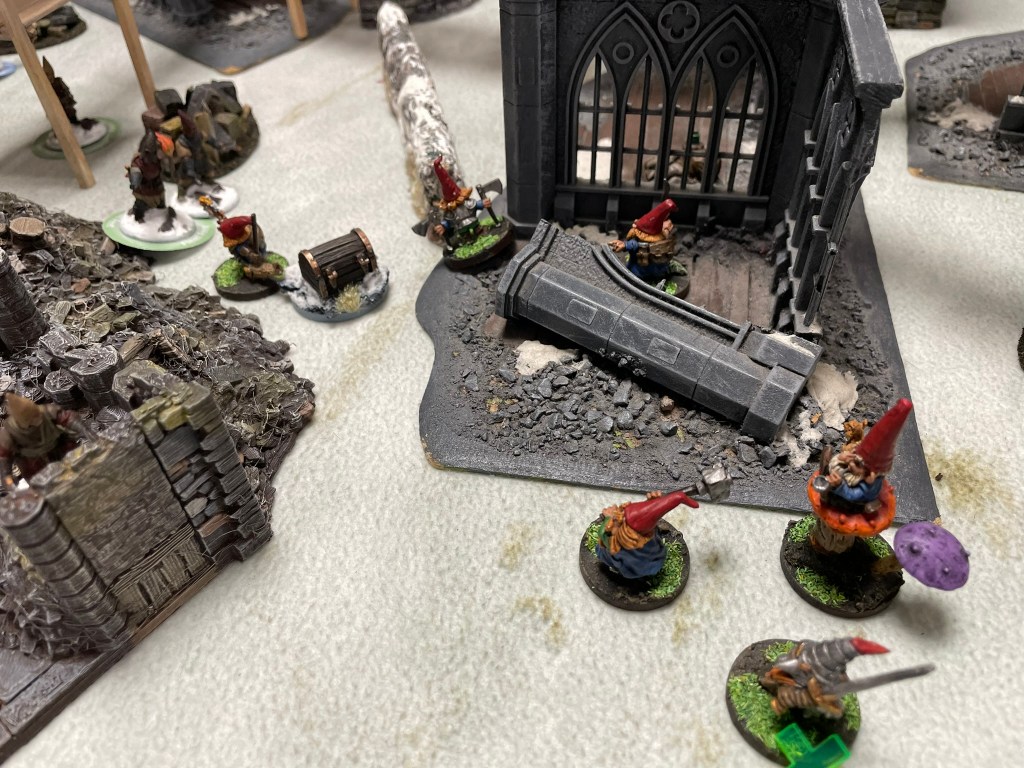
I’ve decided to run an enchanter’s warband. Partly because over the years I’ve become particularly fond of telekinesis as a spell and partly because I want to use my Northumbrian Tin Soldier Gnomes in my warband, and nothing (in my mind) screams enchanter more than a beardy chap in a red hat sat on a massive mushroom.
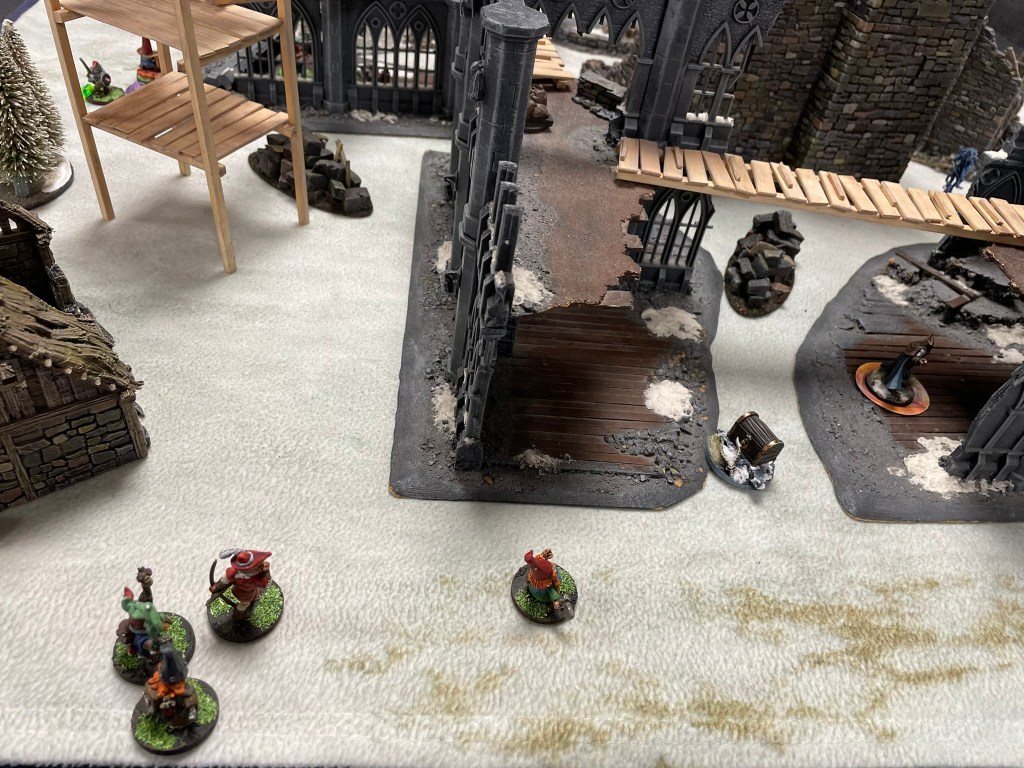
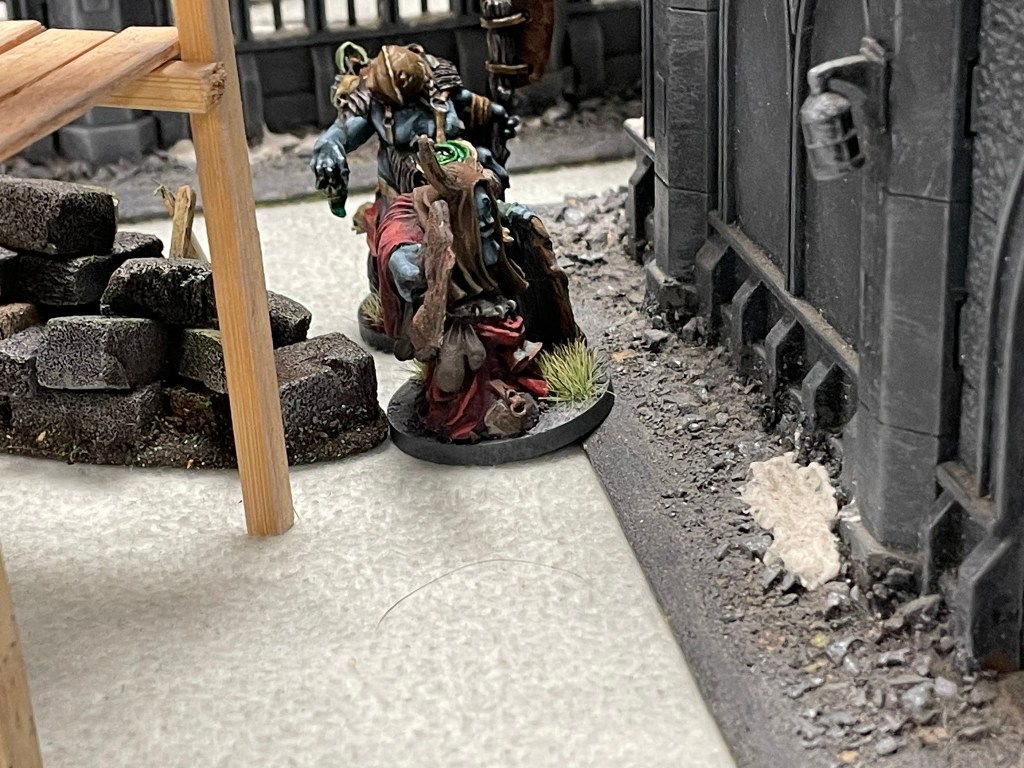
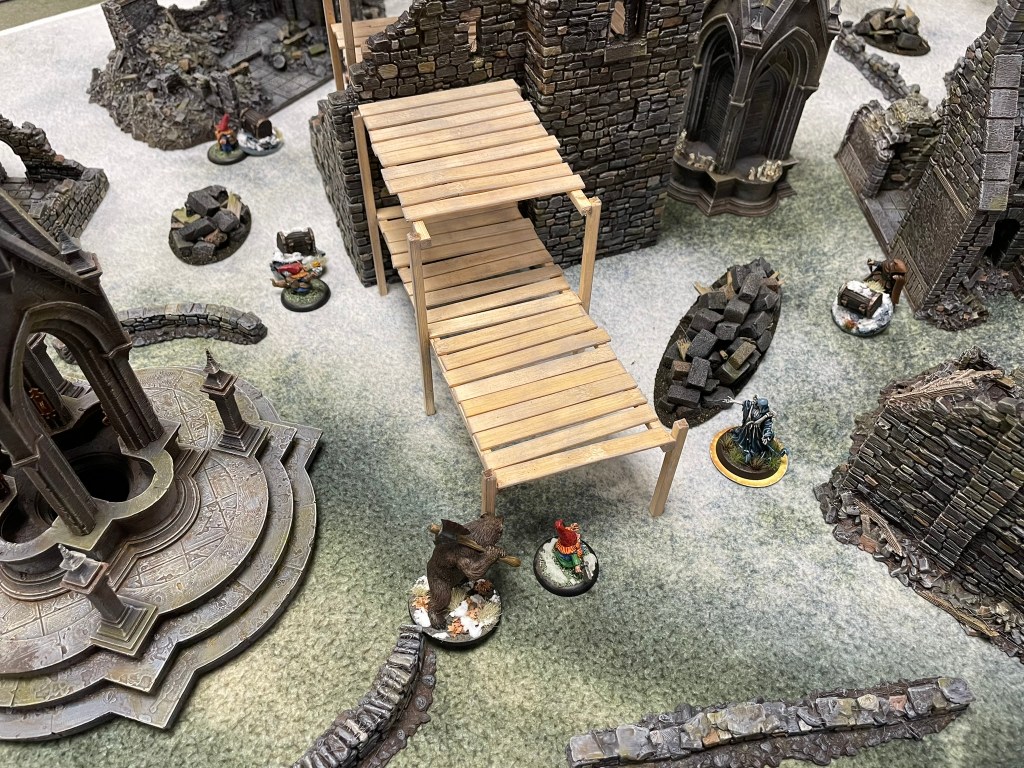
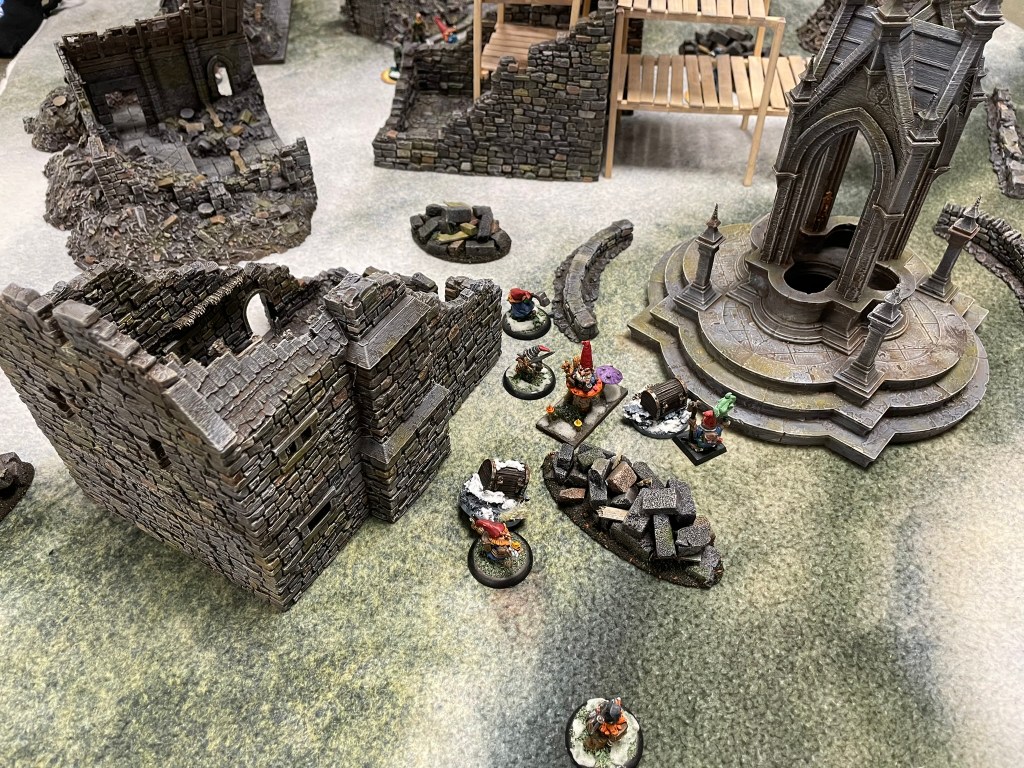
We decided to play The Summoning Bell scenario from the core rule book. With the benefit of hindsight, it’s possibly not the best scenario for starter warbands as it requires a random monster to be generated for each table corner from the start of the game. As luck would have it (for my opponent) I started the game with a bear on either side of my gnomes, whilst my opponent (a necromancer) started with some skeletons and a wraith at his end of the table. Within a couple of turns the restless spirits were in his control and heading towards me.
I on the other hand had to spend my first couple of turns dealing with angry bears, which meant splitting my warband into a group that would push forward to grab treasure and a group that would try and stop Grabdistuff getting eaten. With a combination of gnomish steal and cunning one bear was dispatched and the second sent off on a wild goose chase which ended up with the creature being frozen by the wraith.
The point of the scenario was to stop a bell tolling in a tower at the centre of the table and steal the treasure beneath it. The bears meant I didn’t have an opportunity to get to the tower first. So, I focused on securing two other treasure chests and seeing what I could do to scupper the necromancer’s attempts at stopping the bell.
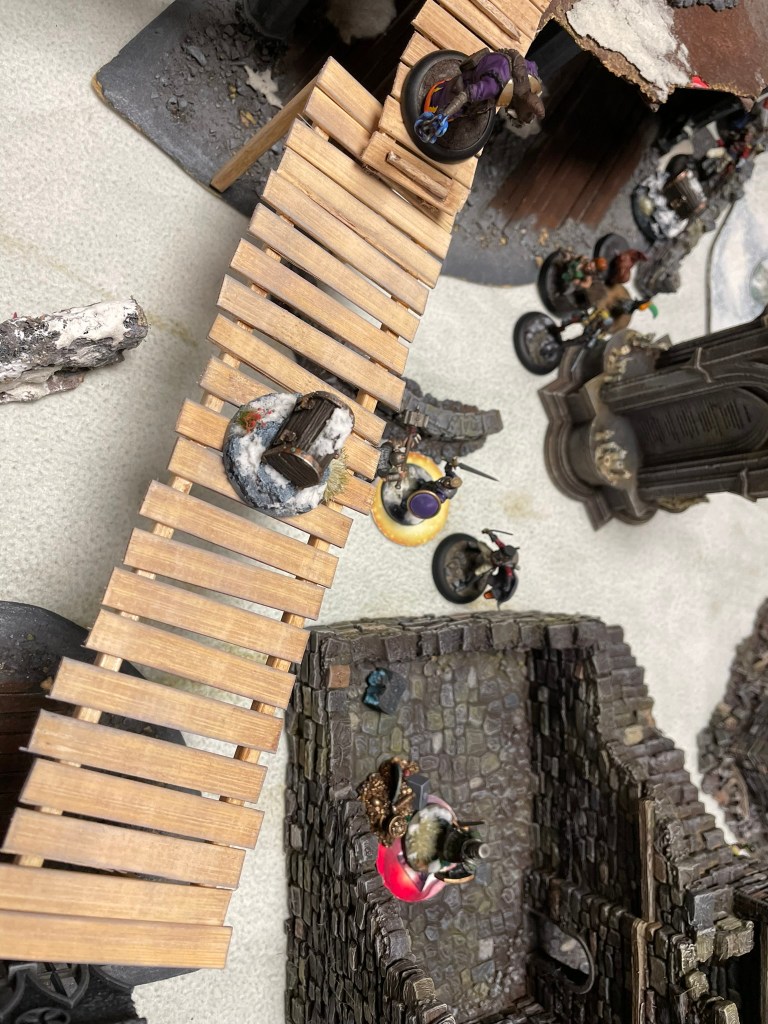
The necromancer spent a fair few turns casting fleet of foot on his retainers, which helped them scale the tower and silence the bell rapidly. Now I needed a plan. An opportunity soon presented itself as a carefully aimed crossbow bolt badly wounded the thief who had silenced the bell and was escaping with the loot. One of my thugs had found themselves near the stairs into the tower and made their way to the level where the injured thief struggled with his extra load. Unfortunately for my thug though, just as she saw the thief the necromancer’s own dark hearted knight attacked her from behind, allowing the thief an opportunity to escape.
I had hoped that Sir Broderick and one of the thugs, with a bit of support from Grabdistuff might be in with a chance of intercepting the thief. Especially since the necromancer and his apprentice had already excited the field with another two chests so there weren’t as many bone darts to be thrown. However, just as the brave gnomes made their way towards the bottom of the tower the wraith loomed around a corner. With no magical weapons to injure it Grabdistuff decided that discretion was the better part of valour and signalled the tactical retreat.
Whilst only two treasures were recovered there was some pretty decent loot to be had. Grabdistuff now has some Gloves of Casting, a bit of extra gold and a Grimoire containing the Write Scroll spell. Sadly, Theodore had the stuffing knocked out of him as he tried to approach the tower and will have to miss the next game, although Grabdistuff and his gnomes are hauled up at a local alehouse so are currently trying to recruit a reliable thief to cover for him.
So, until next time, keep warm and beware the bears that bear arms.
By the way, if you don’t want to miss the next post, pop you’re email below and subscribe to get an email notification.
For the past couple of years, the first event I’ve attended has been Stanes of Blood over in the Southeast. However, this year it wasn’t on and instead the Moonrakers stepped up to run a small event in Bristol, that rapidly became a 44 player showdown. As a result, the Halfings found themselves rubbing shoulders with some of the premiere players in the South.
Going into the event I’d accepted a challenge from Heath, who was bringing Empire of Dust, and I had a lot of feelings about the game. As someone who’s great at picking armies that don’t really pack much of a punch Empire of Dust is always a bit of a tough match up. However, my list for this event includes a Jugger horde with the Brew of Strength, which I was hoping would make life a little easier in this match up.
The Jugger horde is definitely something of an experiment, which to date I’ve been massively on the fence about. It’s performance today was likely to determine whether it would become a permanent fixture in the list. The rest of the list included:
Game 1 vs Empire of Dust, Seek and Destroy
Heath’s list was massively intimidating on the table. A solid line of high defence and nerve with loads of healing. What I tend to find with games against Empire of Dust is they tend to go one of two ways. Either you manage to smash through a couple of key stone units at either end of the line and roll up into the middle for a solid win, or you bounce off them in the first couple of turns and then they grind you down.
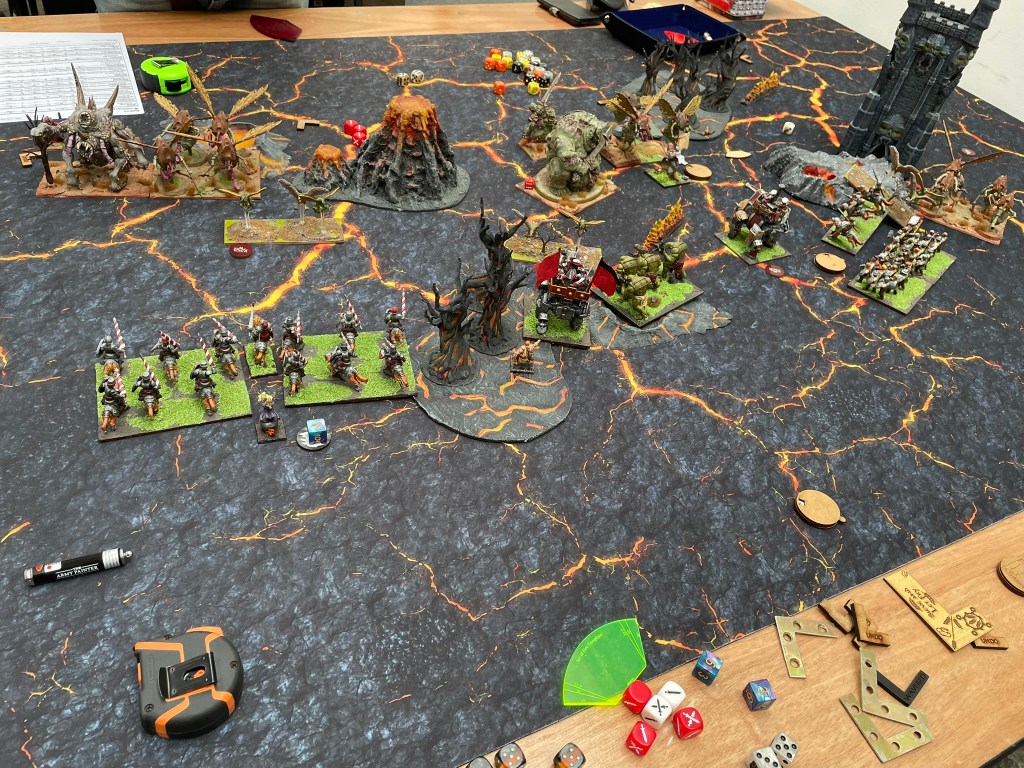
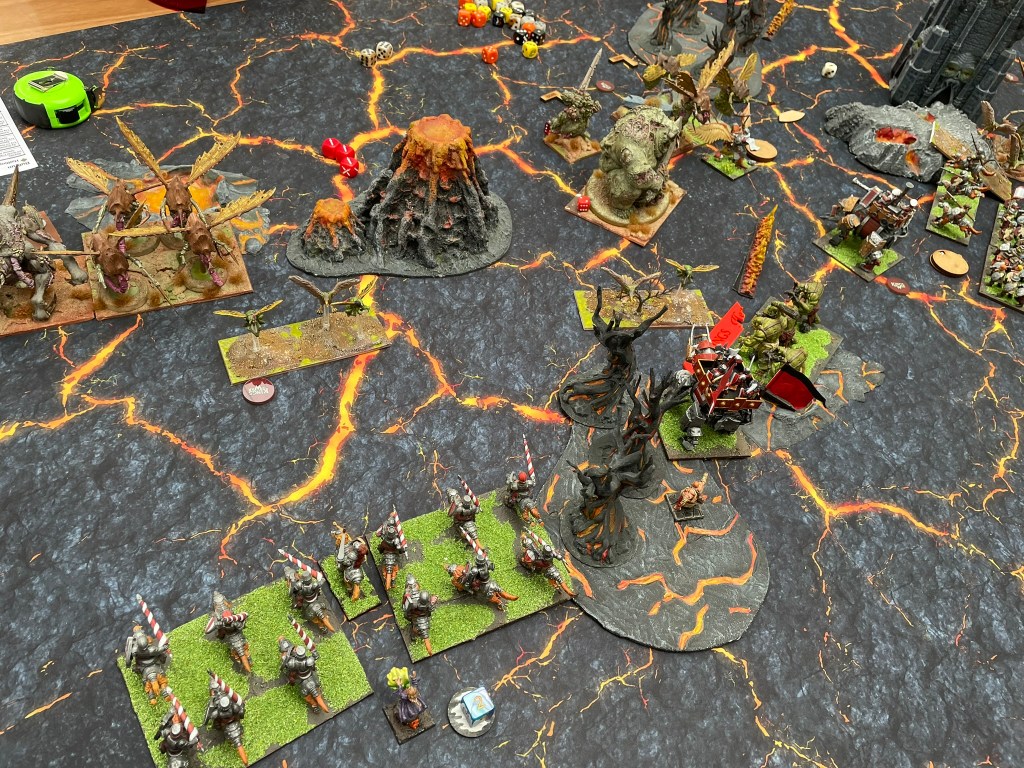
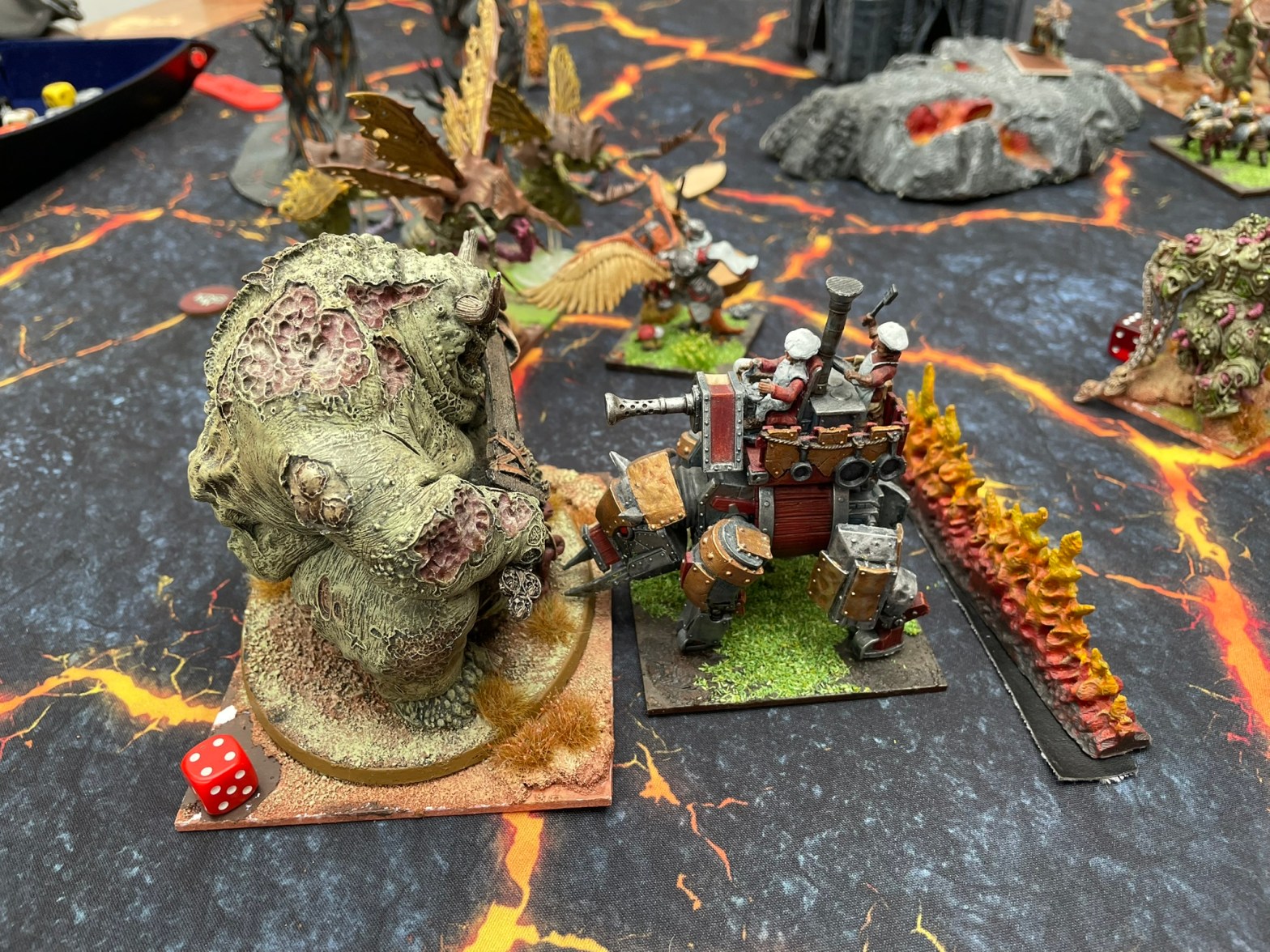
When I set up the loot counters, I did my best to spread them around the table, knowing that the EoD’s strength lay in sticking together to deny flank charges. I was hoping he might send a unit or two off on their own reducing the inevitable wall that would form in the centre. Unfortunately, Heath was not going to fall for that trick and so the game kicked off. On my left flank I had put the Jugger horde, together with a regiment and the Wild Lancers. They started out well, managing to fell a Bone Giant and Shobek. Unfortunately, I messed up the reform allowing the second Bone Giant to get a charge, which could have been avoided, into the horde which took it off the table.
It was a bit of a shame, but to be honest the horde had done more than enough at that point and put me in a great position where I believed I might have a chance. My positivity stemmed from my token placement, which meant there were two loot counters on my far right I could collect with my trolls completely unchallenged, which meant I only had to secure another two tokens for the win.
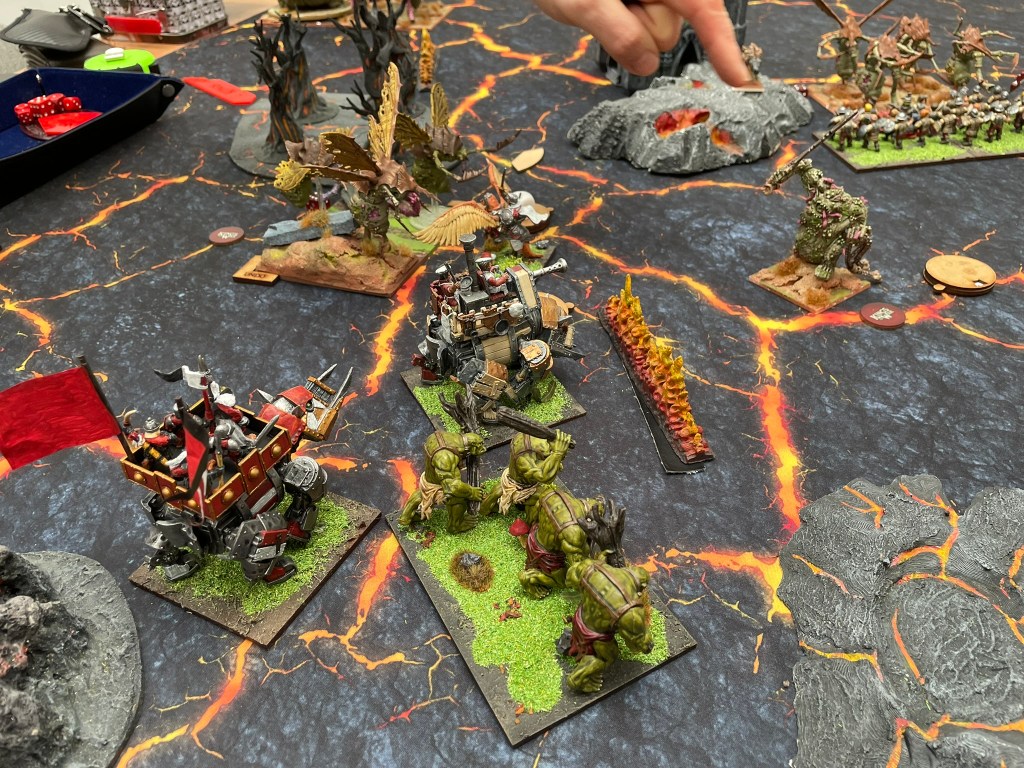
With great in roads being made on the flanks I prepared to break the centre. An over enthusiastic over run from a Mummy regiment left it open to a multi charge from the Iron Beast, the Harvester and unhindered Juggers in the flank. Now all I needed to do was breakthrough the horde of Revenants that anchored the EoD line in the centre of the board. With a rear charge from the Muster Captain on Winged Aralez, a Stalwart horde in the front and some brutal from one of the Saucerors I had high hopes! But it was not to be. The Revenants weren’t going anywhere and over the next few turns the combat would wipe out the Stalwarts, the Captain and a Jugger regiment. Unable to break the centre, and with the momentum from the right flank falling away the Halflings found themselves running from the field, although there was a moment of celebration to be had that they had escaped with two loot counters, but they weren’t enough for the win.
Game 2 vs Goblins, Wrack and Ruin
I always think it’s a shame I don’t encounter Goblin armies more often as they are great fun to play against and offer some really different challenges to a lot of other armies. This particular list featured a good mix of infantry, fleabags and giants as well as the new formation. Having had a few issues with Wrack and Ruin in the past I decided to keep it simple and throw the majority of my unit strength onto my right flank with just a small force of Juggers, Ej Grenadiers and the Muster Captain on the Flying Aralez on my left. The Goblins set up the majority of their troops on my left flank with only a regiment of Fleabags and Groany Snark on my right.
Both armies pushed forward into their respective scoring zones, before turning in towards the centre. With the benefit of hindsight, I realise that I was probably a little too eager to engage with them and foolishly threw both my Iron Beast and Jugger horde into a regiment of goblins that had been pushed ahead of their line. Not surprisingly, the goblin regiment rapidly disappeared from the table however this opened up my Horde to a charge from a hindered Fleabag Regiment, Groany and a unit that I completely forgot was the Luggits. The damage from Groany and the Fleabags was negligible, however the Luggits rolled exceptionally well and the Jugger horde broke.
Despite the breaking of the horde the Halflings where still strong enough to hold onto the scoring zone on the left for turns 3, 4 and 5. What I loved most about this game though was that whilst there was quite a brutal trade of units going on in the centre of the board there was a far more intricate game of cat and mouse happening in my opponent’s deployment zone. The flying Muster Captain and a regiment of Ej grenadiers played cat and mouse with Fleabags and the King in the Chariot looking for an opportunity to support the struggle for the centre. Unfortunately, that opportunity didn’t materialise in a meaningful way, and whilst the Halflings easily managed to keep the Goblins out of their scoring zone they didn’t have sufficient strength to push the green mob back from the centre.
Game 3 vs Halflings, Compass Points
One of the reasons why I wanted to get my head around Halflings is that over the past couple of years when I’ve played against Halflings I’ve found them to be a real challenge, and the people playing them have been great to play against. So, it was brilliant to find myself up against another halfling army. What was particularly great from my point of view was that the list I was playing against is far more representative of what I would expect to see in a Halfling list, so I was interested to see how my force would fair.
Having deployed my opponent scouted his poachers forward right into the charge range of my Jugger horde and I had a sudden flash back to the previous game. Taking the first turn I was immediately faced with the opportunity of a turn 1 charge.
For this game my opponent had deployed relatively evenly across the table, kind of. Although there was a heavier unit count on my left flank, they were quite low on nerve with a flying Muster Captain, Ej grenadiers and Aeronauts. On my right flank stood the Iron Beast and a troop of Wild Runners. In the centre were the majority of their infantry and a regiment of Aeronauts. I had deployed largely across the right side of the table with only a Jugger regiment and grenadiers on the left.
In an audacious moment I decided to aim to take both the centre objectives and the one on my right flank. I ummed and ahhed a little over the turn 1 charge with my Jugger horde as a way to remove one of the Poacher regiments and really press the attack on the central objective on my opponent’s half. In the end I got cold feet due to the amount of enemy units that could potentially find ways to multi-charge the horde (I wasn’t keen to see my horde disappear so quickly again).
Instead, I moved forward cautiously in the centre, keen to avoid the troll gunners and wanting to keep the Aeronauts at arm’s length. On the right flank though I pushed forward very aggressively, given the enemy units protecting it I knew it would be relatively easy to remove the Wild Runners and then deliver multi charges into the Iron Beast at my leisure. Once the beast was dealt with, I would then be able to send units around to secure my opponent’s central objective.
In turn 2 the charges began. Whilst the Stalwarts blocked up the centre by rushing their opposite numbers, the horde removed the poachers they’d had their eyes on, and the trolls took off the Wild Runners with the Iron Beast. However, the momentum got lost very quickly as the enemy Halflings started to bog down my key units. With quite a few units in the centre there was plenty of low value units to throw at my horde. On the right though the Iron Beast just wouldn’t die. Despite taking two rounds of flank charges from the trolls nothing seemed to be able to bring the mechanism down. By the time my Halflings had killed it, there was not enough time to get the cavalry around a house that blocked their most direct path to the furthest centre objective.
Fortunately, the flying Muster Captain had made his way behind enemy lines and, after making an absolute nuisance of himself, turned his attentions towards the objective. However the turns were running out, and my opponent still had a lot of options to delay my progress. His flying Muster Captain came face to face with mine by the objective, effectively cancelling out the scoring. We had both taken control of a flank which left, in turn 6, the tie breaker coming down to ownership of the objective in my centre. I had my Iron Beast and Harvester defending, positioned in such away that his nearby Aeronauts would only be able to reach the beast. The Aeronauts descended, but rolled poorly, failing to even dent the construct, giving the game to my Halflings at the end of the turn, but then a turn 7 meant that my Halflings were also able to secure the object in my opponent’s centre, strengthening the win.
Final thoughts
What a thoroughly great start to a new year. A massive thanks and congratulatory hats off to Andy Marshall for putting on a great event. And of course, a massive thanks to my opponents for a great series of games.
I have to admit I was really impressed with the army overall. Although I finished with two losses and a win, the losses were what I would call good losses, and as a result I ended up coming in a respectable 25th. Despite my misgivings the horde did very well and I’m pretty sure timing is everything when it comes to deciding when to finally commit with it. My main concern about the Halflings was their low nerve, which was one of the reasons for choosing the horde, but it didn’t impact me as much as I thought it would. What was very noticeable was just how useful the terrain mitigation in the army was with strider and the trolls.
The one area where I think the army did underperform was in the killing department, and there is a change to the line up I’m carefully considering that I think would have made a difference in all of the games at this event, but more on this later. The other aspect of the army I really need to give greater consideration to is the Saucery. I think the army really benefits from it, but there’s definitely an art to choosing what the best option each turn is and I got the feeling from a couple of goings on that the buff that benefits the most immediate situation is not always the best one to take. For now, it’s time to kick back and prepare for The Hinckley Heist.
Happy New Year
If you enjoyed this and really don’t want to miss anything else I post, ever… pop you’re email address below and you’ll get a notification for each and every new post.
2025 has arrived and I’m feeling unusually ready for it. Last year I had a great time playing Ratkin, and now I’m looking forward to my next Kings of War chapter. This year I’m planning on finally getting my head and heart around halflings. I’ve had the models kicking around for a couple of years and even manged to play a couple of events with them back in 2023, but wasn’t able to find an army list I could really get excited about.
Halflings are a bit of weird one for me. It’s a faction I’ve never really been that excited about, in any IP. I think it’s because I’ve always seen them as a bit of a one note joke, without that much depth. That changed a little when Mantic released their first version of the army list, but not for the reasons that would usually get me into an army. Unusually I was drawn to the army because of their rules. Normally I pick up an army because of some models I particularly like, or because there is a narrative spark I want to explore. However, in the case of the halflings it was simply because they had loads of nimble cavalry and auras, which are the rules mechanics I really love playing with.
As a result, my relationship with the little people has been a little bit rocky. I’ve been trying to build armies around certain units that just didn’t seem to work well enough for my liking. Just as I have with the rats, I managed to build lists that seemed to both under perform in terms of survivability and killiness. This really came home to roost in the lists I took to a couple of events in 2023 (but unlike with rats I wasn’t excited enough about the faction narrative or models at the time for me to really want to continue playing with them), so whilst I have occasionally revisited the army it’s been in a pretty lacklustre way. That was until a few months ago when I was playing around with some concepts and wrote a short story delving into the relationship between halflings and forest trolls (you can read it here).
Whilst Mantic’s halflings still have a bit of an appetite, it’s no longer their defining feature (second breakfast can be a necessity, but it’s not a personality) and has been tempered considerably compared to other versions of the little folk. Not only that but the introduction of the Greedyguts casts a much welcomed shadow over their world. What’s more their relationship with food, agriculture, animal husbandry and technology has been considered far more deeply, and the result is an interestingly pragmatic and down to earth race. I feel Mantic have made a real effort to create a believable faction that can hold its own in a violent world, and the more I’ve reflected on that the more I’ve found myself getting excited about putting together a force for 2025. What I’m hoping is that my experiences with rats from last year, where I did my best to think more about the structure of my lists from a more competitive point of view, will pay off. In theory what I’m taking to the New Moon tournament in Bristol on 4th Jan will be both a little more resilient and stabby than previous incarnations.
Whilst I technically have everything painted and based there has been quite a bit of rushing to get it done. It’s definitely not my best work, however I have a bit of a plan. Over the next year I intend to continue working on the army to improve on what is already there by tidying paint jobs up, adding highlights, overhauling the basing and… maybe even upping it to full model count (although even I feel this last one is a bit of a stretch). So, for now I’ll leave you with a family photo of what is the starting place for an exciting new year.
Best wishes one and all.
By the way, if you fancy getting an email notification every time I publish a new blog pop your email below.
It’s been a pretty awesome year for the rats. Traditionally I play them for the first half of the year, realise I have no idea how they work, flit between other factions before returning to them for the last event of the year. I then take 6th place in the faction listings in the UK. This year though things have been very different. I’ve not only managed to stick with them for the entire year, but also ended up on top of the Ratty charts (it’s at this point I feel it’s only right to thank Si Brand for only playing Ratkin twice this year to allow any chance of this happening!!).
To Scud or not to Scud
As I planned my list for the 2345 point event the first question I had to answer was whether Scud was coming out to play? After a bit of reflection, I decided to leave him at home as I wanted to maximise the number of drops I could put on the table, and I liked the idea of trying to swamp the opponent with a bit more trash than usual. I also felt the lists I played later in the year suffered for trying to include too many expensive unit choices that lacked reliable damage output because they still only hit on 4s over cheaper trash.
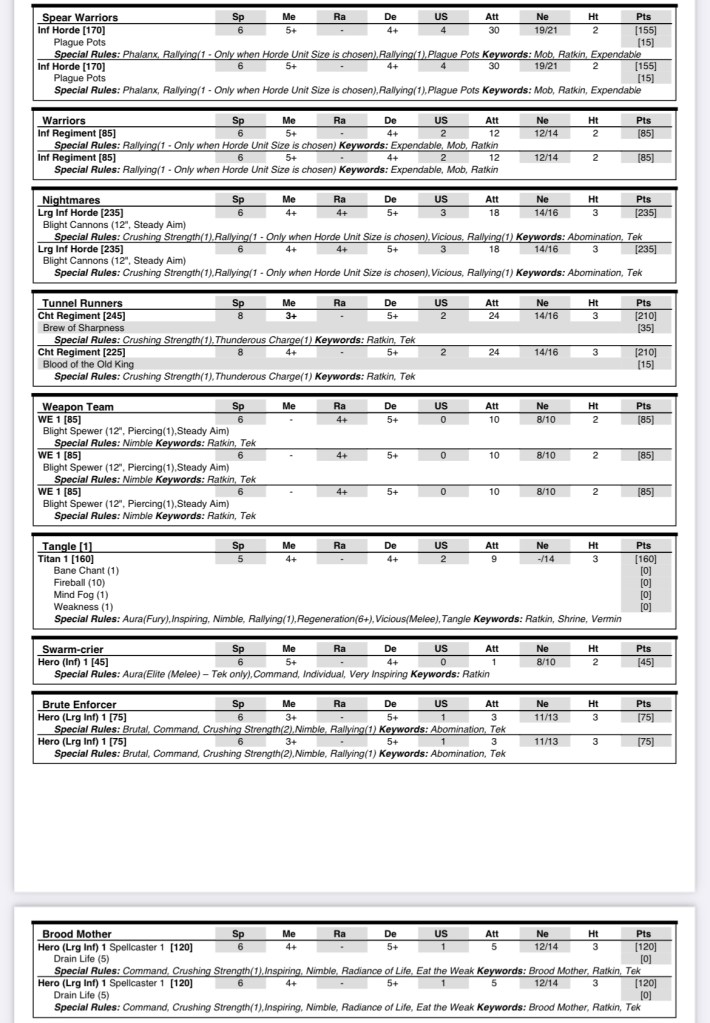
The removal of Scud meant I had the chance to add a couple of Wretch hordes with an inspiring Brute Enforcer to my usual choices. I also decided to include a Nightmare horde which was something of an experiment as I haven’t been blown away by their performance year to date, but I reasoned, they have also not had shooting support from no less than three weapons teams. Maybe this would be the key to getting the most out of this unit without painting up another horde or two. In the end I settled for the following list:
Game 1 vs Forces of Nature
The scenarios for Reaper events can be a little different. The first was a combination of Kill and a chase scenario. Everyone going to the event brought a special chariot-based Reaper character in addition to our armies. I’m not going to go into the details as the character didn’t have a massive impact on any of the games, with the exception of the first one. For the first game points were scored on whether we could keep the character alive and get them over to the opponent’s table side, as well as for the amount of enemy troops killed.
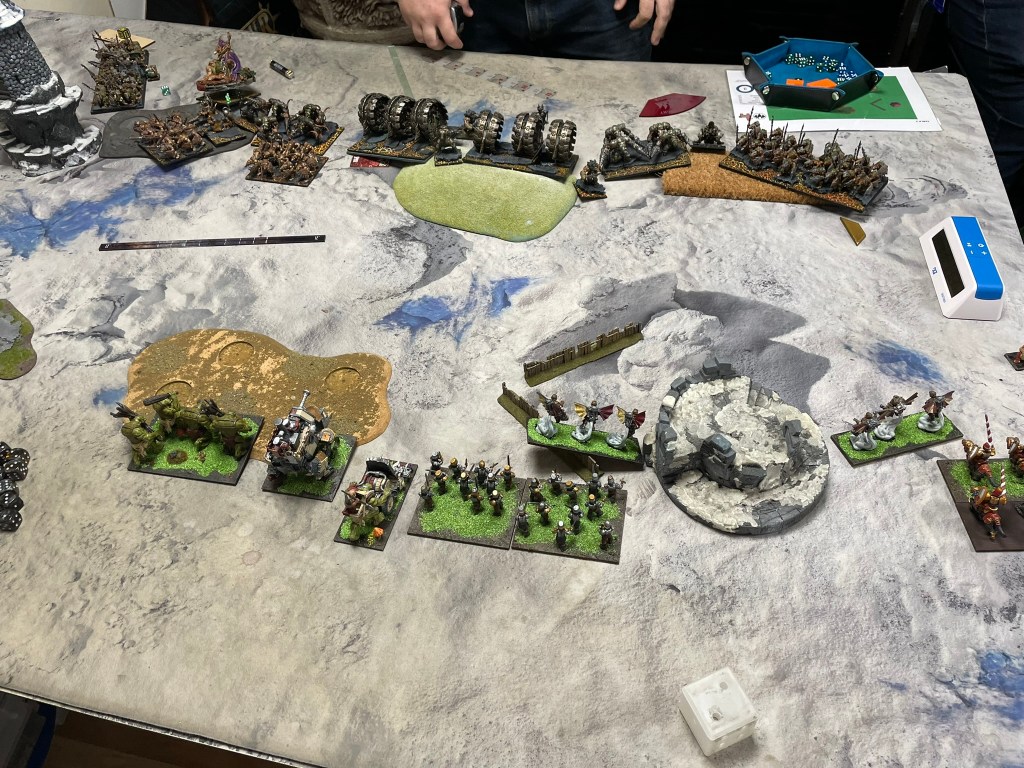
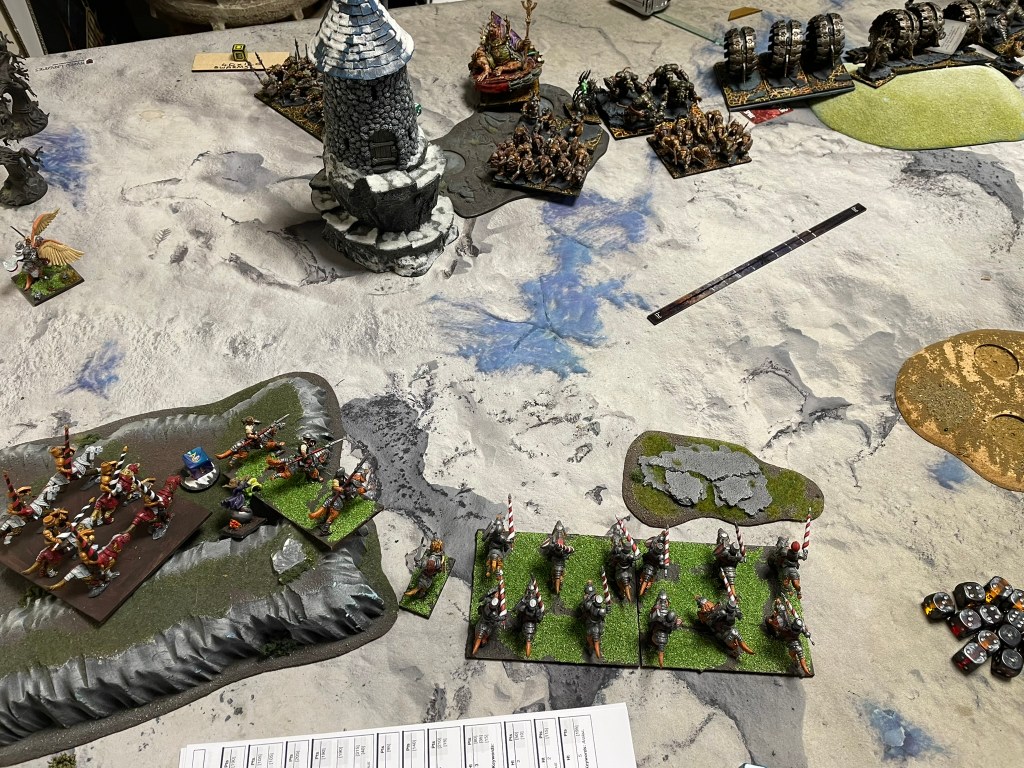
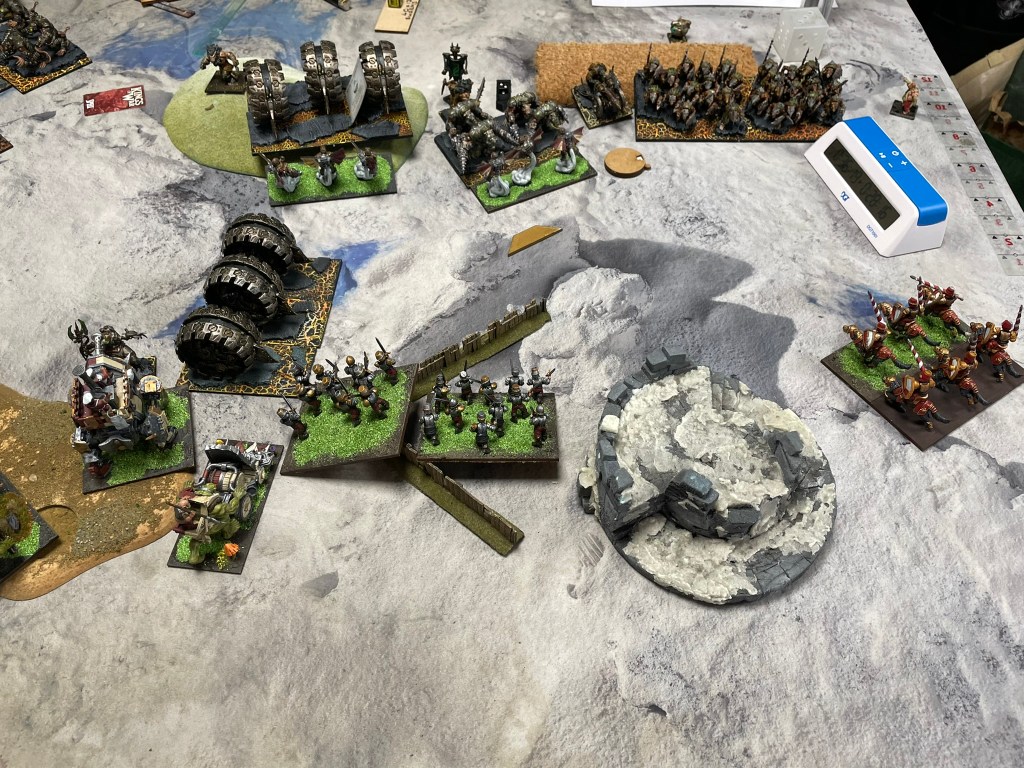
The emphasis of this scenario, for both me and my opponent came down to keeping our characters alive and getting them to the other side of the board. To that end we focused our forces at either ends of the table. My heavy hitters mustered on my right-hand side of the table, whilst my opponent had the bulk of their forces on my left, with what could best be described as token forces attempting to slow down and kill off the characters. In both cases our defending forces could do little to really break the onslaught charging towards them. On my left flank a horde of wretches, the shock troops, a brute enforcer and a regiment vermintide failed to make a particularly impressive stand against forest shamblers, the Wilt Father, air elements, and a whole host of other environmental nasties. Whilst on my right the tunnel runners and shooters easily cut through the resistance offered by fire elements, a hydra and a horde of naiads. There was a moment of high drama when I accidentally left my special character open to a charge from the naiad horde, but fortunately a spectacularly bad set of dice results left the character with only one point of damage. The sharpness tunnel runner regiment then had a flank charge on the naiad horde, which subsequently disappeared.
However, by the time the dust settled, our main fighting forces were too far apart from each other to have really caused sufficient damage to one another for there to be a clear winner based on kill points. I had taken off a little more of my opponent’s force than he had of mine, but it was not sufficient to break the impasse of a draw. All in all, though this was a massively fun game, and a great way to kick off my last event of the year.
Game 2 vs Dwarfs
The scenario for this game required each player to place a loot counter on the centre line. Grab the counter and carry it to a deployment zone. You got one point if you took it to your opponent’s deployment zone, and two for taking it to your own. Once you got it into a deployment zone the counter would then return to the centre line and could be picked up again.
The rest of the Bulwarkers did show up for the game, they just didn’t quite make the photoshop cut!
I was a little worried going up against the dwarfs. This was mainly because I felt I lacked sufficient crushing strength to quickly cut through all the defence 6 they had brought, in particular the three lords on big beasts. For some reason I ummed and ahhed before choosing to go first after winning the dice role to decide who should go first. My opponent nudged me gently into taking first turn though and I very quickly became glade he did.
We had set up so we had similar capabilities opposite each other. On my left flank I had my tunnel runners, night terror and shock troops, opposite his beast mounted lords and infantry. In the centre I had focused my shooting units with the wretch hordes, against Goloch’s Fury and the iron guard.
In the first turn my night terror shot forward and secured the loot counter on my left flank whilst the remainder of the army hung back, ready to charge in if any of the dwarfs decided to charge into the wee beastie. In response the dwarfs moved forward trying to close the gaps between them and the counters without breaking ranks and offering potentially favourable charges to my toughest units.
The result of this was that the night terror was able to start smuggling the first counter back behind my lines, towards my deployment zone. In the centre, the lack of dwarf speed resulted in my wretches being able to form a wall between the tokens and the dwarfs, allowing a vermintide regiment to grab the requisite token. Over the next few turns I slowly carried the counters back to my deployment zone to score four points, whilst using the rest of my army as chaff to block the pursuers. Not much of the rats remained by the end of the game, but it was a win none the less.
I spent a bit time talking through the scenario with my opponent afterwards, and whilst it is a really interesting concept we felt it wasn’t as balanced as it could have been, and gave a massive advantage to the player taking the first turn. I also believe that the composition of our armies made the scenario even more challenging. This is because we both has fast units that could claim counters from the first turn, we then had units perfectly suited to blocking the loot counter carriers on their journeys to the scoring zone. In addition to this neither of us had flyers or long-range shooting, which limited the opportunities to take out the counter carriers. The game certainly felt quite one sided from about turn three, so whilst it was a win a bit more consideration to get the scenario to a really good place would make it more fun. I would love to see a future iteration of this at another event.
Game 3 vs Forces of Nature
The scenario for this game was Wrack and Ruin, an actual scenario from the book! Crazy!
This game was my second game of the year against Forces of Nature and my second game of the event against a wall of defence six. Wrack and Ruin tends to be one of those scenarios I don’t particularly fare well in. I generally make a big mess of how I spread my forces, and this time around was no exception.
You might notice that this army had a very particular theme…
I decided to go in heavily on the left dominate zone, whilst leaving a solid distraction of unit strength on the right. So, the shooters and the wretches went to the right and the tunnel runners and shock troops went to the left. Moving slowly forward it looked like I might just have the balance about right, possibly even perfect as I managed to score in both circles in turn three. I hoped another round like that would clinch me the win and I wouldn’t need to worry about the attrition of the rats for the rest of the game as the maximum points my opponent could score would be three from turn five onwards. Sadly, I ended up being a little over optimistic as to just how quickly I could kill the durable elementals and naiads and slowly the tide turned, spurred on by a double one on a devastated horde of earth elements.
Unfortunately, the army just didn’t have the strength it needed to munch through the enemy, and with no healing nature ground its way through the brave vermin in both circles until a handful of rodents remained to see out turns five and six. However, despite the decisive victory for Nature the turns leading up to turn five were filled with some fantastically dramatic dice outcomes that saw scorchwings held at bay by successive waivers and mighty elemental one shotted by shock troops, dangling a glimmer of hope ahead of us, not to mention making an incredibly fun game and a great way to end a year of playing rats.
Overall, I believe I finished eleventh, but most importantly had a great day playing some fantastic games with some lovely people. It really is the best way to round off a pretty incredible year of gaming. This is my second year attending the Christmas Shroud of the Reaper event, and I would really recommend it to anyone wanting an event that’s a bit different. Now it’s time to pack the rats up and get on with putting the finishing touches to my halfings as it won’t be long until the new moon rises.
Oh, and as to whether I should have Scudded or not… with the benefit of hindsight I can say I probably should have.
Have a great Christmas and a happy New Year.
By the way, did you know you can pop your email address below and subscribe so you won’t miss out on any future posts.
Over the last couple of weeks I’ve played another couple of games with the dogs of Kings of War, and there’s a theme emerging. In fairness it was present in previous games with similar lists but now it’s really starting to be born out, and I just can’t ignore it anymore.
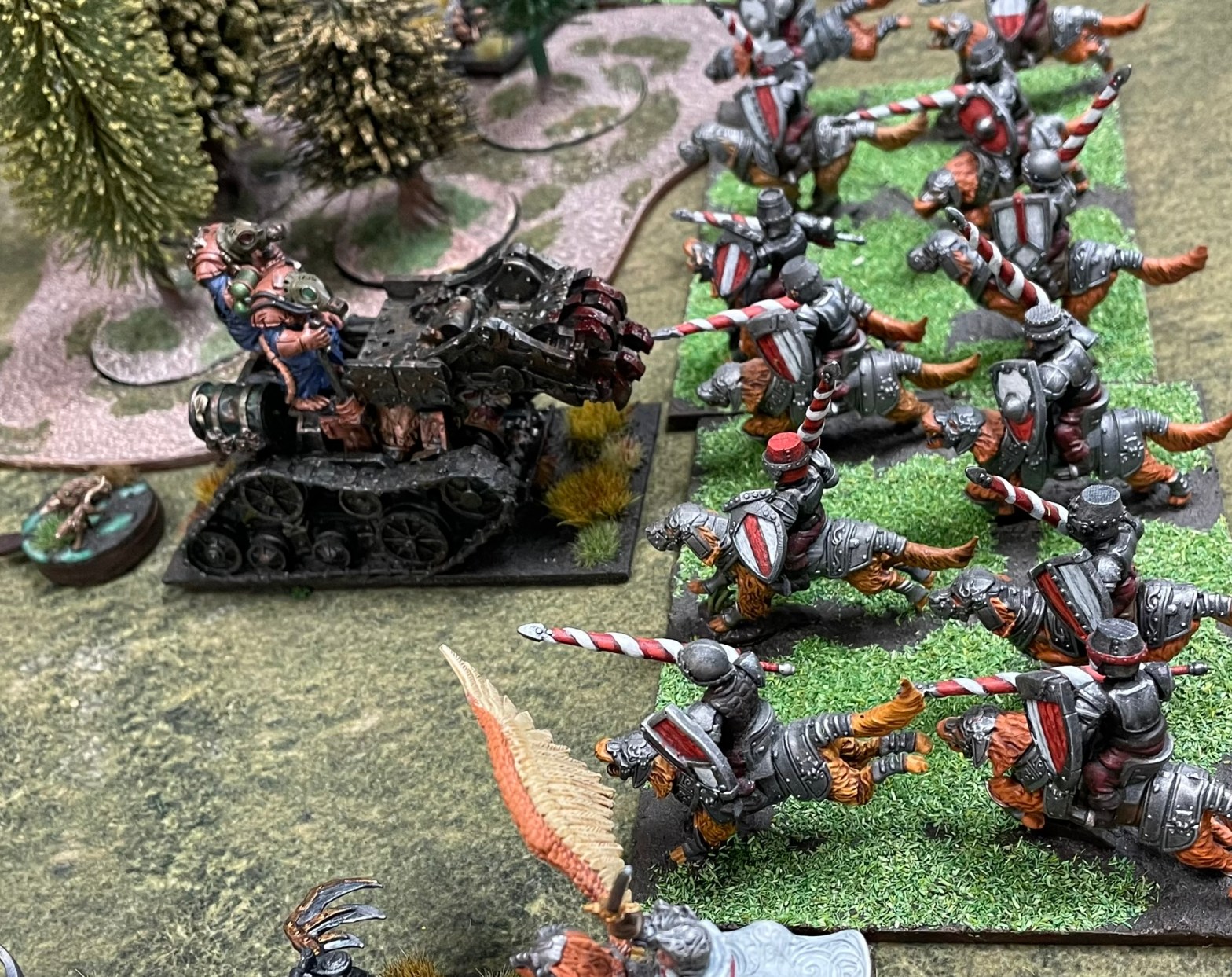
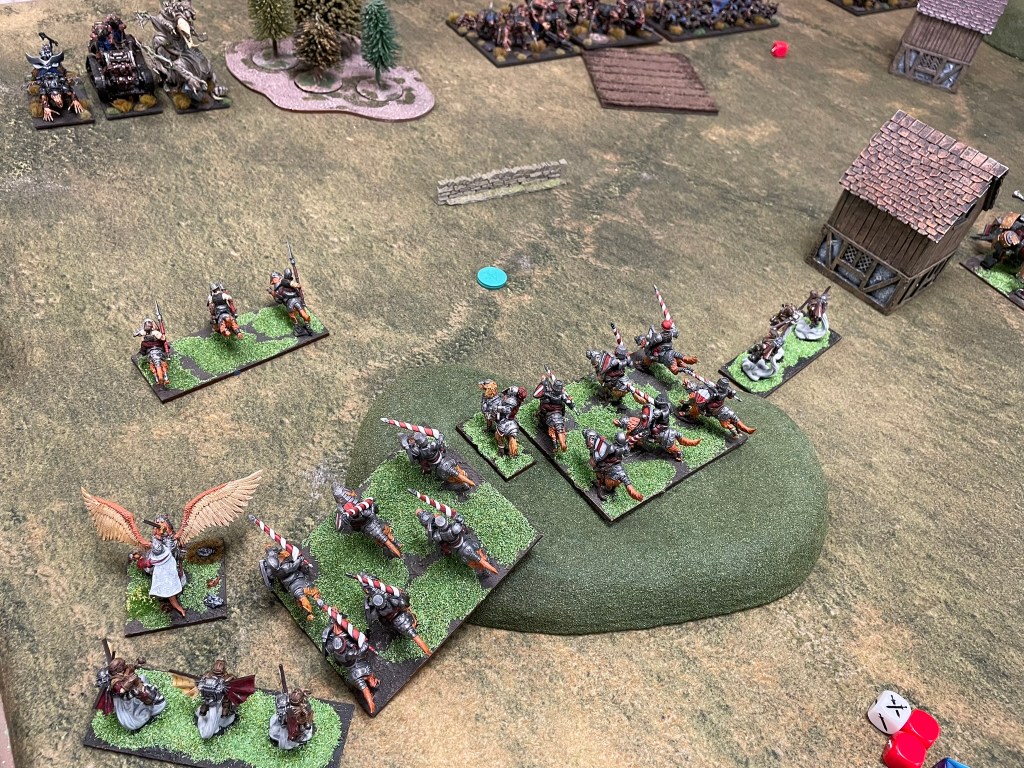
That theme is nerve. It’s something I hadn’t given a huge amount of concern to, the lack of crushing strength and Banechant in the army just seemed more of an issue. In addition to this I was hoping recruiting a fifth regiment of Juggers would sort of address the nerve situation by having more hard-hitting units to throw into the enemy. The hope being that if one was wavered there would be enough to pick up the slack. In my first game, against Kingdoms of Men, this sort of worked, however because there was no real shooting in my opponent’s force the irritating wavers generally occurred in combat, which is immeasurably more useful when the units are locking opponents in place to receive flank charges in the following turn. Consequently, the waver issue was more than made up for by the resulting carnage of the flank charges.
Cavalry hordes just look awesome. Fact.
Despite this I decided to try something a little different for the next game, against the wonderful Steve Hil. On a whim I decided to give a Jugger horde a go. Partly this was serendipity and partly I think concerns about nerves were starting to get under my skin. I’m not going to say too much about the game because it’s been recorded for a future Death By Dragons release (I figured it was only fair following the great Twilight Kin debacle of Clash 2021 {and yes there is a tournament report of it on DBD} where my rats had an absolute field day, that in our next meeting I let him pit the army he’d been playing all this year against a list I’m still very much testing out).
So once again I found myself facing a Kingdoms of Men list. This list presented more direct challenges to mine in the form of a pike horde (phalanx and ensnare) and a reasonable amount of shooting. This absolutely put the cats amongst the flying aralezes. From the first turn shooting resulted in wavers cropping up amongst my troops, and then there was the small matter of a redeployable pike horde that was effectively invincible to most of my army.
All in all, it turned out to be a massively enjoyable game with the takeaways being that nerve is definitely a problem, and I think I need some shooting to deal with ensnare, phalanx and other shooting! So, with that in mind the list moves on… the horde will remain (although I’m really not sure what to do with it, it looks mega), I will be dropping one of the jugger regiments, and I’ll be putting some forest troll gunners in their place.
Now I just need to get it all painted.
I think the gunners will compliment the list quite nicely as their pathfinder makes them pretty mobile, whilst their regeneration will hopefully mean they stick around for a while. A bit of crushing strength will also not go amiss! The aim will be to field this army at the New Moon tournament in Bristol on 4th of January 2025. There’s a fair bit of painting to be done and no more test games as it’s back to the rats for a bit.
Now for the dice
With the first couple of games under my belt I’m finding myself considering the dice in two distinct ways. The first is the actual mechanic, by this I mean the rolling of the dice, the points accrued and that the abilities can happen anywhere on the table. The second is the abilities themselves.
My position going into this is that Kings of War does need a new rules avenue to explore. Over third edition we’ve seen more and more auras applied to the armies and I think there’s only so far this can be taken, and we must be pretty near to the edge of it. I want to see another way that armies can be differentiated, so the arrival of command dice are welcome if only because they indicate a new direction of travel for force development.
Having played with them I think the mechanism is pretty unobtrusive and really easy to get to grips with. I know there are concerns that this could introduce more complexity, but I don’t think the current format does – roll dice, count points, spend points. In that respect I think it’s very Kings of War. Furthermore, the decision to not tie the use of a command to a character, e.g. a unit must be within six inches of a hero to use the command, makes them distinct from an aura and adds to the simplicity. As a Ratkin and Halfling player the last thing I really want are more bubbles that need to be considered to make my armies work. So, on that basis I’m really happy with the general mechanic, it’s quick and easy to get your head around.
However, as with all things, balance is key, and this is where I have slightly more than mild concerns. As has been discussed quite widely, there are some value issues with some of the abilities, and I would go as far as to say these might be as much to do with the general commands (depending on the army using them) as the faction specific ones. My first game against Kingdoms of Men saw my Juggers slaughter everything they touched with an extra point of thunderous charge and a strider aura, even the EJ grenadiers reliably grounded defence five fliers. It wasn’t the best experience for the Kingdoms of Men player whose abilities were limited by terrain and had no mitigation in their list.
On the bright side though Endurance saw Lifeleech played far more by the Saucerors as combined with Iron Resolve it meant a unit could potentially heal back up to five wounds per turn. No small feat. I definitely think my second game with Steve was a great example of just how much fun the dice can be. The nature of our armies meant the abilities didn’t enhance anything to a troubling amount (thunderous charge is irrelevant against phalanx and furious charge is very manageable when applied to melee 5 troops), but they absolutely contributed to the game overall, making it massively enjoyable. I will absolutely be playing the dice going forward casually, but I’m not sure I’ll be overly excited about seeing them at tournaments this year. All that being said I’m excited for the future.
Oh yeah, I’ve recently found out a handy subscription widget exists. Pop an email address below, hit the big green button, and you’ll get notified whenever there’s a new blog up. See you soon.
When it comes to those stirring scenes that perfectly encapsulate why I love fantasy fiction and wargaming I’m hard pressed to find anything better than the relief of Helmsdeep and the charge of the Rohirrim at Pelennor Fields. For me these movie moments bring to life so many fantasy tropes, stereotypes and archetypes in such a raw and powerful way I can’t help myself but want to field massive armies of cavalry. They also made the time spent on the rest of the trilogy not unwasted (kinda).
So, this year I’m going to give into the temptation and run a cavalry heavy army. However, I understand there is a view that cavalry is (in the politest possible way) a bit suboptimal in King currently. This I can certainly live with, as I’m a confirmed mid-table player and really need to start owning this! All that aside though, massed cavalry looks great on the table and that’s really the thing that’s driving this.
I thought, though, it might be worthwhile just kicking the intellectual tires on the horses before they bolt into a close gate and I end up with a fun, but not particularly challenging army for others to defeat. The first thing I did was think about all the things that let cavalry down in the game, and I’m talking here about the heavy knight profile that has 16 attacks, move of 8, melee 3 and thunderous charge 2.
I’ve decided to call it the Agincourt issue. This is simply a fancy name for getting bogged down. To my mind there are about four things that really cause the knights of the game a bad day.
Terrain – thunderous charge is easily stripped making those all-important charges pretty impotent
Faster units – these beat the knights to the charge, stripping their thunderous charge rendering them pretty useless
The grind – follow up attacks after the charge, without the benefit of thunderous charge, are pretty ineffective
Individuals – with so much freedom of movement their ability to strip thunderous charge means they can really take the sting out of charges
It’s pretty clear that there is a theme developing here. A combination of thunderous charge being relatively easy to remove during the game and no shortage of ways to do it mean knights can be countered relatively easily. So, should I give up? Probably, but I refuse.
In part this is because a Kingdoms of Men army built around five knight regiments turned up to Clash of Kings 2021 and took eighth place, and I’m not even aiming for those heady heights. This gives me a template from which to start wondering what the best way to approach a similar build with Halflings would be.
Looking through the list it’s pretty clear the idea behind the list is to have the knight regiments supported by lots of flying chaff to protect them and set up charges. Importantly though the list also features plenty of Banechant and the Brew of Strength to bolster the wound rolls, and a reasonable amount of chip shooting. All in all, it’s a really nice list, but how does this translate to Halflings? To be honest I’m not completely sure because there are elements Halflings can’t easily replicate, namely the Banechant. Additionally, two of the Banechanters are wizards who have lightening bolt, which I can’t really replicate either, which complement two scout troops and top up the shooting. Whilst I’m not convinced the shooting is a core requirement for the army, I would say the Banechant probably is.
There is another challenge as well, which comes in the form of nerve. Kingdoms of Men knights have a rather low nerve point of 14/16 which makes them susceptible to wavering, but native Headstrong and an option to take Indomitable Will more than makes up for this. The Juggers, that will play the equivalent role of the knights have a 13/15 nerve with no waver mitigation, but just how important is this? And what are the upsides for Halflings, because the Kingdoms of Men feel like they are really well suited for this type of build, unlike the dog riders.
Well, I’m not going to lie, going into this there is definitely more than a little uncertainty running around in my head. I think what Halflings absolutely bring to the table is terrain mitigation with a Strider Aura and the potential for a lot of Brutal. Additionally, plenty of Iron Resolve and some Lifeleech put a bit of healing on the table which Kingdoms of Men don’t bring. Add in the flexibility that Nimble can bring for redeployment and I think it really reduces the key concern down to just how important the Banechant is.
Now, full disclosure, I have played a couple of test games with mainly dog-based armies and the recurring issue seems to be the nerve more than the lack of damage output. What I’m hoping though is a switch from four Jugger regiments, all with magic items, to five, only one having the Brew of Strength, will give me more core punching units so that if one gets wavered there are plenty more available to fill in.
My thinking at the moment – will it change? Most likely!!!
Now I need to get some more dogs painted. Wish me luck!
This is one of those books that’s been on my reading list for a number of years and has never made it to the top because it’s so long! After playing a couple of games of Silver Bayonet this year I decided the time had come to get stuck in, but because of its length it would have to be an audio book.
After downloading it I was a little overwhelmed to see that it came in with a running time of 36 hours. I’m pretty sure this is the largest single book I’ve consumed, and it did make me wonder just whether the story really needed all those pages? Surely there would be a bit of repetition or redundancy in there. Of course, I’ve read some pretty weighty trilogies in the past and they were very enjoyable, but coming in three books made them feel a little more manageable.
Jonathan Strange and Mr. Norrell is a historical fantasy about two magicians wanting to return practical magic to England. Set during the early 1800s it provides an alternative history of England where magic has been practiced extensively in bygone times, and the worlds of men and fairies have been as connected as any of the various counties of the country.
At its heart it is a book about relationships, wrapped up in a lavish fairy tale world that imposes and integrates itself so perfectly into a period of highly structured societies and global conflict. The detailed and thoughtful portrayal of the human history provides a solid scaffolding around which Clarke has layered magic and mysticism to present something truly engaging.
The main characters are meticulously crafted, and their conflicting personalities lay the foundations for a relationship that carries the story from the very first to the very last page. The other protagonists are equally well presented and support the delivery of this tall tale. What I like most about this book is the beautiful balance between comedy and horror. There are some truly twisted moments in this story and yet there is a dark humour that manages to soften the excesses of certain characters and allow others to be adopted by the reader despite their devious natures.
In addition, a series of footnotes and short folk tales help to bring the history of magic to life and entrench it firmly into everyday life. Give much of the story is centred around Yorkshire one of the pieces of folk lore I particularly liked was the tale of the King and the charcoal burner, and there are many more scattered throughout the book to enjoy.
All in all, this is an absolutely brilliant read which I would recommend everyone who loves a good fairy tale, or historical fantasy, take 36 hours out of their day to enjoy.
Since really taking the dive into Kings of War a few years ago Clash of Kings has become a real highlight to the year, and it’s taken me on some interesting journeys. As someone whose first army is Ratkin I haven’t really seen any massive changes to the faction over the last few years, probably the biggest being the introduction of the formation. That being said the smaller changes have definitely provided some interesting opportunities to explore different aspects of the army and keep me coming back to them.
This year I decided to really commit to playing the rats, and they’ve come to every tournament with me, whereas in previous years I have jumped between a number of different factions. I think playing Ratkin has given me not only a better appreciation of the army, but also Kings of War, and it’s for this reason next year’s focus will be on the Halflings!!!
The spark of inspiration for this has come from seeing the points reduction on Saucerors, at 30 points its pretty damn significant, and the introduction of the optional command dice rules. I’ve had a Halfing army for a couple of years but have never quite gotten around to finishing a full force. The reason is that I’ve never thought I’ve fully understood the army. On the surface it feels a bit like Ratkin with loads of synergies and a number of units with subpar stat lines, but it plays so differently. Ratkin synergies are so reliable that they really need to be factored in at list building stage. Whereas the Gastromancy synergies are so random they really shouldn’t be relied upon from one turn to the next (I doubly feel this because I generally play with two Saucerors). But whilst Gastromancy is not a guaranteed recipe for success, many of the Halfling units have elements of competency that the Ratkin could only dream of, there are units you want to take with melee 3, defence 6, terrain mitigation and more nimble fliers than you can shake a baguette at. All this makes for very different dynamics when it comes to hitting the table. One of the things I really believe about the command dice is that they are going to really add to the Halfling flavour.
Another big driver for trying out the Halflings is just how much I’ve enjoyed playing against them over the last couple of years. I think without exception all the games I’ve played have been really good fun, and really quite challenging. They’ve also made me question my previous attempts at list building, which have generally focused on Juggers, flying dogs and Forest Trolls (not the shooty ones). In play I’ve found my own lists quite fragile, however, my experience against Halfling lists is that they are incredibly resilient and can really put out some damage, particularly from shooting.
So inspired by the joy of those games, and the desire for a slightly different challenge, I’m going to work on getting an army finished for my first event in January next year. And just to make things interesting I’m going to see if I can put together an enjoyable, reasonably competitive list with no repeat units, and by this I mean that not only will there not be more than one of any unit type, there will not be more than one size of any unit type, i.e. if I take braves I can either have a regiment, horde or legion, but not all three, or even two. I think Halflings will manage this quite well as it always seems to me that most armies have duplicates of maybe one or two units at a max. I have a couple of lists in mind and I’m looking forward to giving one a test run next weekend.
Ratkin have not seen any massive changes in third edition from one Clash of Kings book to the next. Whilst in some ways it can be quite exciting to have half your army overhauled, it also may mean the faction hasn’t been in a great place, which is probably far less exciting. In the UK we have had the mighty Simon Brand championing rats throughout the third edition and pulling out some great results, which demonstrates just what can be achieved with the furry little devils. If you’re reading this because you’re interested in playing Ratkin I’d recommend this year’s Countercharge army review because it is one of the best overviews of the faction to date.
However, if you don’t have three hours to spare and want something a little more condensed, and rough around the edges you could finish reading this article! So, without further ado, let’s kick off with the two most impactful changes, in my humble opinion.
Spears and Swarm Criers
Of all the changes from CoK 2024 these two have probably had the biggest impact on ratkin armies. Most armies I’ve seen on the UK tournament scene have had at least a couple of hordes of rats with pointy sticks. Generally, these have been warriors, however I’ve been bringing shock troops as well. A great question that got raised this year was whether Shock Troops are actually worth the additional points when they’re essentially as durable as Spear Warriors, and the main bonus is melee 4 over 5? As someone who easily gets attached to units on the basis of lore, or cool models, this was a question I really didn’t want to engage with, however some really unhelpful outcomes at the Clash of Kings event got me thinking about this more seriously. Over the course of the weekend, I had some truly horrendous rolls come from the shock troops that didn’t do me any favours (the three or four turns one horde spent in combat with an Ogre Palace Guard Captain and failed to kill it was particularly galling). Ignoring the combat outcomes for a second though, I would say that hordes with phalanx have been an absolute must for me this year and have massively changed the way I approach games, I certainly have a lot less concerns about alpha strike armies now.
Swarm Criers have also become something of a mainstay in line ups now. Mine went immediately onto a fleabag and started hanging out with the Tunnel Runners and a Night Terror. The result was some pretty impressive damage output and suddenly, when combined with a sharpness drinking Tunnel Runner regiment, my army had a reliable unit for damage output, something rats are not really known for. Over the course of the year these units have been causing so much frustration the Swarm Crier regularly finds himself taking a charge, which is when you know an individual is doing something right! One of the other benefits I’ve found with the elite aura is the impact it has on Brute Enforcers and Night Terrors. These low attack units have definitely benefitted from the aura a few times, which has helped chip away a few extra wounds on the enemy.
I suspect the Swarm Crier upgrade has also contributed to more Nightmares making their way to the table. Whilst I’m not a fan, I can absolutely see why they are proving popular. Sitting them in the middle of an army, fully rallied, with support from radiance of life, drain life, a fury aura, and now elite in melee, well, there’s a lot to be said for that. Currently I only have one horde painted, and since I don’t often play with Brood Mothers or the Tangle, when I do put them on the table they disappoint, but who knows what the future will hold! (Me, and I’m currently trying out lists with Brood Mothers and the Tangle)
Disappointing spam and the surprising MVP
One of the changes from last year across the game was how wizards were priced. As a result Ratkin became able to access large amounts of lightning bolts for even less points. Having tried a lightning themed list in 2023 I decided to have another go as I was hoping the extra points this would free up would result in some of the gaps in the previous list getting plugged. So, I took lightning bolt heavy lists to two events with some very consistent results. Of all the lists I’ve played this year, this style felt the most match up dependent. Facing an army that had good targets the shooting was brilliant. A great example was facing a Green Lady army where the casters were able to shoot away the chaff leaving the heavy cavalry facing off against spear hordes they would eventually get overwhelmed by. However, against factions with loads of heal and defence five or six on everything (looking at you Empire of Dust) the shooting just wasn’t effective and so the warlocks contributed very little. It’s for this reason I’ve found myself gravitating to war engine teams, which have become my MVP for the year.
Whilst I feel more comfortable shooting at things a long way away, than things that are very close, the point at which the warlocks aren’t causing damage they have no other use and can be easily ignored. The weapons teams need to get closer, but they also act as excellent chaff. They’ve pulled me out of some incredibly tight spots and caused so much disruption for opponents that it is hard to consider the 85 point price tag anything other than a bargin.
The cherry on top of the iced bun
The final change I wanted to mention is the Night Terror. I’ve always loved playing these little critters, but couldn’t for the life of me understand why they were considered heroes throughout third edition. As fun as they are, I could never quite get them into a list because there were so many better heroes to choose from. Like a number of rat fans all I really wanted was for them to become monsters, but the rules committee absolutely went above and beyond on these. Not only did they become monsters, but the got rallying. I feel like these have absolutely increased my enjoyment of running Hackpaws and Scud. In the past Scud was always a unit that gave rallying, but rarely benefitted from it. This year it’s been a rare occurrence that Scud has been without a Night Terror by his side and their rallying of each other has been the source of any number of raised eyebrows.
That’s all great, but what about next year?
As I’m writing this, I’m still waiting for my copy of CoK to arrive, but to be honest I’m not expecting things to change massively as I understand there aren’t major changes to Ratkin in the new book (if you have the book and there are: no spoilers please), other than the command dice. I’m intrigued by the dice, but I think that’s more because of what they could become, rather than what they are now. Fielding a synergy heavy army I’m totally okay with effects being applied to units that don’t normally have them when a certain set of circumstances align. I also think that the increasing number of synergies being built into armies more generally means there is a need for another mechanic to set up differentiation. I also don’t mind a bit of randomness (my other army is a Halfling army with two saucerors, don’t you know). The one concern currently at the back of my mind is whether there are certain factions that will benefit more from the general orders than others, for example rerolling damage dice for a unit with crushing strength two and vicious is arguably more valuable than rerolling a wound without these things (and that’s before you consider the defence of the unit they are facing). For this reason, I’m keen to play as many games as possible with the dice and talk about them, because if there is any chance of them becoming a fixture in fourth edition it would be good to see issues pre-empted and sorted out so only the positive bits make it into the next version.