Carcassonne is a great game. It’s simple, aesthetically pleasing and packs quite a strategic punch for a game that generally lasts no longer than thirty minutes. Like so many successful games it’s spawned a huge number of expansions, which I’m slowly becoming more and more intrigued by, so on the basis I can find people who will support me in this quest, I’m going to attempt to review an expansion set a month until I’ve played them all.
The plan is then to rank them based on how worth they are including in the game. I’d also like to try playing a mega game with all the expansions, but I feel that is for another year. One thing at a time!
To date I’ve played three expansions: Rivers and Bishops (which were included in the original Carcassonne set I bought), Inns and Cathedrals (which I don’t think I’ve reviewed so that’s something for a future date) and most recently Dragon and Fairy, which will be the focus of this blog.
I’ll start by registering an enjoyment of the expansions to date. Whilst I think Carrcassonne is a great self-contained game that’s ideal for getting people playing quickly, as a wargamer I do like my games to have a bit of extra involvement. So far, I’ve enjoyed adding on an occasional expansion for a bit of extra thinking and a bit more rules diversity. That being said I do recognise that not all expansions are created equally, and including extra rules can turn people off a simple game if there isn’t immediately recognisable value in adding those extra rules. So, as I review my way through the expansions I’m going to take this into account, so let’s get into it.
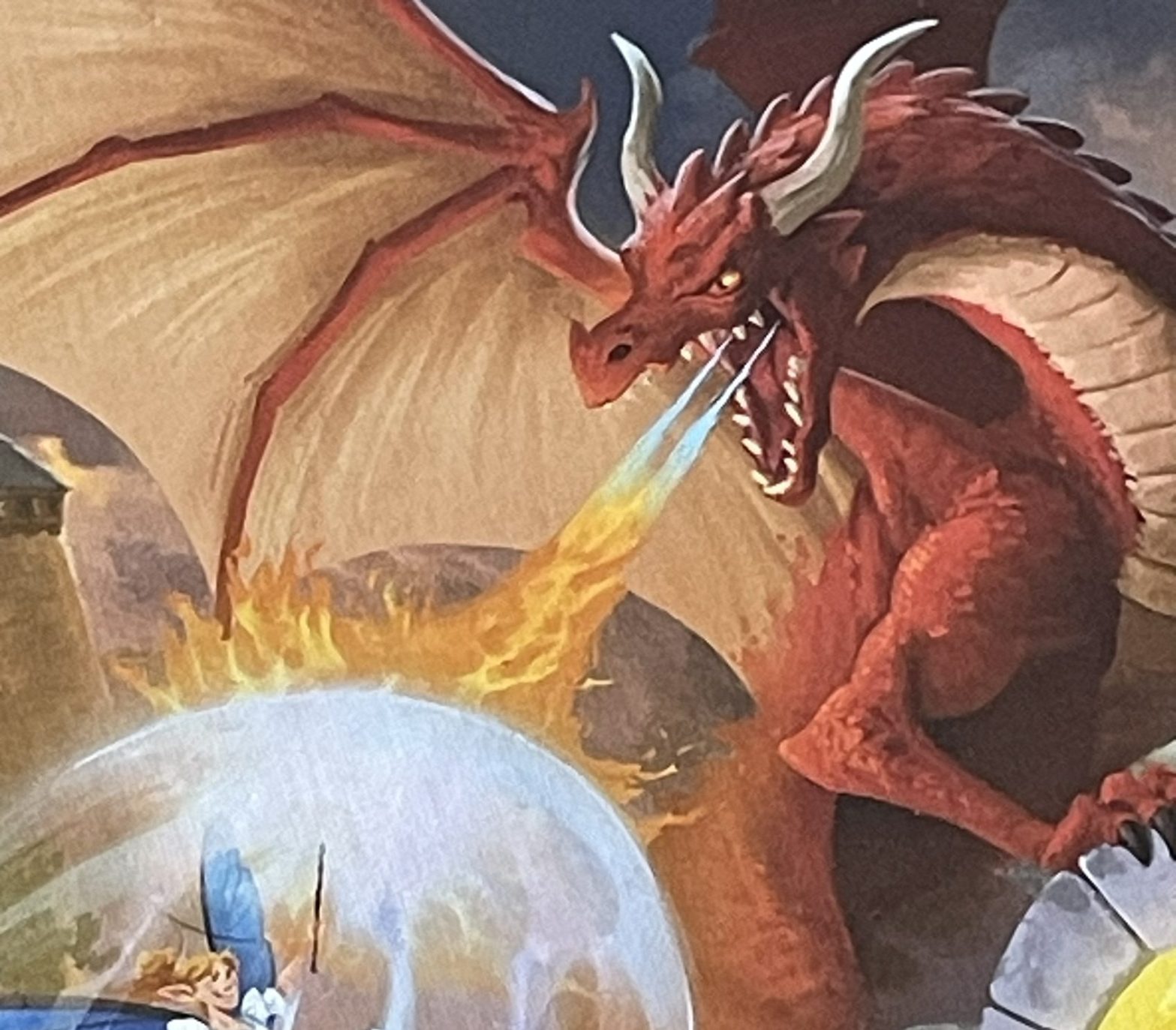
Being a predictable fantasy enthusiast I will admit to being attracted to this set because it had a dragon in it. Yes, I’m that basic. Getting my hands on a dragon meeple was undoubtedly central to my decision making, however, I was intrigued as to how this would work in the rules. In addition to the dragon, this set also introduces the Fairy and portals. There are also a number of new tiles with relevant terrain features.
What struck me immediately about this set was it introduced a certain amount of mischief to the game allowing you to attack opponents, potentially robbing of them of their constructions, and claim unfinished features that do not have an owner without having to build onto them. All this is done in a really slick, but fun, way.
The Dragon is a marauding beast that is powered by a combination of game mechanics and players’ pettiness. Players can’t take possession of the Dragon, but they can influence its movement. Honestly, there is nothing worse than watching a dragon appear close to a half-finished city and threaten to remove the only meeple you have in it.
Happily, the Fairy provides some help. Complete a feature that you don’t score, out of the goodness of your own heart, and karma rewards you with some protection from the Dragon and extra points if the meeple they are protecting completes a feature whilst the Fairy is still with them. Beware though, the Fairy is fickle and can vanish off to help another player as quickly as it came to help you.
The final component of this set are the portals. They solve a problem that the Dragon creates, namely unoccupied, unfinished features. Pop a meeple on a portal and they can claim any unfinished, unclaimed features. It’s a neat set that fills in some interesting strategic gaps in the core mechanics, and for the time being will make it the clear number one recommendation when it comes to expansions. I’d also mention that this set got a really good reaction from my opponent, who is not as keen on uber complicated games as I am, this was because, unlike with the other expansions we’ve tried, the new mechanics brought something really different to the game which was fun, and pretty easy to pick up.
To keep up with what’s going on you can follow @wizards_bookshelf on Instagram and Threads or drop you’re email below to subscribe.
 The Wizard's Bookshelf